
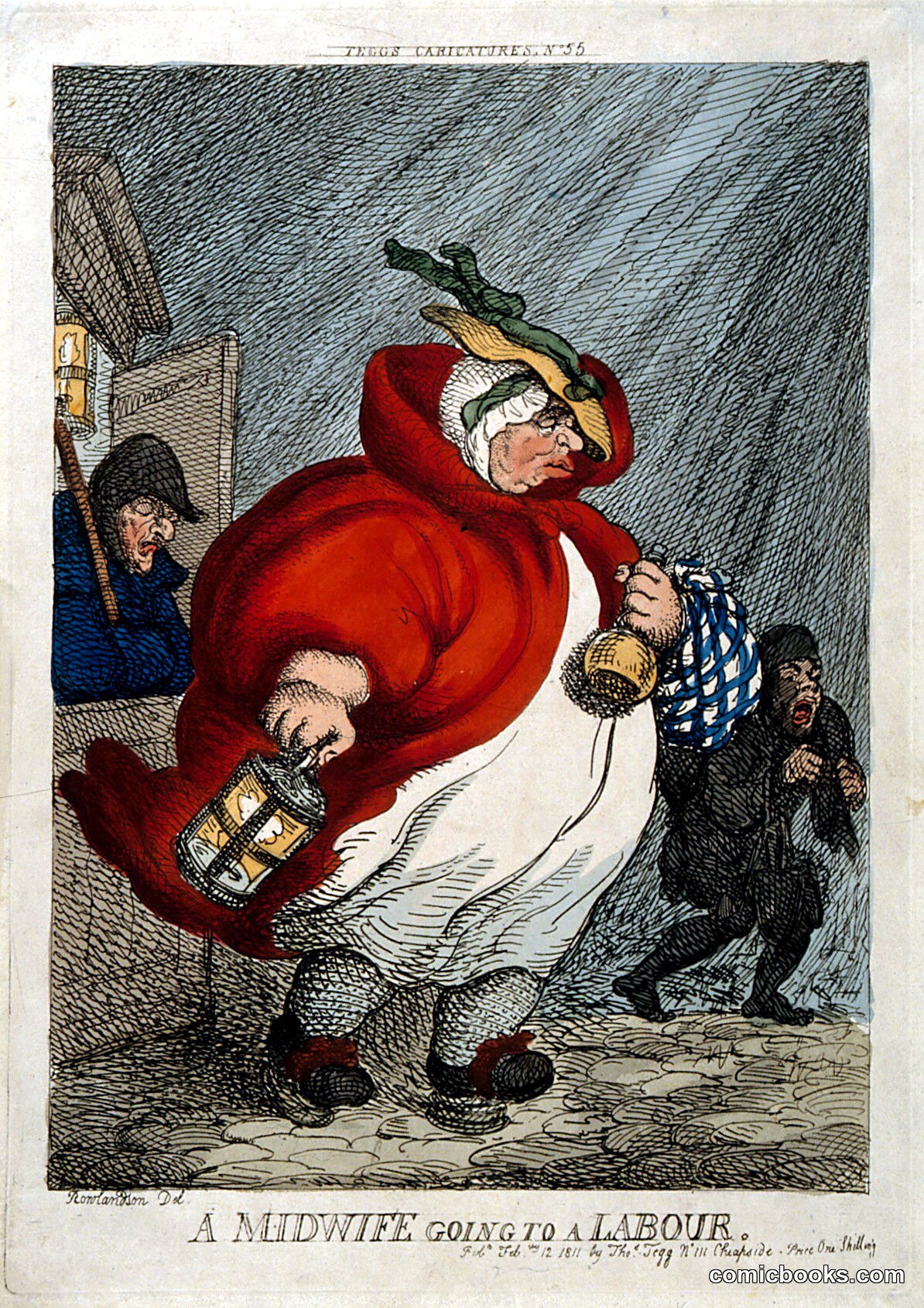
Thomas Rowlandson's hand-coloured etching shows an enormously rotund midwife barreling through a stormy night, lantern swinging, clutching a bundle, while two smaller figures — a doorway watchman and a stumbling attendant — are nearly flattened in her wake. The humour is broad and merciless: she is grotesquely fat, her red cloak billowing like a sail, her cap askew over a lumpen face. Class caricature is the engine here — working women of trade were stock comic targets in Georgian print culture, their bodies exaggerated as signs of appetite and low station. Rowlandson's loose, energetic etched line, built on Hogarth's moral comedy and Gillray's deformational licence, fed directly into the sequential panel tradition: the recurring comic type, the compressed physical gag, the narrative frozen mid-lurch that would define the comic strip's visual grammar.
About this artifact
- Creator
- Thomas Rowlandson
- Date
- Thomas Rowlandson, 1811
- Rights
- Public domain — free to view, share, and reuse.
- Restoration
- Digitally restored and hosted by ComicBooks.com · high-resolution version available.
Part of our mission to preserve and restore the public-domain heritage of the medium.