
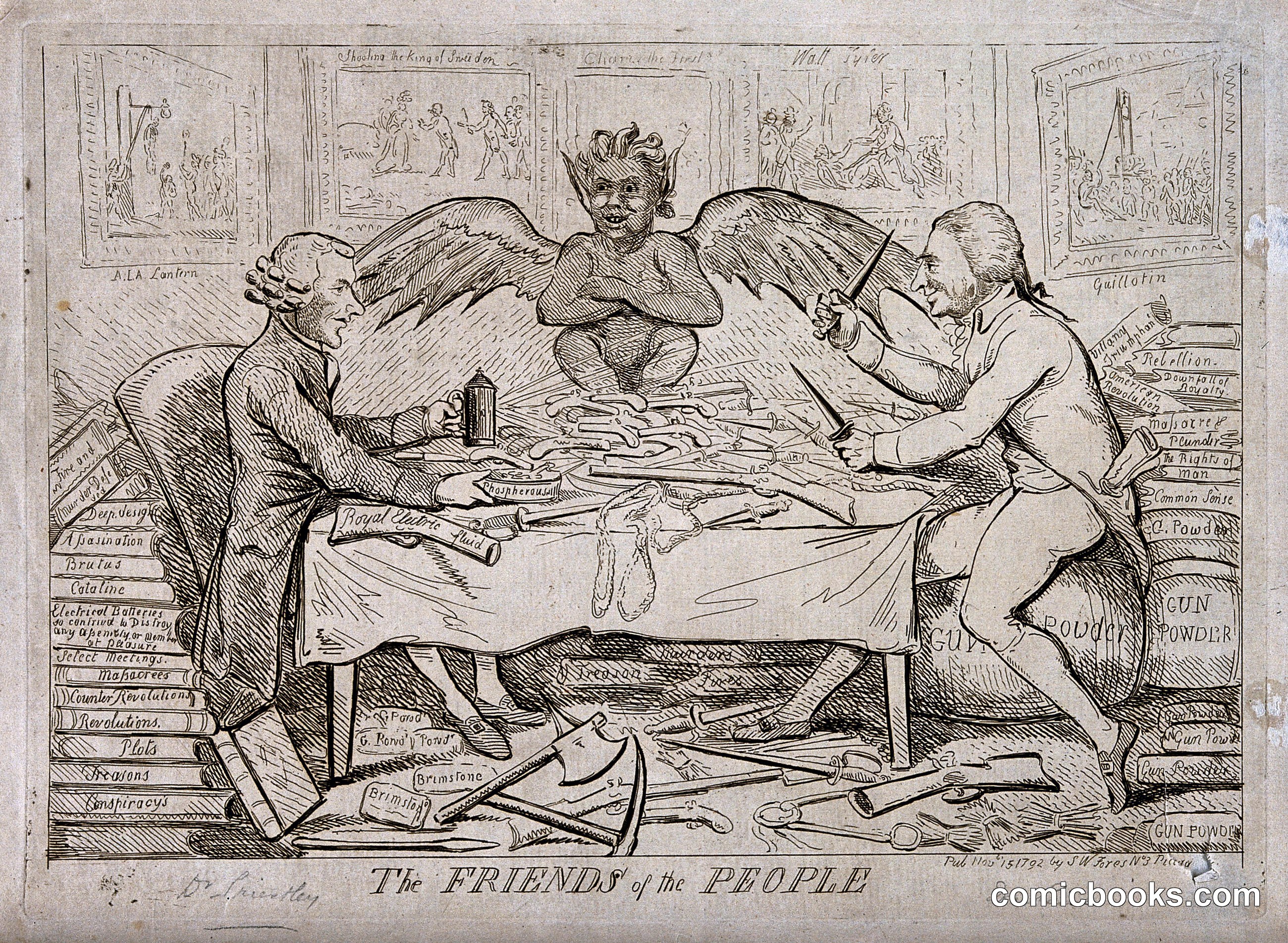
Two men — identified as radical philosopher Joseph Priestley and pamphleteer Thomas Paine — flank a table strewn with revolutionary documents and tools, while a winged devil-child grins between them, binding their cause. Paine raises a knife; Priestley leans over a stack of seditious texts. Axes and broken implements litter the floor. Isaac Cruikshank's etching deploys the physical grotesquerie standard to late-Georgian print satire: exaggerated postures, symbolic clutter, a demonic chaperone meant to damn both men by association. Class and political caricature here served outright propaganda — Priestley's Birmingham laboratory had been burned by loyalist mobs the previous year. This tradition of sequential symbolic imagery, from Hogarth's moral series through Gillray and Rowlandson, supplied comic strips their grammar of exaggeration, panel-crowding, and visual rhetoric long before the term 'comics' existed.
About this artifact
- Creator
- Isaac Cruikshank
- Date
- Isaac Cruikshank, etching, 1792
- Rights
- Public domain — free to view, share, and reuse.
- Restoration
- Digitally restored and hosted by ComicBooks.com · high-resolution version available.
Part of our mission to preserve and restore the public-domain heritage of the medium.