
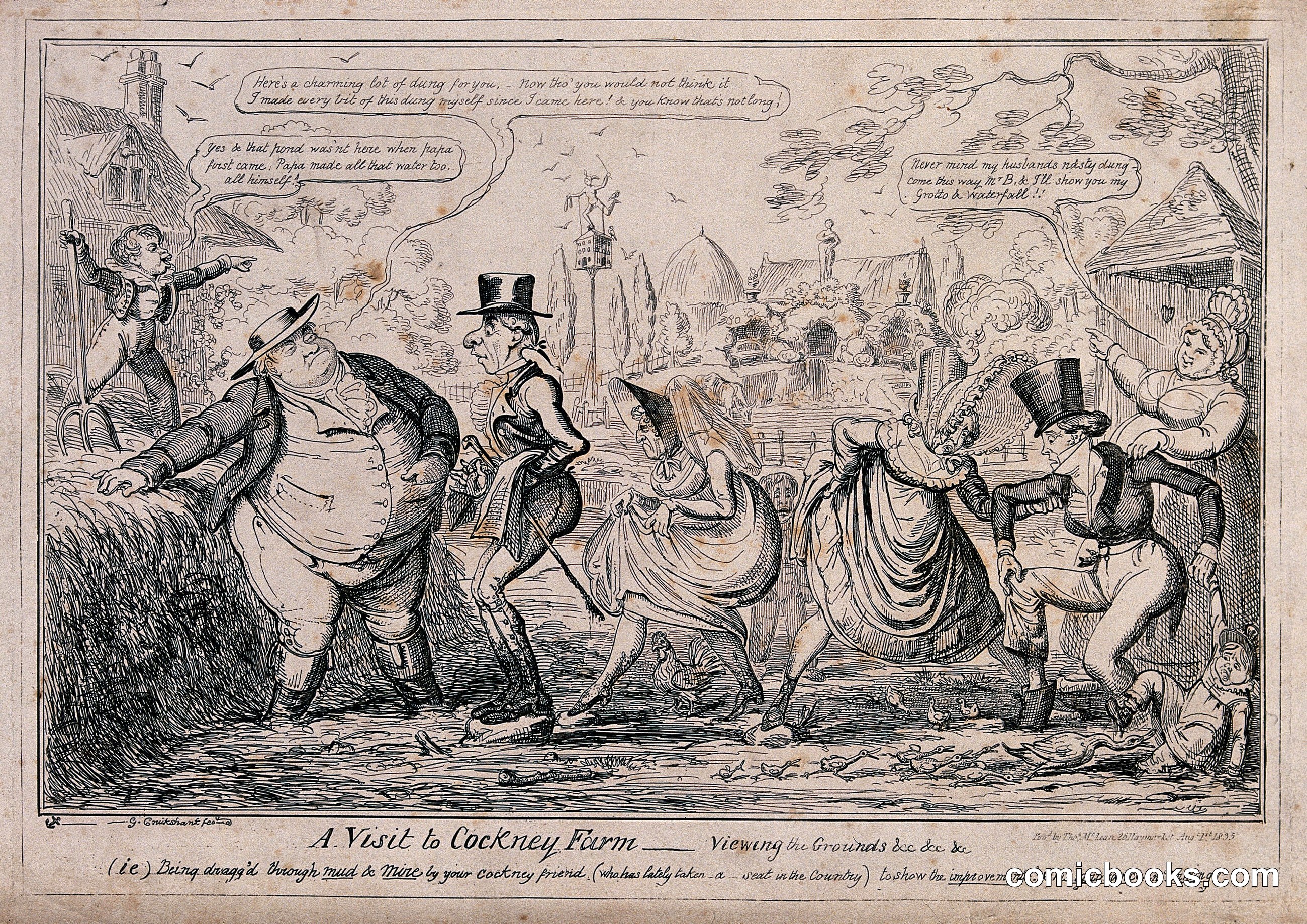
George Cruikshank's etching catches London day-trippers — the 'Cockney,' a standing comic type for the urban Englishman bewildered by rural life — mincing through a farmyard ankle-deep in mud and chicken mess while longing for the ornamental grotto visible behind. The figures are rendered with the rubbery, bulging distortion Cruikshank inherited from Rowlandson and Gillray: paunchy husbands, wives squealing at livestock, a knowing farm-boy laughing at them all. Class ridicule is the engine here — the aspiring middle sort exposed as helpless outside their city pavements. Cruikshank's work sits precisely at the hinge between Georgian print satire and the illustrated comic narrative; his collaborations with Dickens and his own sequential picture-stories made him a direct structural ancestor of the comic strip.
About this artifact
- Date
- 1835
- Rights
- Public domain — free to view, share, and reuse.
- Restoration
- Digitally restored and hosted by ComicBooks.com · high-resolution version available.
Part of our mission to preserve and restore the public-domain heritage of the medium.