
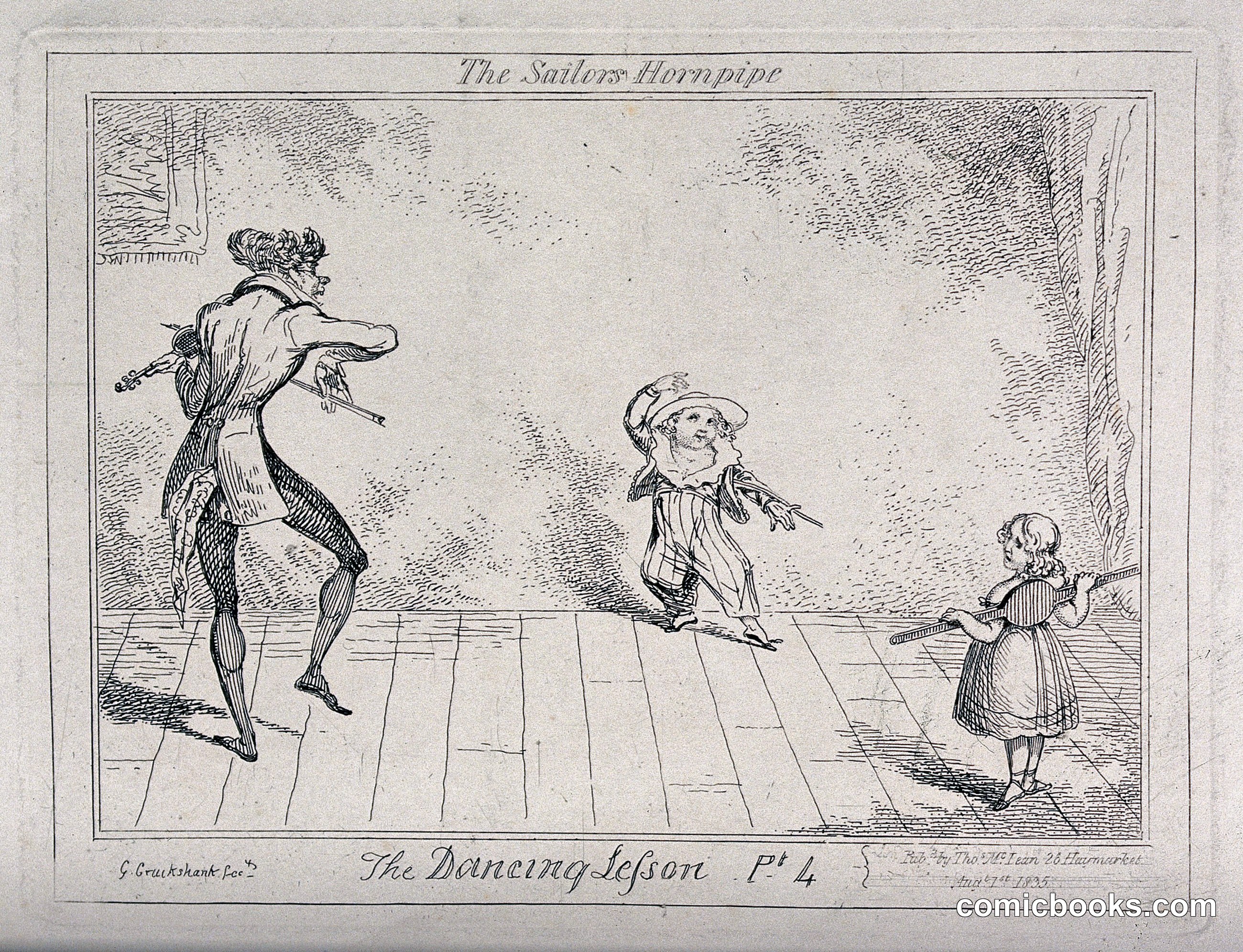
George Cruikshank's etching shows three figures on bare planked boards: a lanky adult male dancer mid-step, coat-tails flying, performing the sailor's hornpipe; a small boy in an oversized hat mimicking the steps with exaggerated limbs; and a little girl at right, a posture-board strapped across her shoulders to correct her spine — the standard middle-class orthopedic cruelty of the period. The scene lampoons the contradictions of genteel education: hornpipe frivolity alongside rigid physical 'improvement.' Cruikshank's line work, fine cross-hatching, and grotesquely elongated figures descend directly from Gillray and Rowlandson, the tradition that taught sequential comic art how bodies in motion could carry social argument. His page-by-page plate numbering anticipates the periodical comic strip's own grammar of episodic narrative.
About this artifact
- Date
- 1835
- Rights
- Public domain — free to view, share, and reuse.
- Restoration
- Digitally restored and hosted by ComicBooks.com · high-resolution version available.
Part of our mission to preserve and restore the public-domain heritage of the medium.