
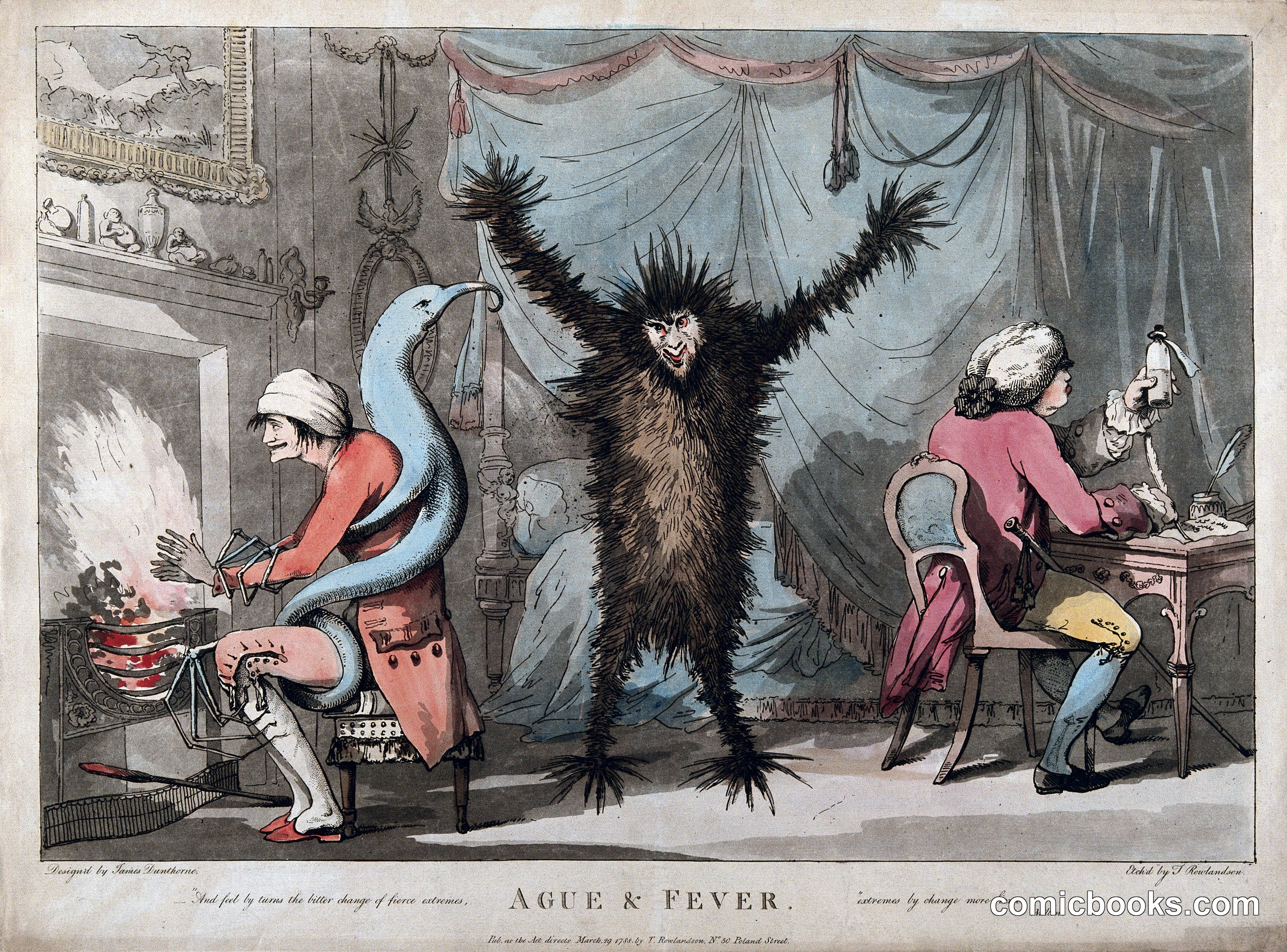
Thomas Rowlandson's hand-coloured etching gives literal, grotesque body to two afflictions that plagued Georgian England: a shaggy, spike-haired beast representing Fever rears its arms in the room's centre, while a sinuous blue serpentine creature — Ague, the malarial shivering — coils around a man hunched miserably by the fire. At the right, a wig-powdered physician scratches prescriptions, indifferent or helpless. The personification of disease as monster belongs to an allegorical tradition running from medieval woodcuts through Hogarth's moral series; Rowlandson pushed it toward visceral comedy. Crucially, the figures here are class-legible — the patient is prosperous, the doctor fee-taking — but free of the ethnic caricature Rowlandson deployed elsewhere in his catalogue. Prints like this, sold cheaply from London shops, trained popular audiences to read sequential visual narrative: a direct ancestor of the comic page.
About this artifact
- Creator
- James Dunthorne
- Date
- 1788, after James Dunthorne
- Rights
- Public domain — free to view, share, and reuse.
- Restoration
- Digitally restored and hosted by ComicBooks.com · high-resolution version available.
Part of our mission to preserve and restore the public-domain heritage of the medium.