
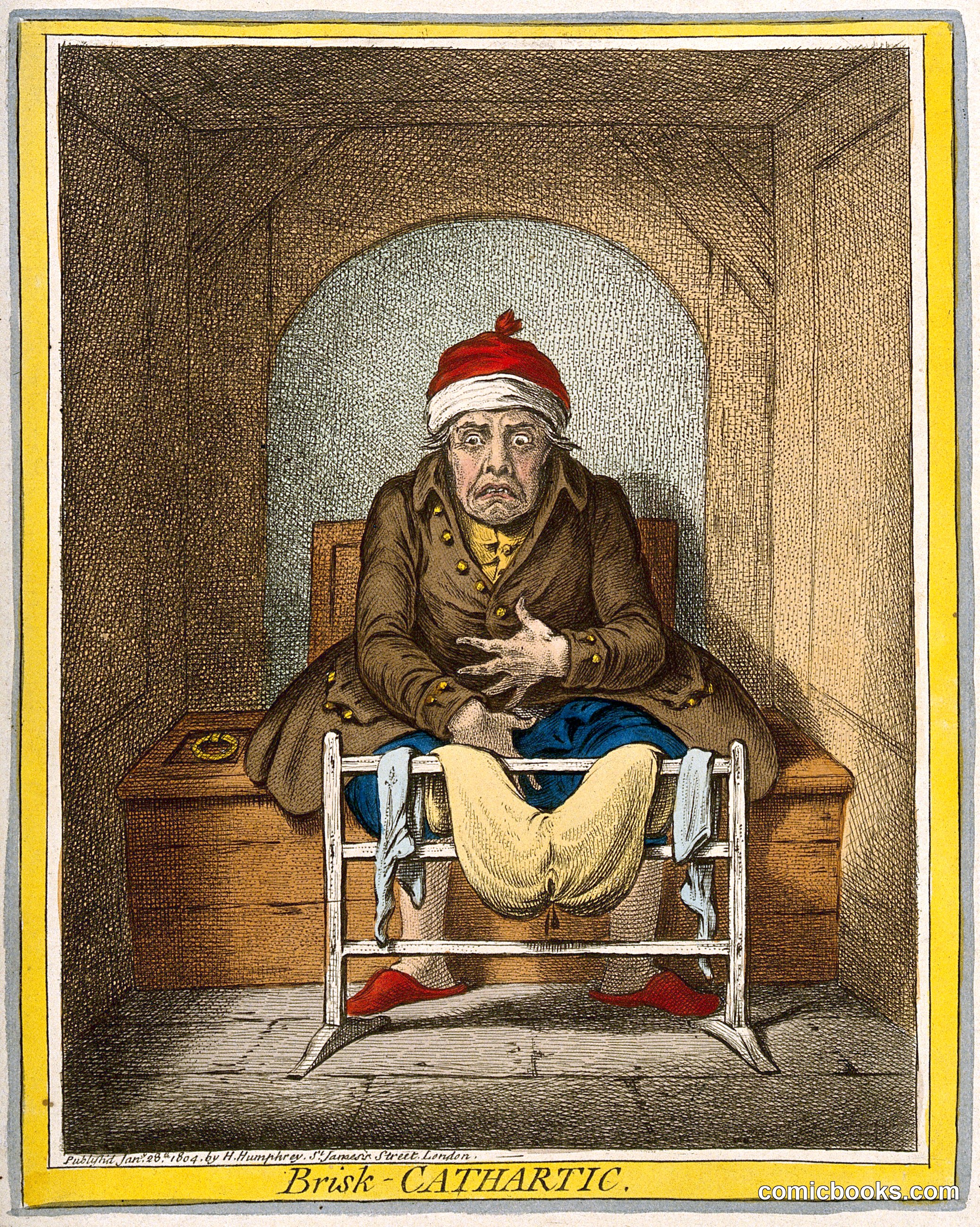
A haggard man — nightcap askew, eyes wild with distress, coat buttons straining — sits trapped in a commode chair, legs braced on the footrest, hands wringing. The caption reads Brisk Cathartic. The target is the fashionable Georgian vogue for purgative medicine: quack remedies sold to the anxious middle and upper classes. Gillray's hand-coloured etching exploits exaggerated facial expression — the lingua franca of 18th-century British print satire — to reduce human dignity to its most humbling moment. That tradition, running from Hogarth's moral series through Rowlandson and later Daumier, trained readers to decode visual hyperbole and sequential implication. It is precisely from this lineage of cheap, widely sold satirical prints that the comic strip — and eventually the comic book — inherited both its expressive grammar and its democratic, irreverent instinct.
About this artifact
- Creator
- James Gillray
- Date
- 1804, after James Gillray; etched by J. Sneyd
- Rights
- Public domain — free to view, share, and reuse.
- Restoration
- Digitally restored and hosted by ComicBooks.com · high-resolution version available.
Part of our mission to preserve and restore the public-domain heritage of the medium.