
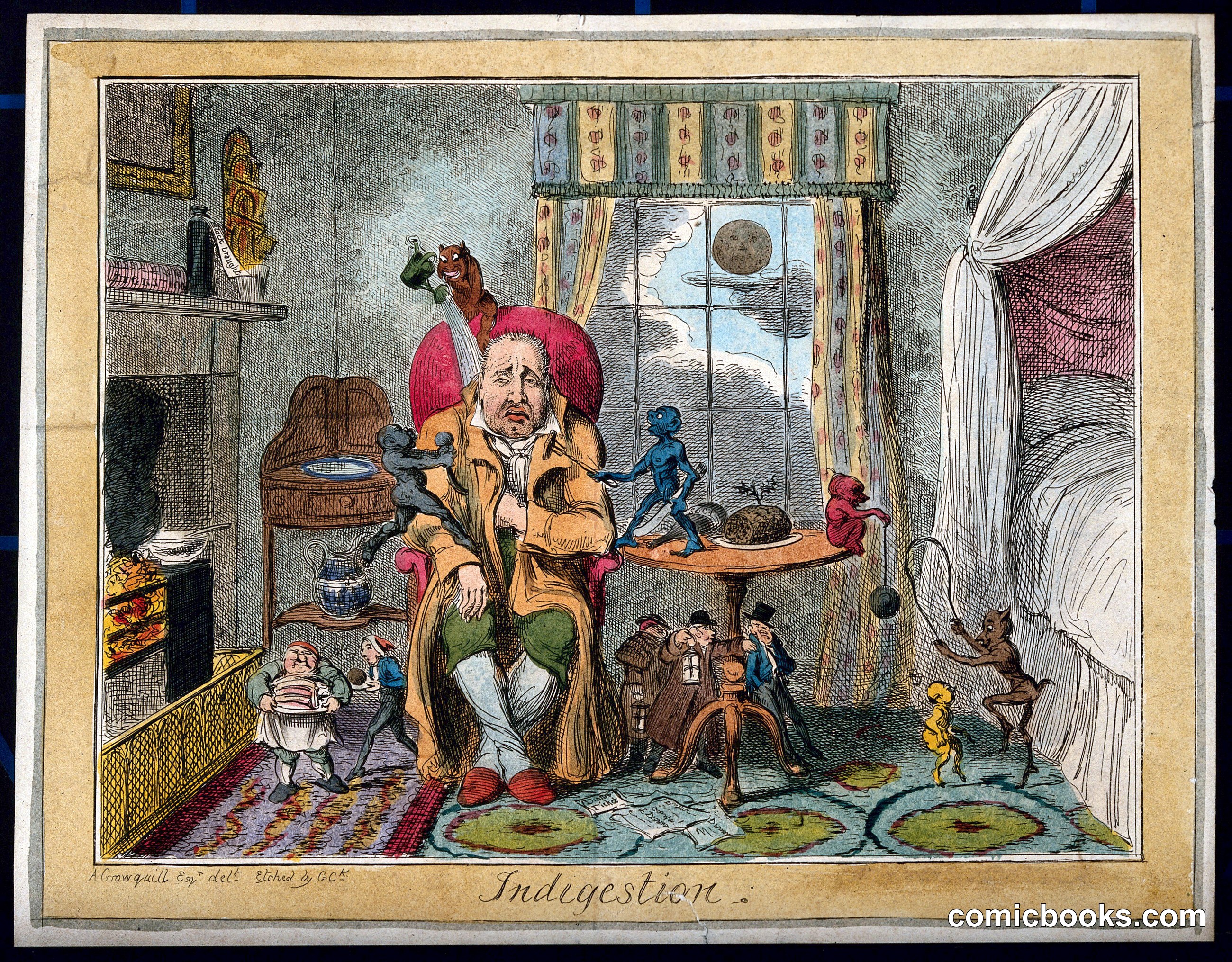
George Cruikshank's hand-coloured etching renders a stout, ruddy-faced gentleman slumped in his armchair, besieged by a carnival of miniature demons and grotesque imps — pouring liquid into his ear, sawing at the table, prodding his belly, clambering across the floor. The victim's swollen features employ the exaggerated physiognomy standard to Regency caricature: bloat as moral evidence, excess made legible on flesh. Cruikshank, working from Alfred Crowquill's design, inherits a satirical print tradition running through Hogarth's sequential moral narratives and Gillray's grotesque political bodies. That tradition — single-sheet, hand-coloured etchings sold through London print-shop windows — trained audiences to read exaggerated figures, action crowds, and visual comedy simultaneously, the precise literacy that would later make the comic strip's wordless or captioned sequences immediately intelligible to mass readers.
About this artifact
- Creator
- Alfred Crowquill
- Date
- 1835, after Alfred Crowquill
- Rights
- Public domain — free to view, share, and reuse.
- Restoration
- Digitally restored and hosted by ComicBooks.com · high-resolution version available.
Part of our mission to preserve and restore the public-domain heritage of the medium.