
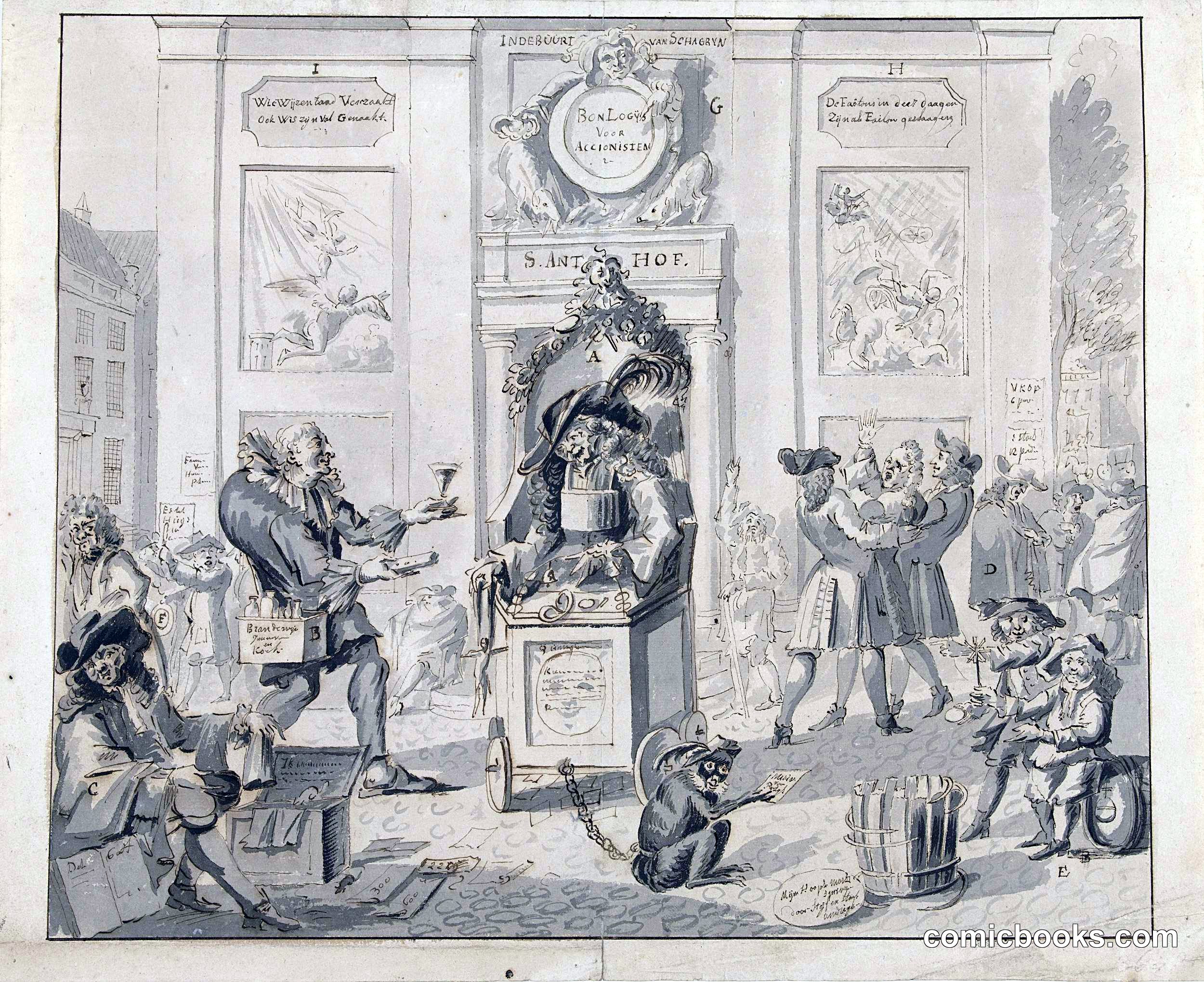
This Dutch etching lampoons the Scottish financier John Law, whose speculative Mississippi Company scheme collapsed in 1720, ruining thousands of investors across Europe. The central figure—Law himself, grotesquely caricatured—sits in a wheelchair dispensing worthless paper while crowds of desperate creditors, beggars, and the diseased surround him. The print exemplifies the Northern European tradition of political satire inherited from earlier Flemish and German prints: multiple narrative scenes, elaborate allegorical details, and cruel physiognomy combine to pillory a single historical villain. This etched medium allowed for sharp social commentary and wide circulation. The work descends from Bruegel and anticipates Hogarth and Gillray, establishing the visual language—exaggeration, symbolic props, crowded composition—that would evolve into modern editorial cartooning and eventually the sequential art of comics.
About this artifact
- Date
- 1720
- Rights
- Public domain — free to view, share, and reuse.
- Restoration
- Digitally restored and hosted by ComicBooks.com · high-resolution version available.
Part of our mission to preserve and restore the public-domain heritage of the medium.