
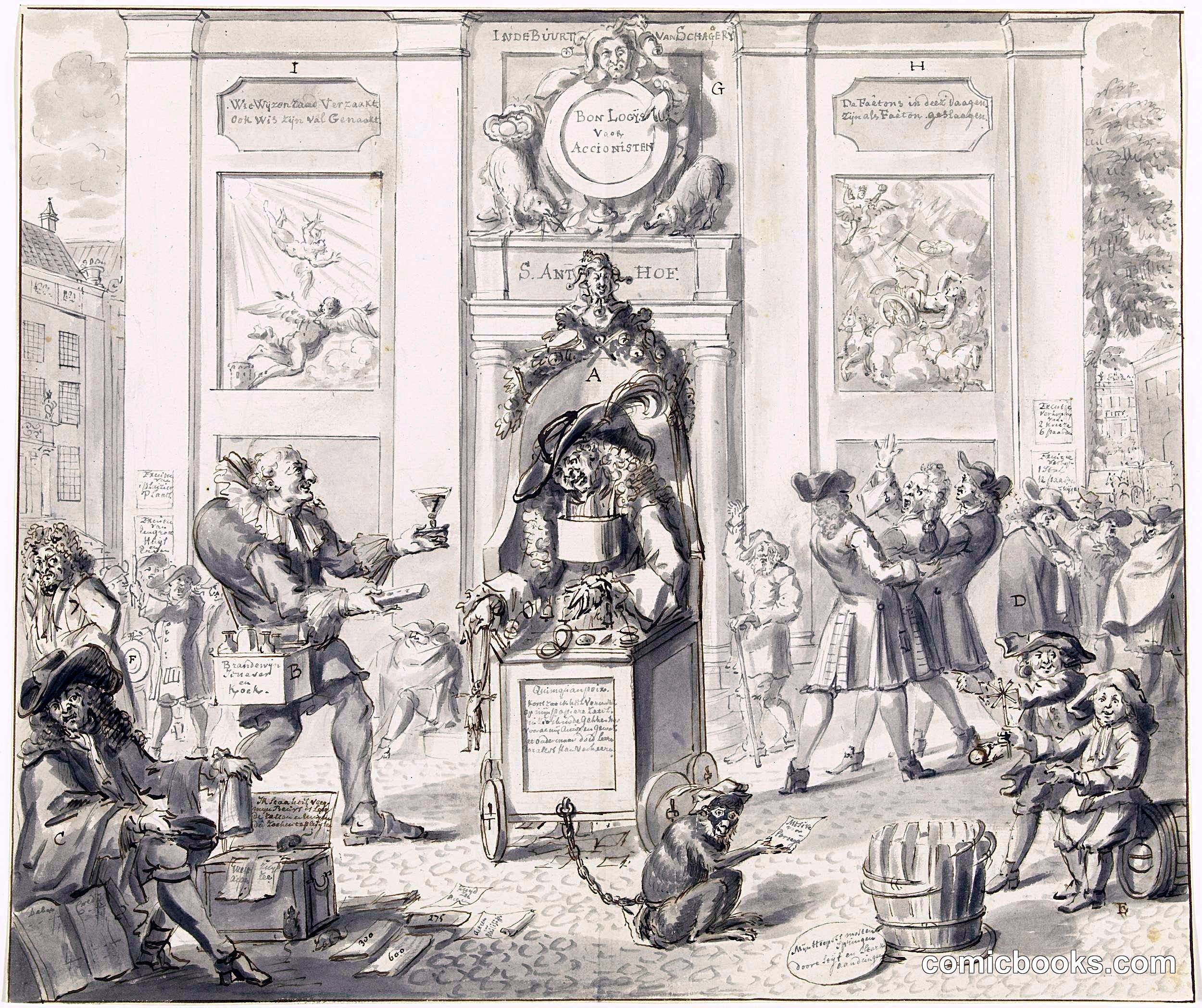
This Dutch etching satirizes the financial collapse of John Law's Mississippi Company scheme. A richly dressed Law sits enthroned in a wheeled chair—a symbol of helplessness—while crowds of ruined investors, beggars, and the disabled surround him outside a poorhouse. Allegorical panels above show his rise and fall. The print exemplifies early 18th-century political satire's merger of financial critique with visual mockery: exaggerated features, symbolic props, and layered moral commentary packed into a single frame. Such works descended from Hogarth's sequential narratives and prefigured the caricature traditions of Gillray and Rowlandson, establishing visual satire as a tool for public dissent. The equation of financial villainy with physical degradation and poverty reflects period anxieties about speculation and class upheaval.
About this artifact
- Date
- 1720
- Rights
- Public domain — free to view, share, and reuse.
- Restoration
- Digitally restored and hosted by ComicBooks.com · high-resolution version available.
Part of our mission to preserve and restore the public-domain heritage of the medium.