
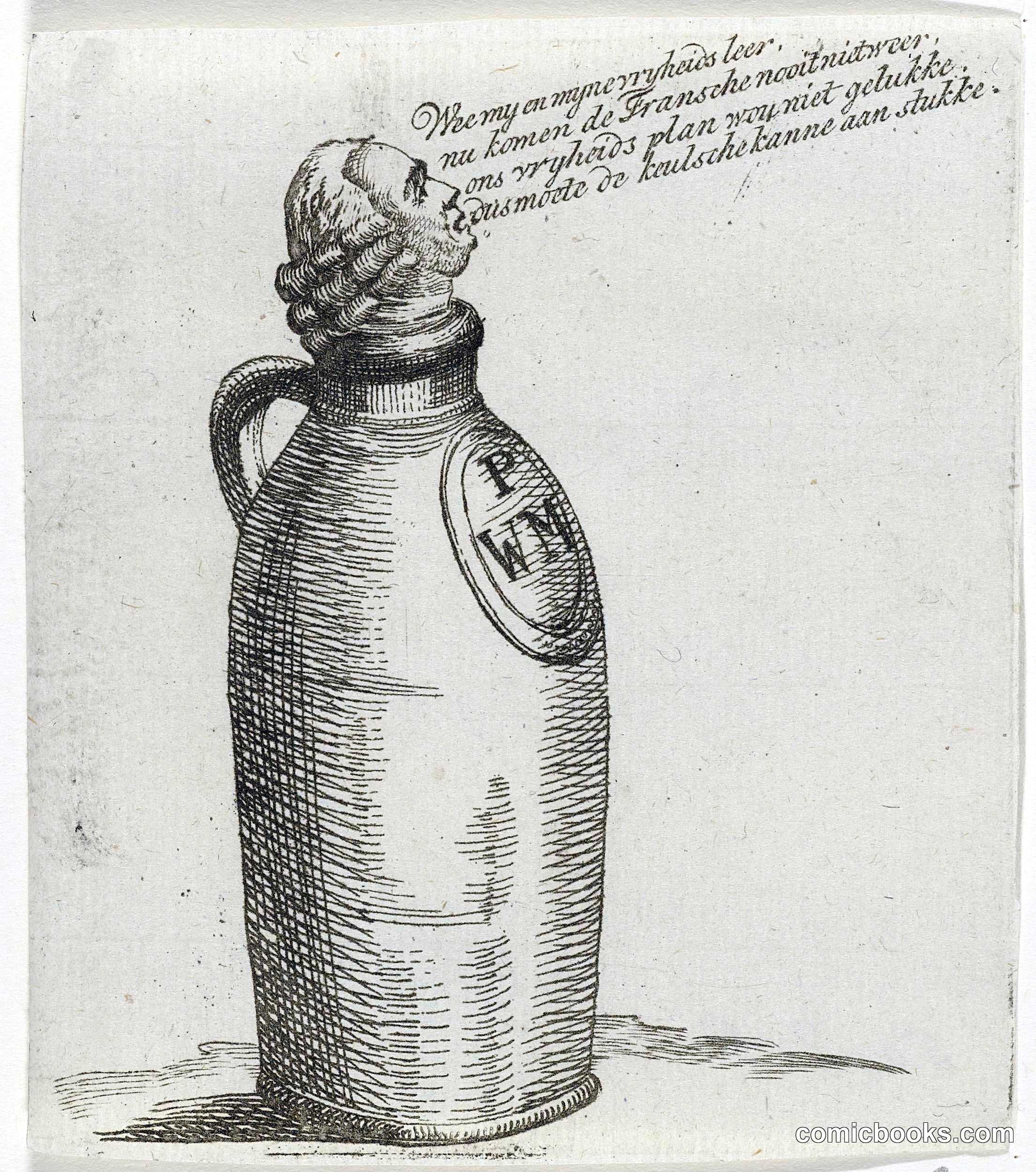
This Dutch etching transforms a human head into a bottle—a visual pun on the subject's name and character. The figure's wavy hair forms the bottle's neck, while the body becomes its cylindrical form, complete with a handle and decorative panel. Text in Dutch curls from the mouth.
Such anthropomorphic satire descended from sixteenth-century print traditions and flourished in the hands of Hogarth, Gillray, and Rowlandson. This Northern European example demonstrates how political and personal ridicule operated across borders through engraved mockery. The conceit—reducing a person to an object—rendered the target contemptible through formal wit rather than caricatured features, though both methods coexisted in period satire. These prints reached mass audiences and established visual conventions that would eventually feed into the comic strip tradition.
About this artifact
- Date
- 1787
- Rights
- Public domain — free to view, share, and reuse.
- Restoration
- Digitally restored and hosted by ComicBooks.com · high-resolution version available.
Part of our mission to preserve and restore the public-domain heritage of the medium.