
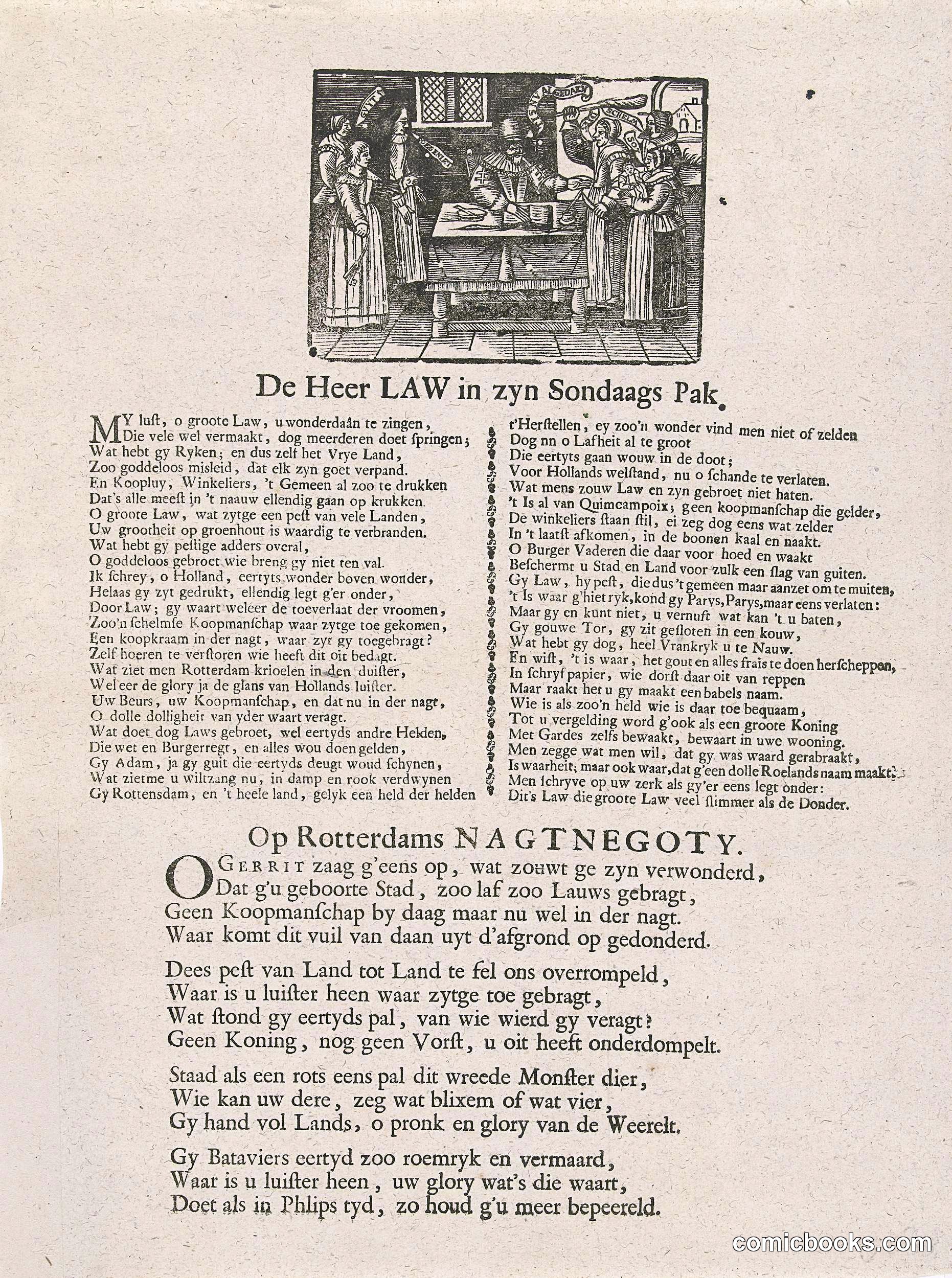
This Dutch woodcut satirizes the Scottish financier John Law and his catastrophic Mississippi Scheme, which collapsed in 1720, ruining thousands of investors across Europe. The print shows Law in an interior scene with figures gesturing toward him in accusation and distress. The accompanying verses in Dutch mock his pretensions and financial recklessness, invoking Rotterdam's suffering and naval glory to shame the city's losses.
The work exemplifies the popular print satire tradition of the early 18th century, when woodcuts and etchings served as mass media for political and economic commentary. Such prints circulated widely among literate urban audiences, establishing conventions—exaggerated dress, accusatory gestures, moralizing verses—that would persist through Hogarth, Gillray, and into modern editorial cartooning and sequential art.
About this artifact
- Date
- 1720
- Rights
- Public domain — free to view, share, and reuse.
- Restoration
- Digitally restored and hosted by ComicBooks.com.
Part of our mission to preserve and restore the public-domain heritage of the medium.