
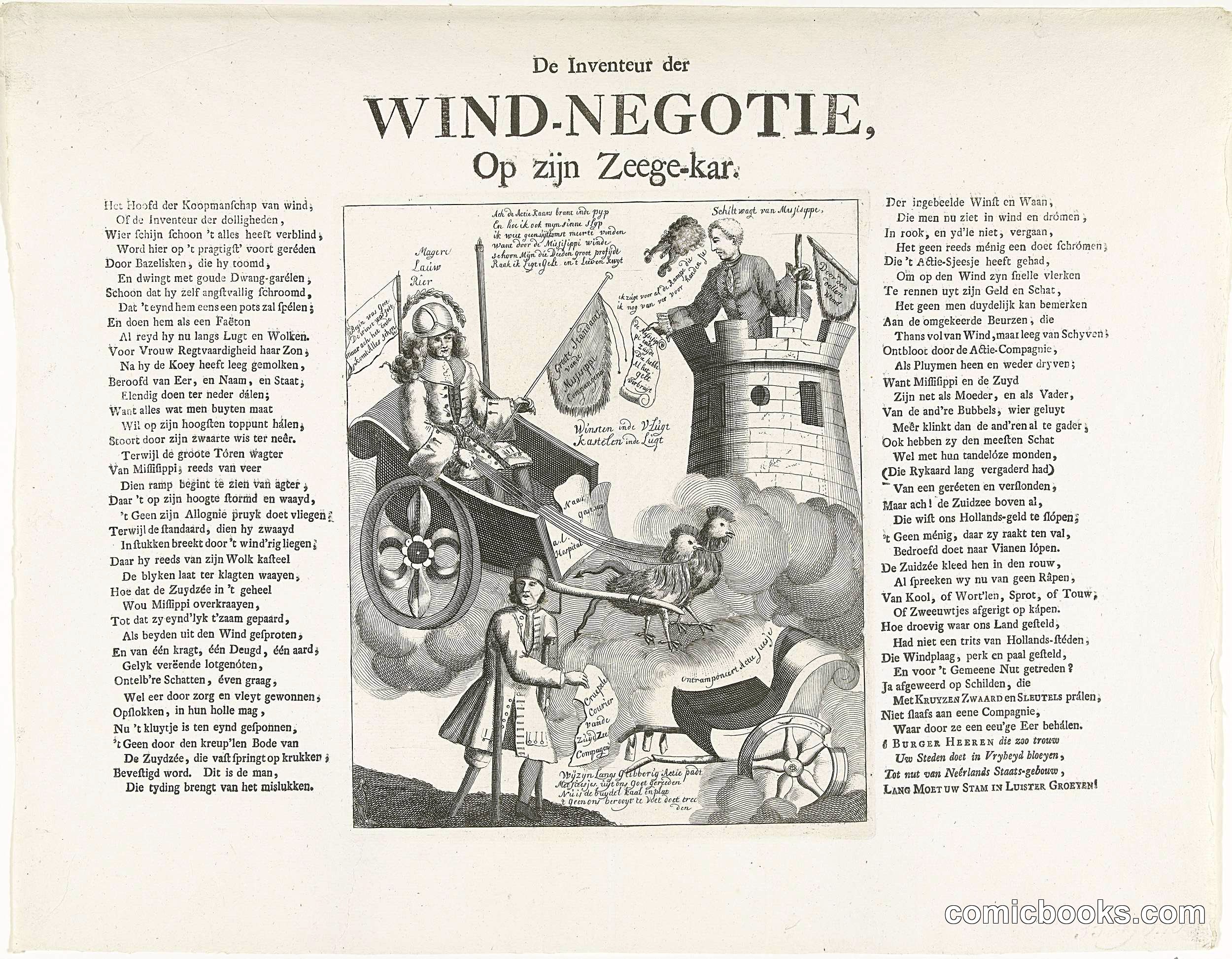
This Dutch engraving pillories John Law's Mississippi Company scheme, which collapsed in 1720, ruining thousands of investors. The print shows Law triumphant in a fantastical chariot drawn by bubbles and filled with worthless paper—a visual pun on the "wind" (bluff) underlying his financial promises. Allegorical figures and merchants populate the crowded scene, some celebrating, others left destitute. The work exemplifies the Northern European tradition of political and economic satire that preceded the modern comic strip: dense with text and symbol, aimed at a literate public, and employing exaggeration to expose fraud. Engraved and distributed widely, such prints functioned as the era's most effective medium for ridiculing public figures and lampooning speculative excess—a predecessor to graphic satire in newspapers and comic books.
About this artifact
- Date
- 1720
- Rights
- Public domain — free to view, share, and reuse.
- Restoration
- Digitally restored and hosted by ComicBooks.com · high-resolution version available.
Part of our mission to preserve and restore the public-domain heritage of the medium.