
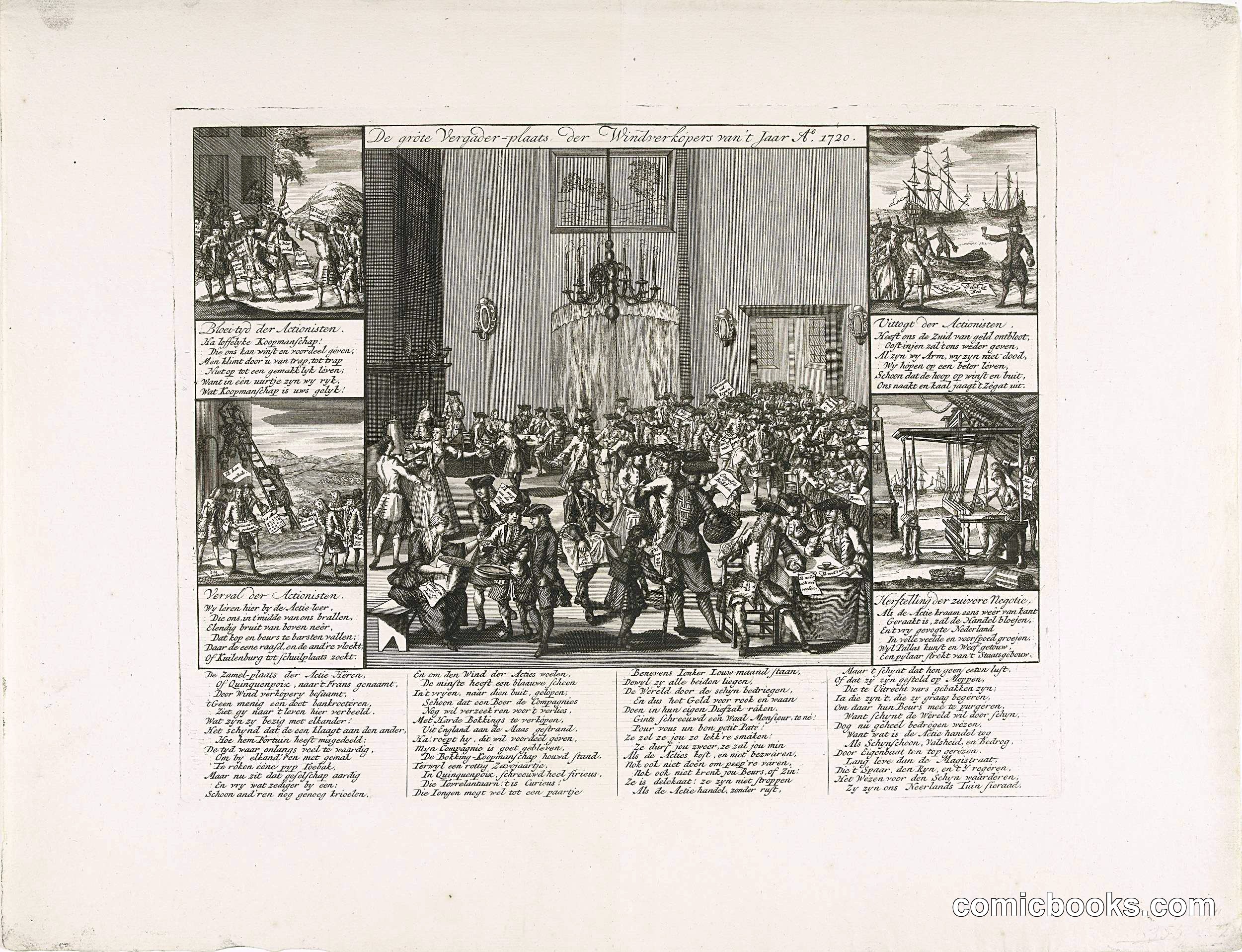
This Dutch engraving satirizes financial speculation during the South Sea Bubble collapse. A crowded indoor market scene shows merchants hawking invisible commodities—literally "wind"—to credulous crowds. Corner vignettes depict the chaos: ships arriving with worthless cargo, investors hanged, fortunes lost. The print employs the Northern European tradition of moral allegory in multi-panel compositions, using exaggerated facial types and frenzied crowds to ridicule greed and gullibility. Published in the wake of 1720's market crash, this etching exemplifies how printmakers used dense, narrative imagery and accompanying verse to convey political commentary—a visual language that would evolve through Hogarth's sequential scenes into modern sequential art. Satire here targets the mob behavior of speculators across class lines.
About this artifact
- Date
- 1720
- Rights
- Public domain — free to view, share, and reuse.
- Restoration
- Digitally restored and hosted by ComicBooks.com · high-resolution version available.
Part of our mission to preserve and restore the public-domain heritage of the medium.