
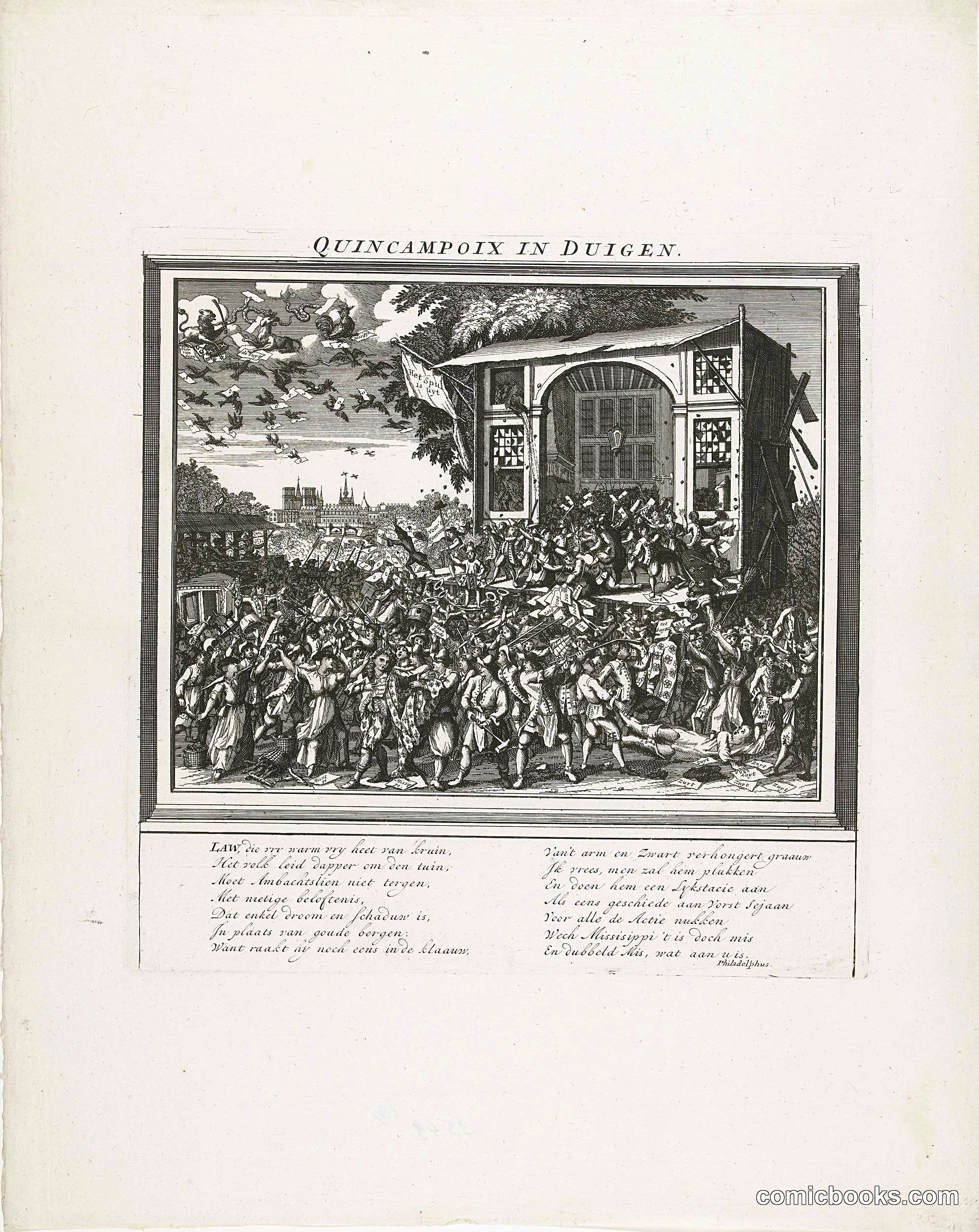
This engraving depicts the financial panic of 1720, when John Law's Mississippi Company scheme collapsed across Europe. A crowd storms a grand building—figures gesturing wildly, fighting, and crushing forward in economic chaos. The print combines elements of religious procession with mob disorder, its dense composition filled with individualized faces and exaggerated poses expressing greed and desperation.
Such prints were central to early modern political satire, following Hogarth's sequential narratives and anticipating the sharp social commentary of Gillray and Rowlandson. These engravings circulated as single sheets among literate audiences, using crowded scenes, architectural framing, and verse captions to mock public folly. The tradition directly influenced later satirical newspapers and eventually the visual vocabulary of comic art—the dynamic composition, moral perspective, and mix of text and image all prefigure the sequential panels of modern comics.
About this artifact
- Date
- 1720
- Rights
- Public domain — free to view, share, and reuse.
- Restoration
- Digitally restored and hosted by ComicBooks.com.
Part of our mission to preserve and restore the public-domain heritage of the medium.