
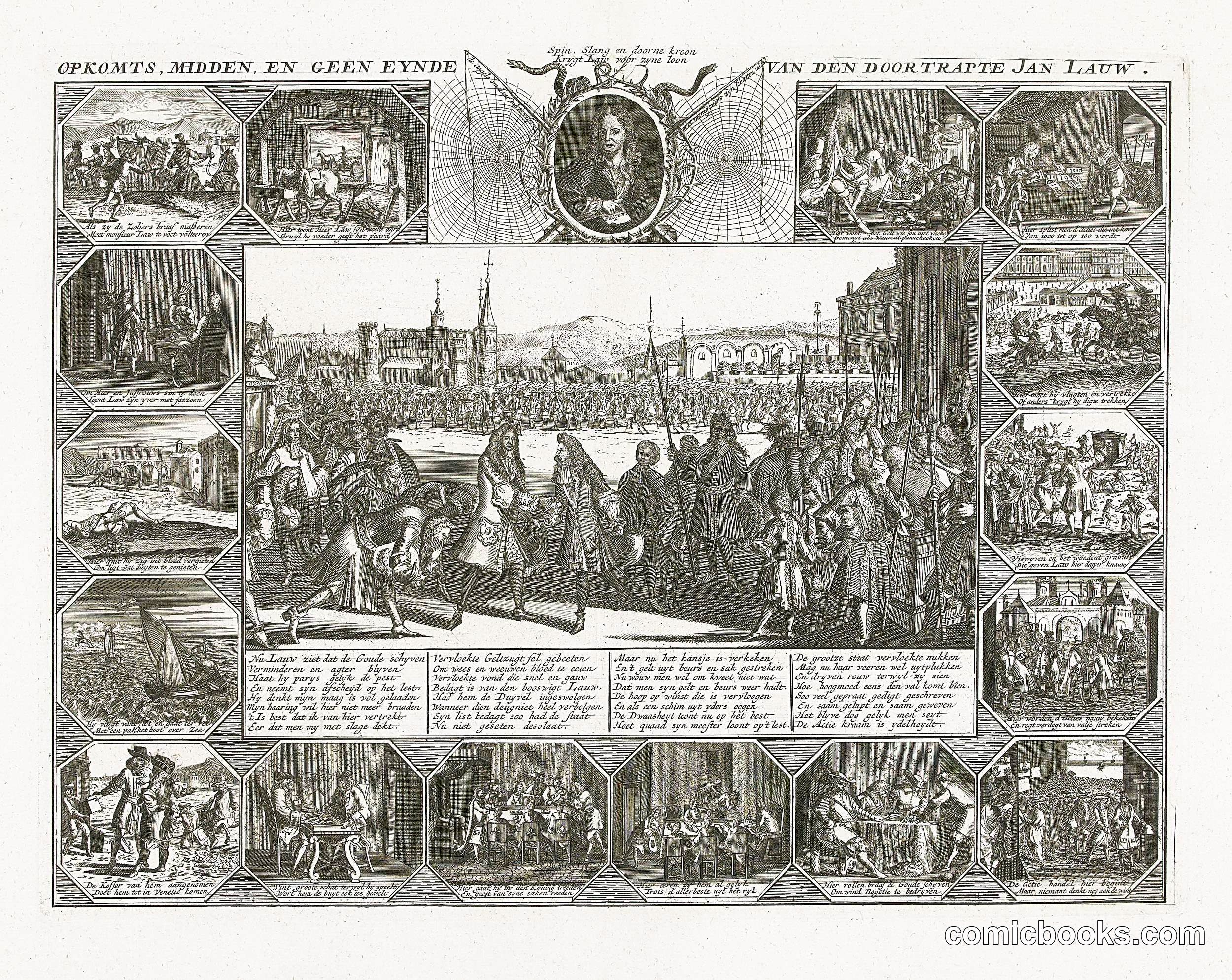
This Dutch engraving satirizes the speculative mania surrounding Scottish financier John Law's Mississippi Company scheme. The central panel depicts a crowded public square where fortune-seekers gather; surrounding vignettes show Law's operations—gambling, deception, financial dealings, and social chaos. Printed from copper plates in the tradition of Northern European broadsheet satire, it employs sequential narrative panels to chronicle financial fraud and its social consequences. The work exemplifies how 18th-century printmakers used multiple scenes to unfold a story of corruption and public gullibility, a format that directly anticipates the comic strip. Law's scheme collapsed spectacularly in 1720, ruining thousands of investors across Europe and generating bitter satirical imagery that mixed social commentary with visual comedy—crude, pointed, and widely distributed.
About this artifact
- Date
- 1720
- Rights
- Public domain — free to view, share, and reuse.
- Restoration
- Digitally restored and hosted by ComicBooks.com · high-resolution version available.
Part of our mission to preserve and restore the public-domain heritage of the medium.