
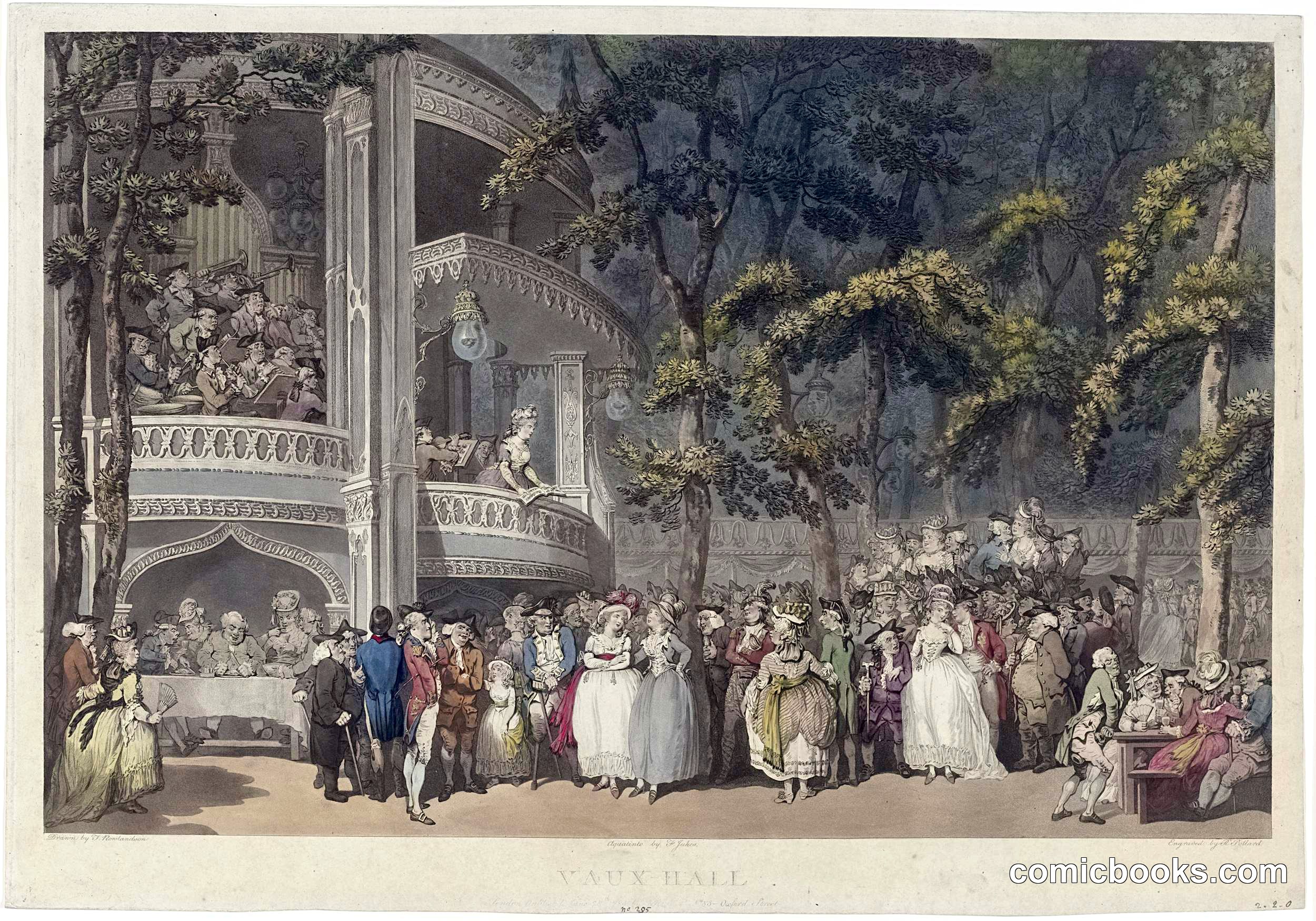
This hand-colored etching depicts the famous pleasure garden as a crowded, chaotic social theater. Elegantly dressed figures—aristocrats, merchants, and aspirants—mingle beneath neoclassical architecture and ancient trees, their interactions and poses suggesting the anxieties and pretensions of mixed-class sociability. The print belongs to the tradition of social satire established by Hogarth and refined by Gillray and Rowlandson: observational comedy rendered through careful composition and telling detail rather than crude exaggeration. The artist captures how public spaces became stages for negotiating status, where appearance and performance mattered as much as birth. This print documents both eighteenth-century leisure culture and the visual language from which modern sequential art descends—the idea that society itself is legible through carefully arranged human figures and architectural settings.
About this artifact
- Date
- 1785
- Rights
- Public domain — free to view, share, and reuse.
- Restoration
- Digitally restored and hosted by ComicBooks.com · high-resolution version available.
Part of our mission to preserve and restore the public-domain heritage of the medium.