
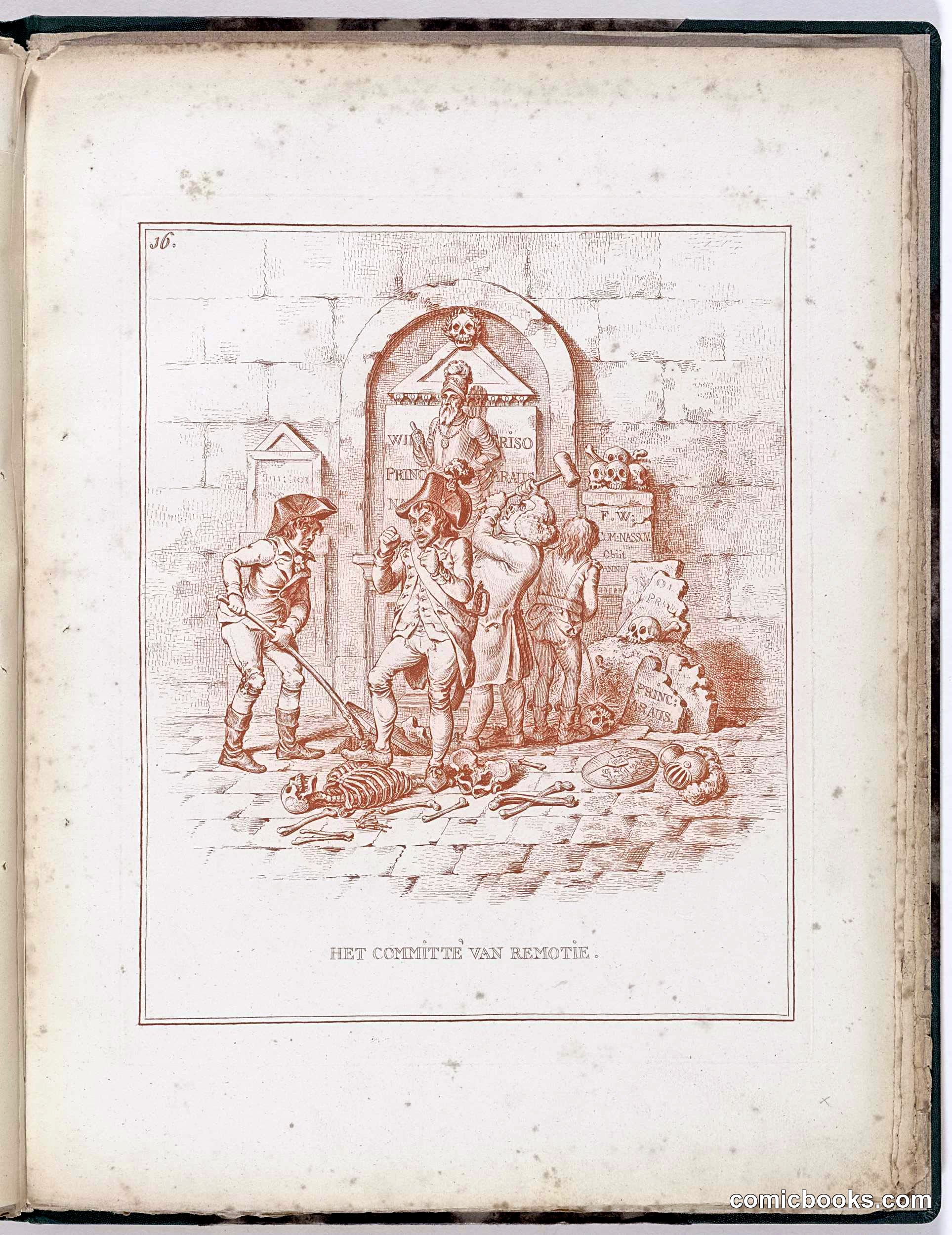
This hand-colored etching depicts a chaotic scene at a tomb or shrine, where figures in period dress—soldiers, officials, and common people—gather around skeletal remains and military equipment. The composition satirizes political authority through the visual vocabulary of the Dutch Golden Age: crowded narrative space, grotesque physical types, and symbolic props scattered across the foreground.
The print belongs to the rich tradition of political caricature that emerged in 18th-century Europe, following Hogarth's sequential moral narratives and developing alongside Gillray's acid-etched commentary on power. Such engravings reached mass audiences through affordable reproduction, establishing conventions—exaggerated physiognomy, layered allegory, crude wit—that would evolve into the comic strip. Here, the artist uses bodily distortion and dramatic staging to mock institutional pretension, a technique central to how visual satire shaped modern comics' language of irreverence toward the powerful.
About this artifact
- Date
- 1795
- Rights
- Public domain — free to view, share, and reuse.
- Restoration
- Digitally restored and hosted by ComicBooks.com.
Part of our mission to preserve and restore the public-domain heritage of the medium.