
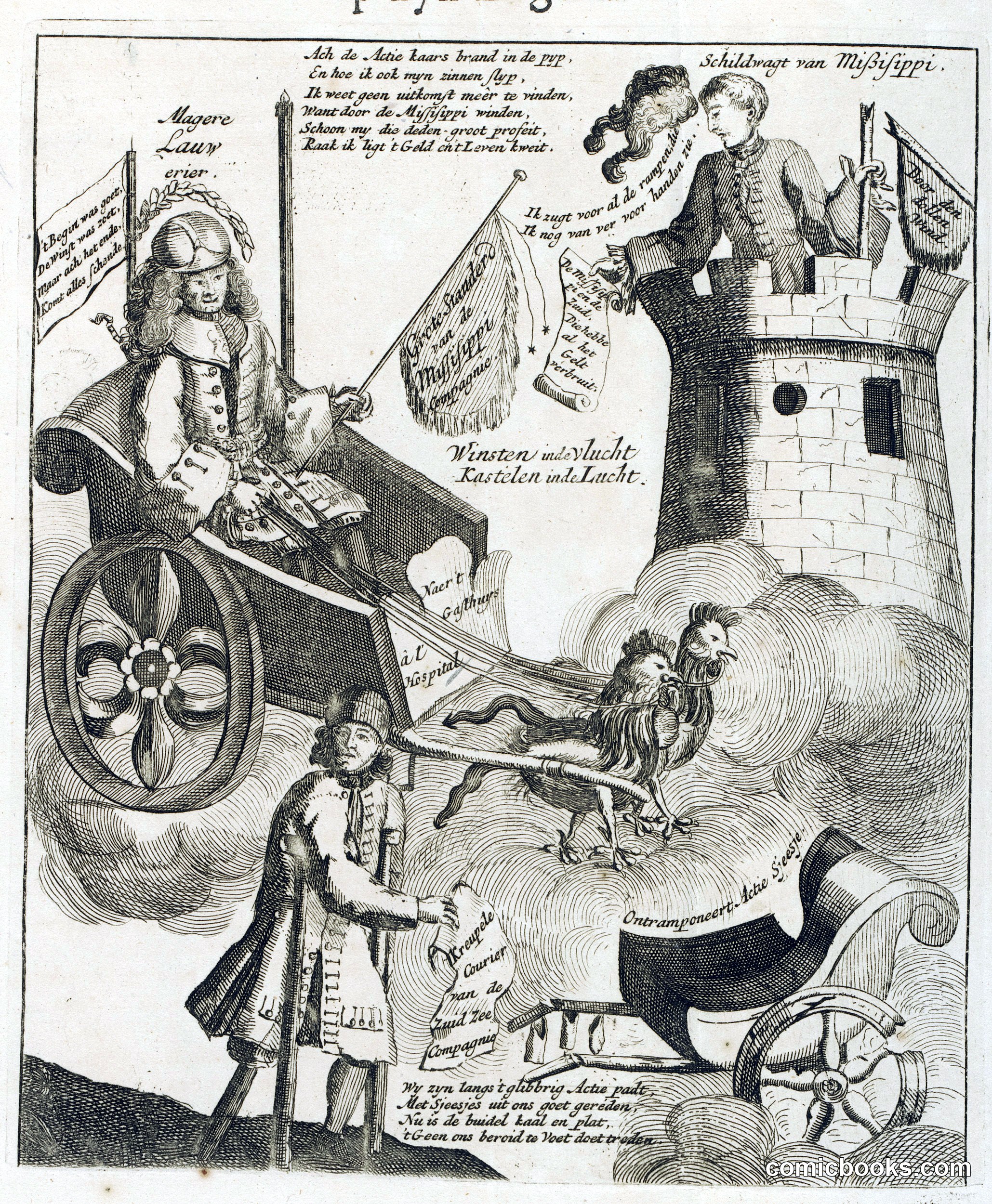
This Dutch engraving mocks John Law's Mississippi Company scheme, the financial bubble that collapsed in 1720. Law, a Scottish financier, sits in a chariot drawn by figures representing fraud and deception, while ministers in a tower above dispense worthless paper. Below, victims suffer as their fortunes vanish into smoke and wind—visual metaphors for the scheme's insubstantial promises.
The print exemplifies the Northern European satirical tradition that preceded modern comics: allegorical compositions combining caricature, symbolic objects, and dense text to attack specific figures and follies. Like Hogarth's moral narratives and later German Bilderbogen sheets, it uses sequential imagery and grotesque portraiture to expose economic crime to public ridicule. The etching's formal arrangement—the corrupt central figure surrounded by consequences—became a foundational compositional strategy for political cartooning and sequential art.
About this artifact
- Date
- 1720
- Rights
- Public domain — free to view, share, and reuse.
- Restoration
- Digitally restored and hosted by ComicBooks.com · high-resolution version available.
Part of our mission to preserve and restore the public-domain heritage of the medium.