
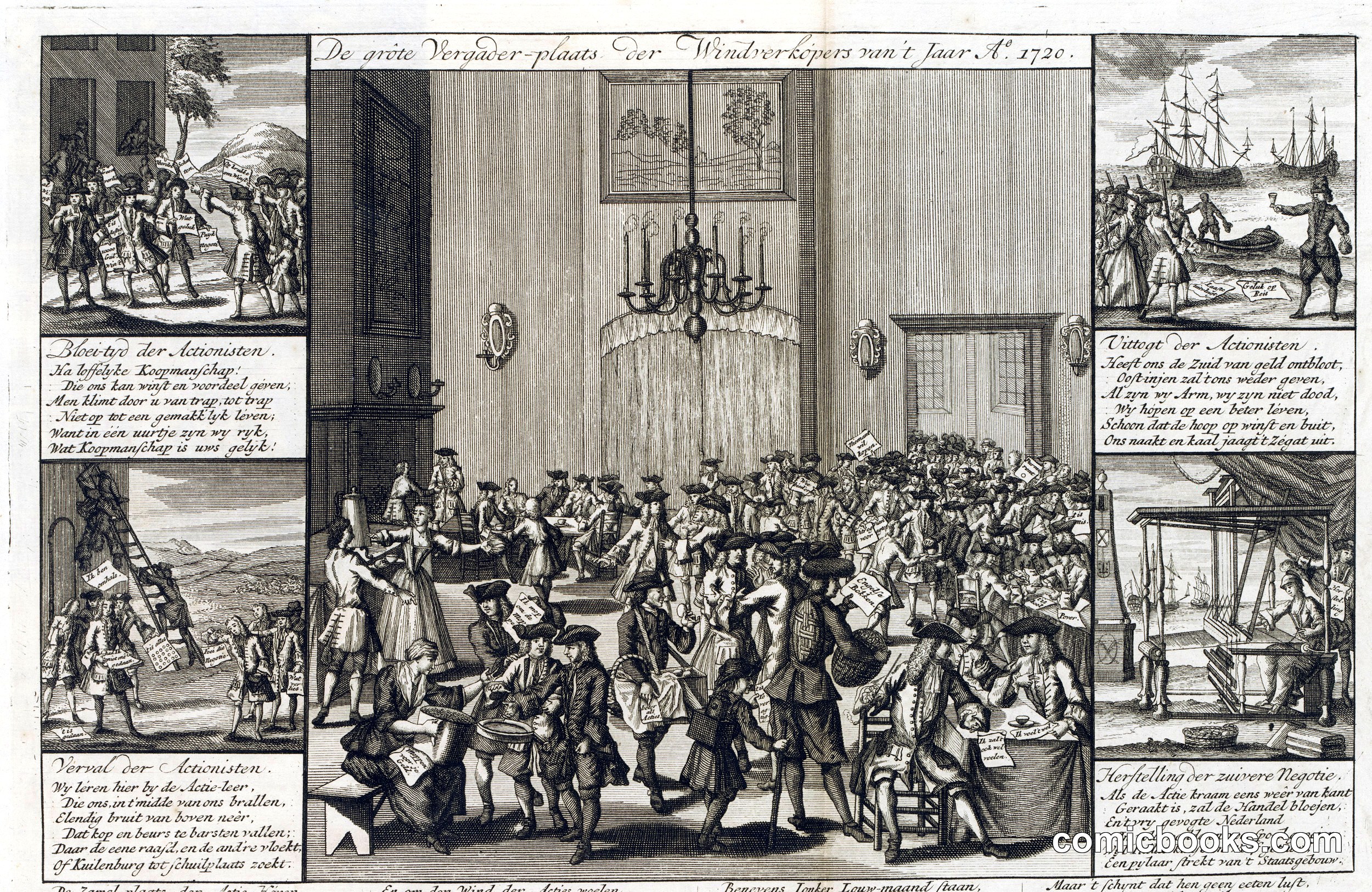
This Dutch engraving satirizes financial fraud and quackery through a crowded indoor scene of charlatans hawking worthless remedies and schemes to a gullible public. Four corner vignettes show victims suffering consequences of their purchases—shipwrecks, poverty, illness, and ruin—while the central hall teems with con artists, dupes, and pickpockets in chaotic commerce.
The print descends from Northern European broadsheet satire and anticipates the caricature tradition of Hogarth and later masters. Its layered narrative, multiple viewpoints, and moral instruction through visual consequence establish conventions comic artists would adopt: the fool made visible, vice punished, folly exposed through sequence and accumulation rather than single image. The etched line work captures both architectural specificity and human type—a vocabulary Gillray and Rowlandson would refine.
About this artifact
- Date
- 1720
- Rights
- Public domain — free to view, share, and reuse.
- Restoration
- Digitally restored and hosted by ComicBooks.com · high-resolution version available.
Part of our mission to preserve and restore the public-domain heritage of the medium.