
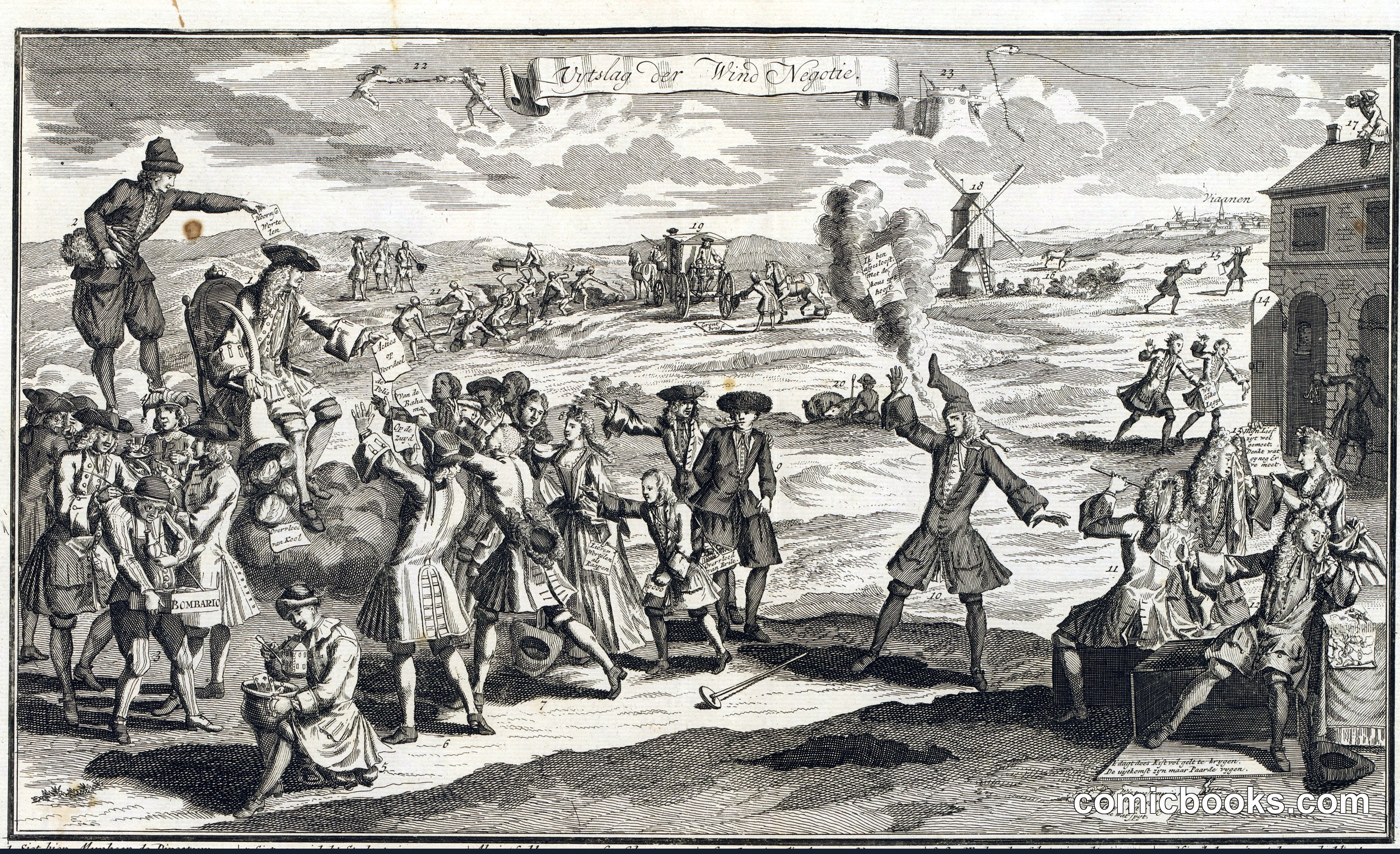
This Dutch engraving satirizes financial speculation during the early eighteenth century. Crowds of figures occupy a windswept landscape, some gesturing wildly, others engaged in heated debate or collapsing in despair. A figure at left appears to offer worthless paper; a windmill dominates the right. The print employs the visual chaos and exaggerated body language typical of Northern European satirical prints—a tradition reaching back to Bruegel and codified by Hogarth and his contemporaries. Such engravings, distributed as single sheets to a broad public, combined social observation with grotesque caricature and physical comedy. They established the vocabulary of visual satire—crowded compositions, symbolic props, distorted features expressing folly or vice—that would eventually inform the sequential narratives of modern comics.
About this artifact
- Date
- 1720
- Rights
- Public domain — free to view, share, and reuse.
- Restoration
- Digitally restored and hosted by ComicBooks.com · high-resolution version available.
Part of our mission to preserve and restore the public-domain heritage of the medium.