
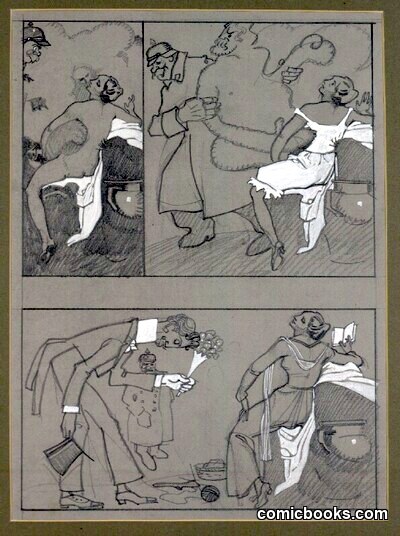
Franz Wacik's 1920 print employs the vocabulary of 18th- and 19th-century political satire to mock classical pretension and sexual hypocrisy. The four-panel sequence depicts a bourgeois man's transformation—from seduction through deception to abandonment—using exaggerated anatomical caricature and expressive line work typical of Germanic Expressionism. The print descends directly from Hogarth's narrative sequences and Daumier's social commentary, translating Old Master mythology into contemporary scandal. Wacik's crude physicality and class-marked figures reflect both the Bilderbogen tradition and Weimar-era cynicism toward authority and morality. This work represents satire's evolution from hand-colored prints to modernist graphic critique, a bridge between 19th-century caricature culture and emerging comic narrative forms.
About this artifact
- Creator
- Franz Wacik
- Date
- 1920
- Rights
- Public domain — free to view, share, and reuse.
- Restoration
- Digitally restored and hosted by ComicBooks.com.
Part of our mission to preserve and restore the public-domain heritage of the medium.