
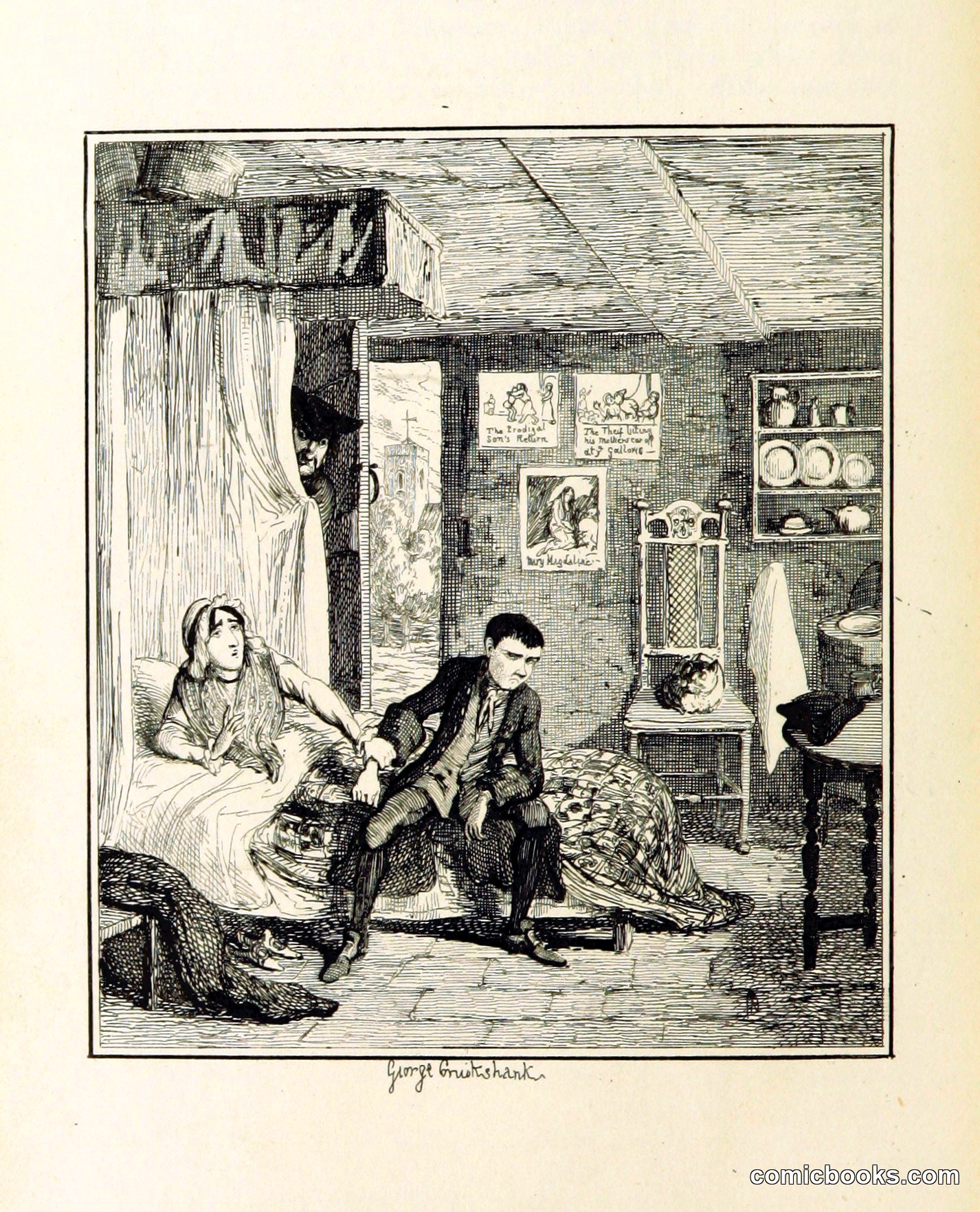
A steel or wood-engraved interior scene — almost certainly reproduced from Cruikshank's original steel engravings for Ainsworth's 1839 novel — shows a brooding young man seated at a bedside, a woman reclining toward him, while a cloaked figure lurks behind bed-curtains. Crude devotional prints pinned to the wall (The Prodigal Son's Return, Mary Magdalene) signal a thieves'-kitchen milieu; the crowded shelves and flagstone floor place these figures unmistakably in London's criminal poor. Cruikshank descends directly from Hogarth's Industry and Idleness moral-narrative sequence: sequential pictures moralizing working-class transgression, rendered for a mass reading public. That tradition — Hogarth to Rowlandson to Cruikshank to the illustrated penny-serial — is the direct ancestor of the comic strip's panel-by-panel storytelling and its romanticized outlaw heroes.
About this artifact
- Date
- 1854
- Rights
- Public domain — free to view, share, and reuse.
- Restoration
- Digitally restored and hosted by ComicBooks.com.
Part of our mission to preserve and restore the public-domain heritage of the medium.