
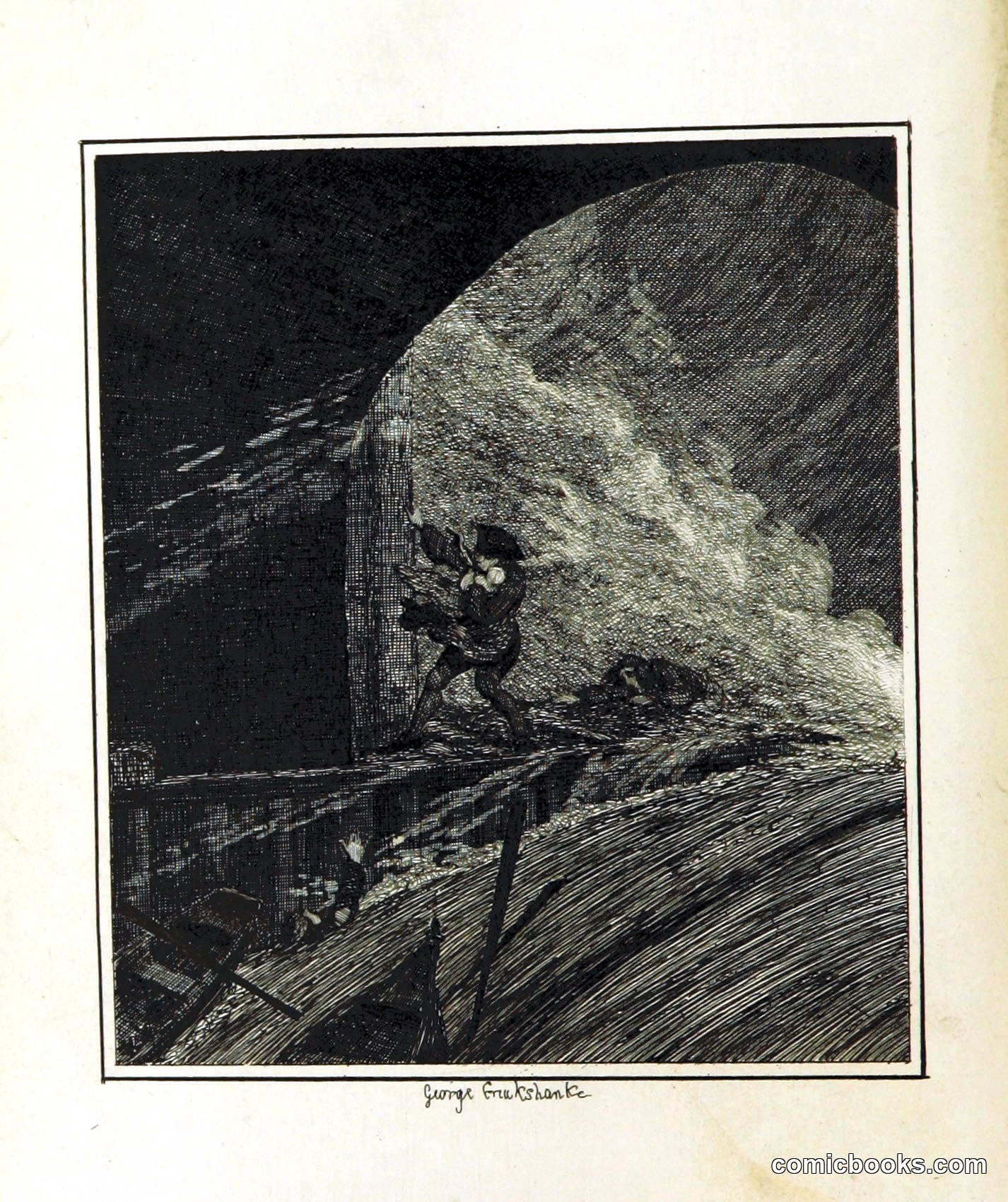
George Cruikshank's wood engraving captures a violent nocturnal confrontation on a road or bridge: a cloaked figure braces against a massive wave or explosion of white force, debris scattered at his feet, darkness pressing in from every side. The scene illustrates William Harrison Ainsworth's romanticized criminal, Jack Sheppard—a thief and escape artist who became a folk anti-hero, his story a persistent embarrassment to Victorian moralists who feared it glamorized crime. Cruikshank, inheritor of Gillray's and Rowlandson's tradition of dramatic English print satire, here channels that lineage into narrative book illustration—sequential, character-driven pictures that sit directly upstream of the comic strip. His dense cross-hatching and theatrical chiaroscuro gave working-class readers visceral drama before cinema existed to supply it.
About this artifact
- Date
- 1854
- Rights
- Public domain — free to view, share, and reuse.
- Restoration
- Digitally restored and hosted by ComicBooks.com.
Part of our mission to preserve and restore the public-domain heritage of the medium.