
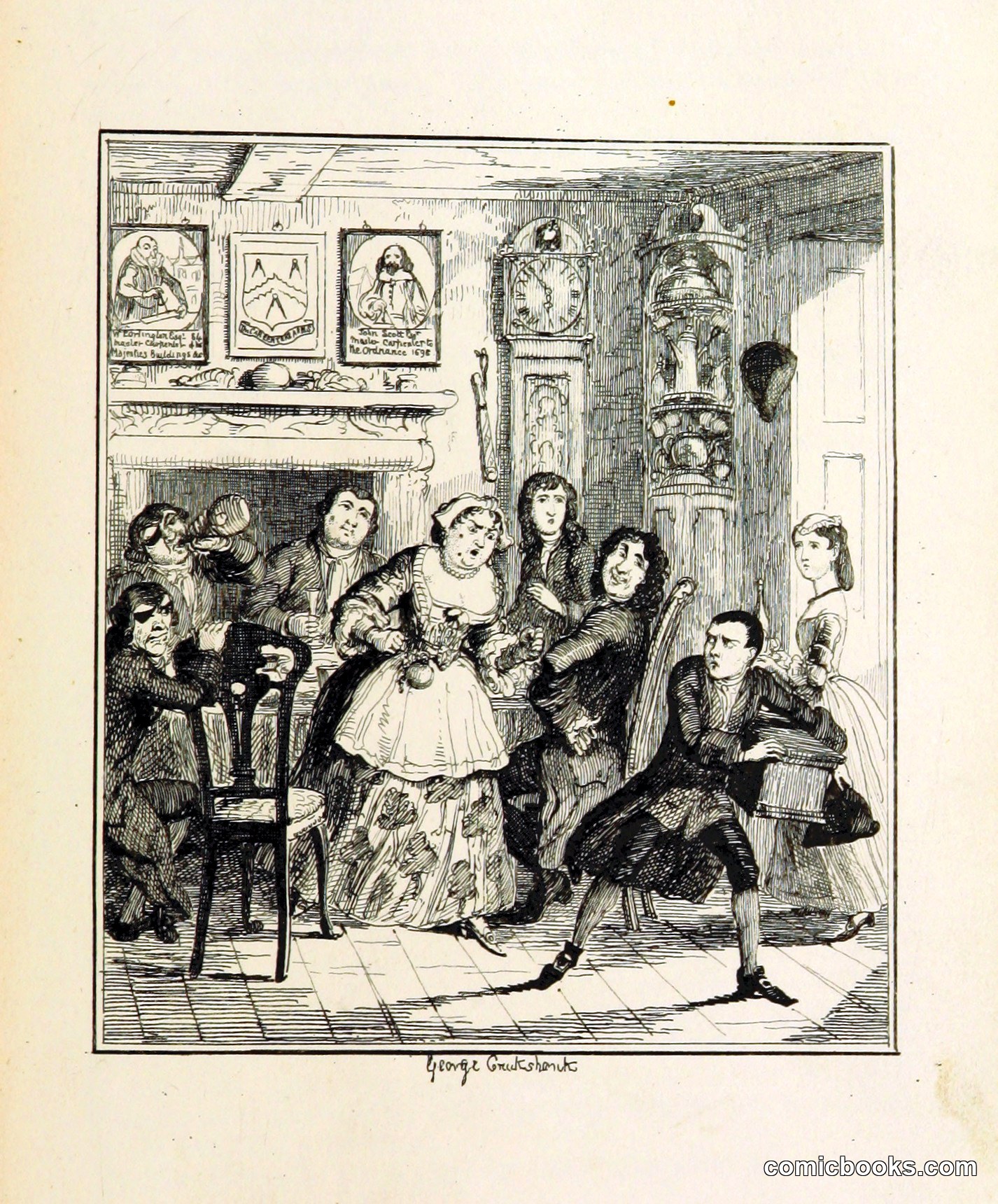
George Cruikshank's steel engraving illustrates a crowded interior — a tavern or parlor — where a florid woman in period dress holds court among men rendered with broadly comic, class-coded faces: jowly, sharp-nosed, or slack-jawed, the physiognomic exaggeration common to Victorian popular print. A grandfather clock and framed portraits anchor the Georgian setting. Cruikshank (1792–1878) trained in the tradition of Gillray and Rowlandson, whose political and social caricatures established sequential visual storytelling as a legitimate popular art. His illustrated novels — Oliver Twist, Jack Sheppard — carried that lineage into narrative sequence, panel by panel, making him a direct ancestor of the comic book. The working-class characters here carry the condescending grotesquerie typical of mid-Victorian illustration, where poverty read as physical comedy.
About this artifact
- Date
- 1854
- Rights
- Public domain — free to view, share, and reuse.
- Restoration
- Digitally restored and hosted by ComicBooks.com.
Part of our mission to preserve and restore the public-domain heritage of the medium.