
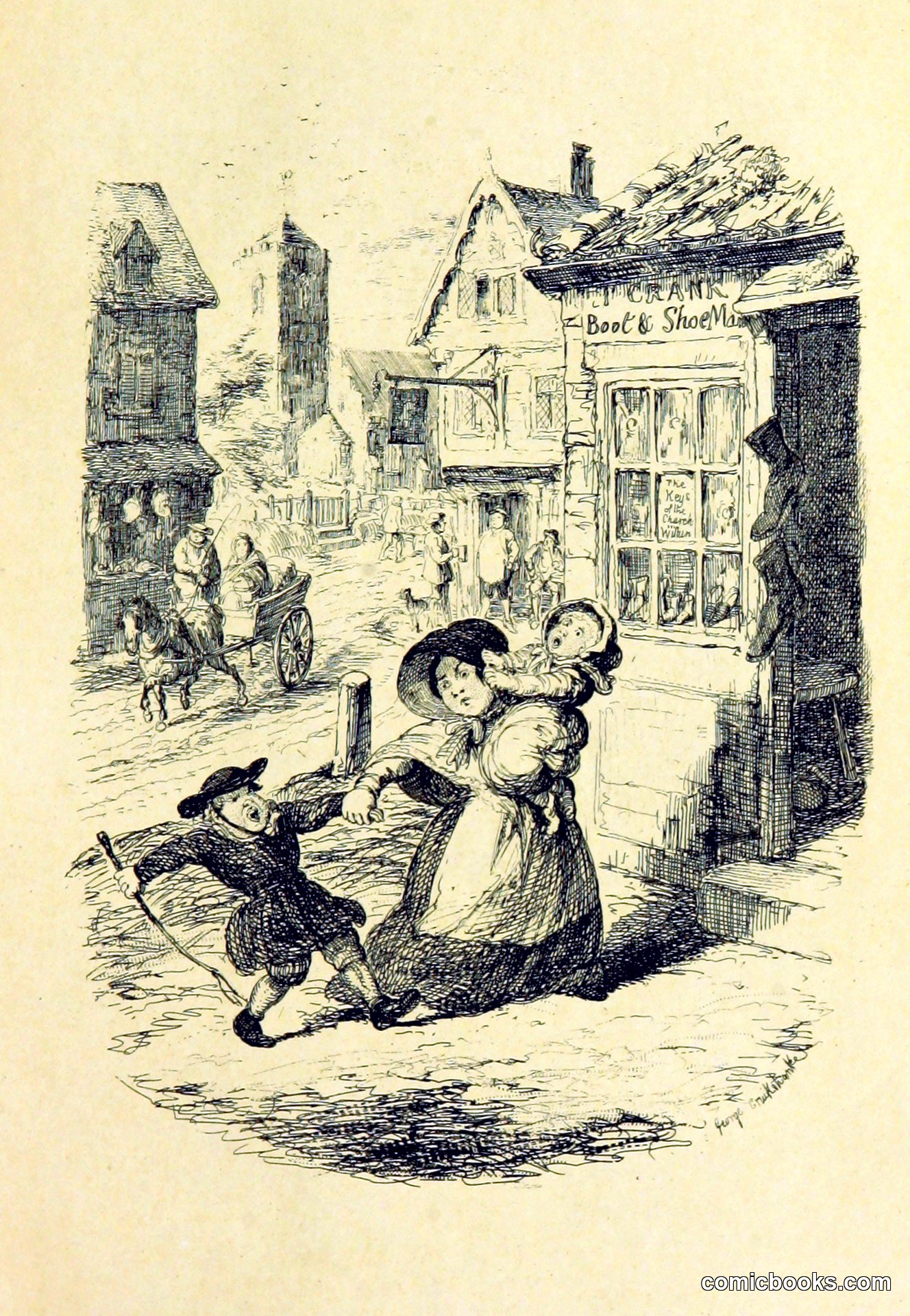
A pen-and-ink illustration — rendered in fine cross-hatched line engraving consistent with mid-Victorian wood-engraving reproduction — shows a busy London street of the working poor. In the foreground, a stout woman carrying an infant on her back is jostled or accosted by a small boy wielding a stick; the figures are rendered with the exaggerated proportions and comic bulk that George Cruikshank made his signature. Behind them, costermongers, a horse cart, and shopfronts — including a boot-and-shoe maker — establish a crowded, grimy urban world. Cruikshank's draftsmanship descends directly from Hogarth's moralized street scenes and Rowlandson's ribald crowd work, treating working-class bodies as inherently comic through distortion. That tradition of sequential, character-driven illustration, sold in cheap illustrated volumes, fed directly into the comic strip's vocabulary of recurring figures, panel-ready compositions, and socially satirical observation.
About this artifact
- Date
- 1858
- Rights
- Public domain — free to view, share, and reuse.
- Restoration
- Digitally restored and hosted by ComicBooks.com.
Part of our mission to preserve and restore the public-domain heritage of the medium.