
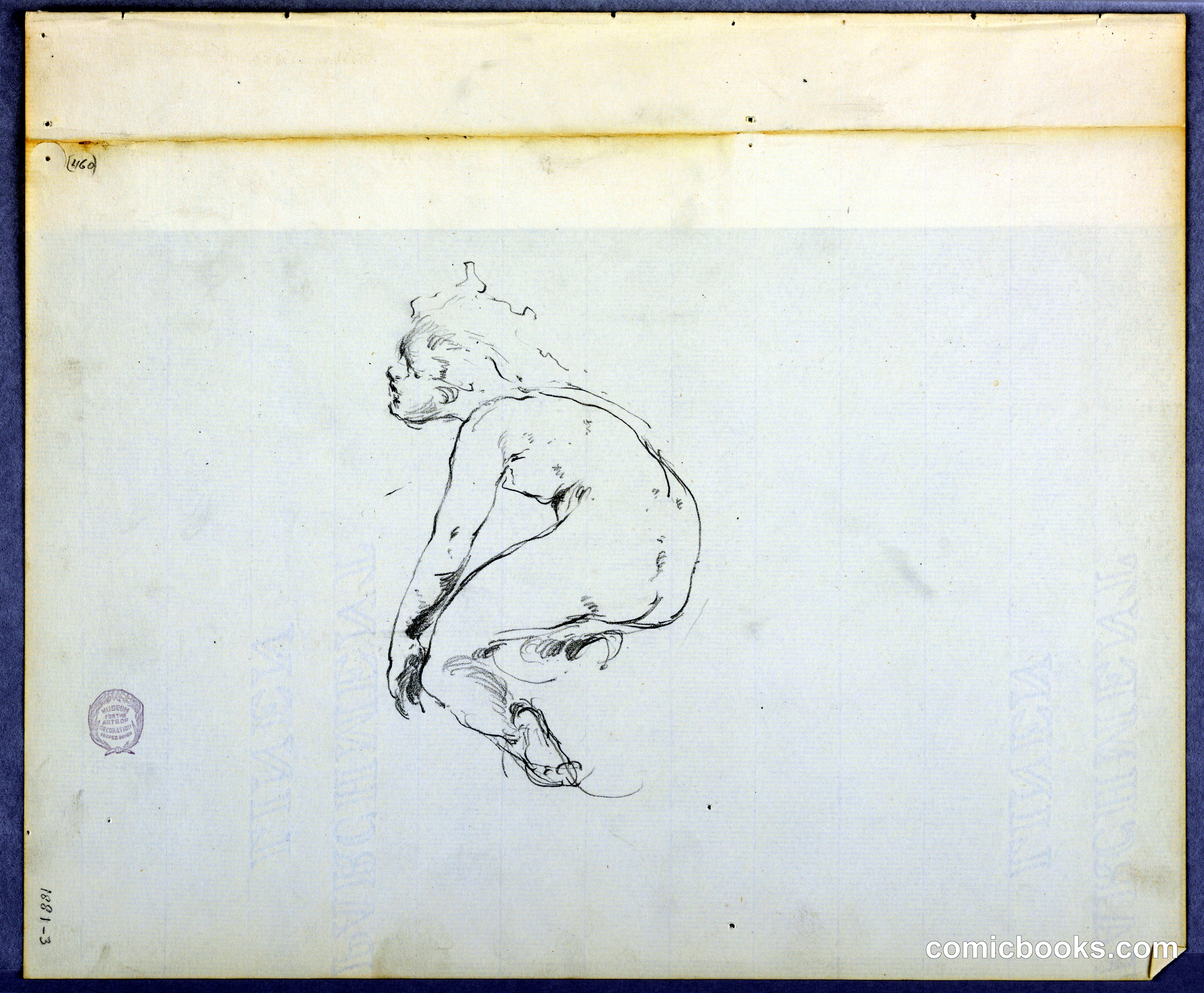
This sketch by Robert Frederick Blum exemplifies the foundational drawing practices that undergirded American illustration in the late nineteenth century. Working in ink with assured, economical lines, Blum captures a seated female figure in three-quarter view, her posture and musculature rendered with anatomical precision. Such studies—drawn from life or memory—formed the essential vocabulary for illustrators who would soon populate the Sunday newspaper pages. Blum's generation of artists, trained in both academic tradition and commercial speed, developed the visual fluency that made sequential art possible: the ability to render consistent characters across multiple panels with clarity and expression. These foundational skills, honed through countless figure studies, enabled the birth of the comic strip as a narrative form.
About this artifact
- Creator
- Robert Frederick Blum, American, 1857–1903
- Date
- circa 1881
- Rights
- Public domain — free to view, share, and reuse.
- Restoration
- Digitally restored and hosted by ComicBooks.com · high-resolution version available.
Part of our mission to preserve and restore the public-domain heritage of the medium.