
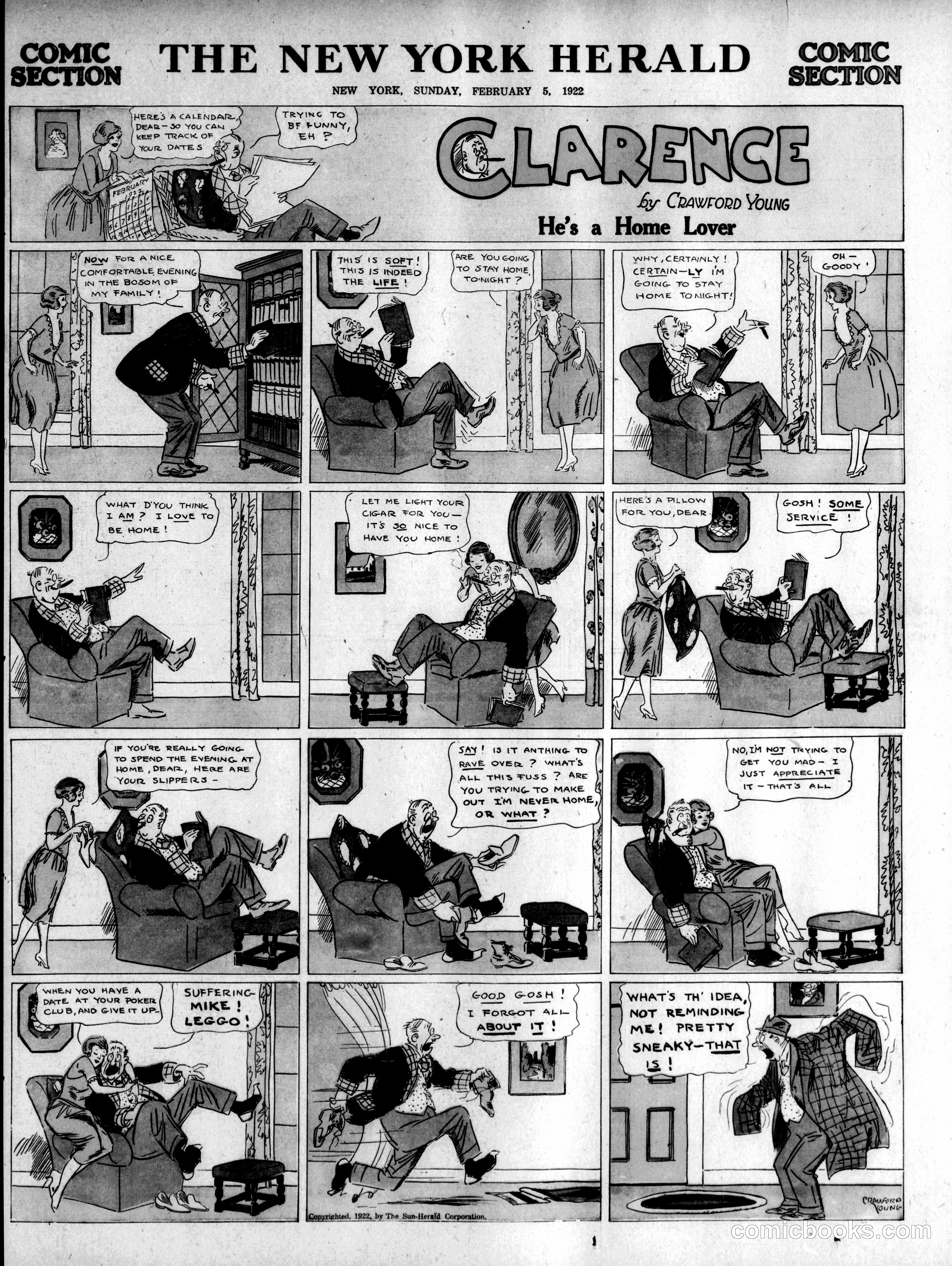
This Sunday comic strip from the New York Herald follows Clarence, a domestic character caught between his employer's social obligations and his preference for home comfort. Young's strip uses sequential panels with speech balloons to develop situational humor across twelve frames, tracking Clarence's resistance to a night out and his eventual capitulation. The strip exemplifies early-twentieth-century newspaper comics: recurring character, visual gag construction, and domestic comedy pitched at middle-class readers. By 1922, the Sunday comic section had become standard in major papers, establishing the visual grammar—bordered panels, narrative sequence, expressive linework—that would define comic books when they emerged as a format in the following decade.
About this artifact
- Date
- February 5, 1922
- Rights
- Public domain — free to view, share, and reuse.
- Restoration
- Digitally restored and hosted by ComicBooks.com · high-resolution version available.
Part of our mission to preserve and restore the public-domain heritage of the medium.