
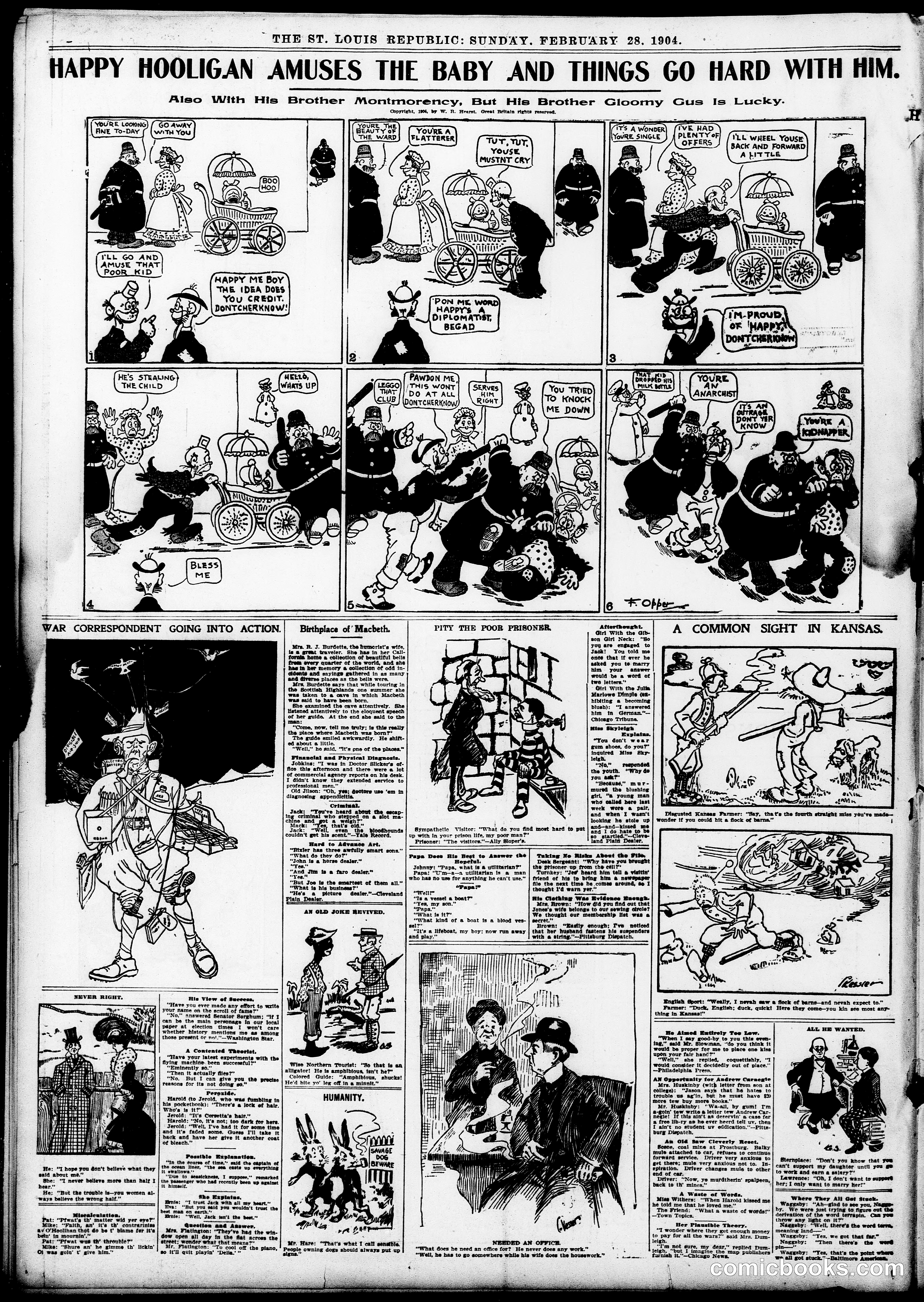
Six panels follow Frederick Burr Opper's tin-canned tramp, Happy Hooligan, as he attempts to amuse a baby in a pram. His good intentions cascade into slapstick: a runaway carriage, a confrontation with police, and the inevitable arrest — while his dapper brother Gloomy Gus escapes blame entirely. Opper's line is loose and expressive; speech balloons crowd the action; secondary characters react in exaggerated silhouette. Opper, a veteran of Puck magazine, launched Happy in 1900 for Hearst's syndicate. These Sunday color pages — distributed nationally and read by millions — established the recurring character, the sequential panel grid, and the speech balloon as standard tools. The comic book, arriving three decades later, inherited every one of them.
About this artifact
- Date
- February 28, 1904
- Rights
- Public domain — free to view, share, and reuse.
- Restoration
- Digitally restored and hosted by ComicBooks.com · high-resolution version available.
Part of our mission to preserve and restore the public-domain heritage of the medium.