
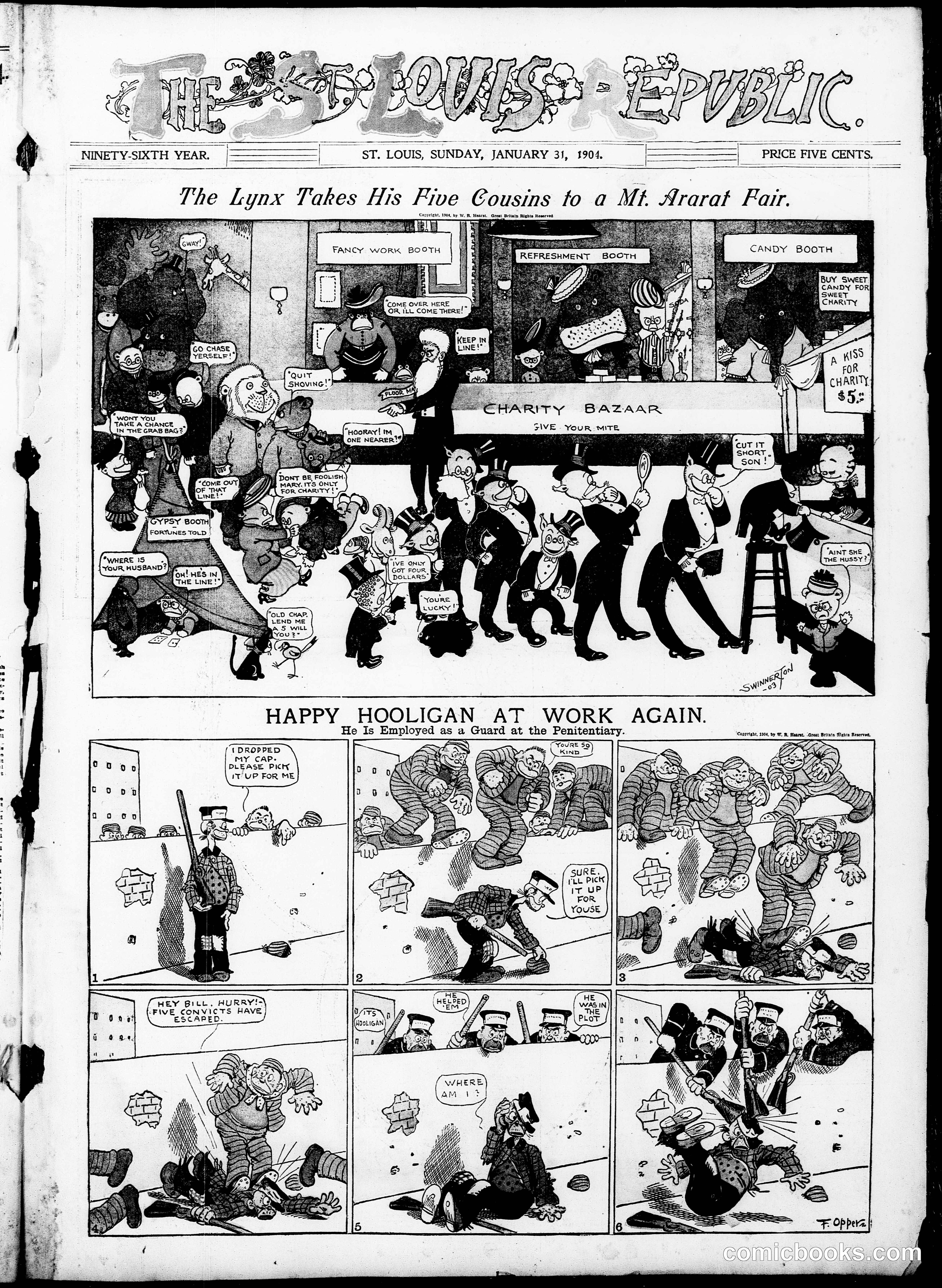
This Sunday broadsheet page pairs two strips. The upper tier, The Lynx Takes His Five Cousins to a Mt. Ararat Fair, is a crowd scene set at a Charity Bazaar — booths selling candy, refreshments, and kisses — with anthropomorphic animal dandies and a jostling queue rendered in Swinnerton's loose, confident line. Below it, Frederick Opper's Happy Hooligan runs six panels: Hooligan, working as a penitentiary guard, bends to retrieve a dropped cap, allowing five striped convicts to escape; the resulting chase ends in a pile-up of slapstick violence. Opper's panel-to-panel timing — a clear cause-and-effect chain of sight gags — shows the Sunday page's role in developing sequential visual storytelling. Launched in 1900 in Hearst papers, Happy Hooligan was among the first recurring comic characters to build audience loyalty across weeks, helping establish the commercial and narrative logic that would eventually produce the comic book format itself.
About this artifact
- Date
- January 31, 1904
- Rights
- Public domain — free to view, share, and reuse.
- Restoration
- Digitally restored and hosted by ComicBooks.com · high-resolution version available.
Part of our mission to preserve and restore the public-domain heritage of the medium.