
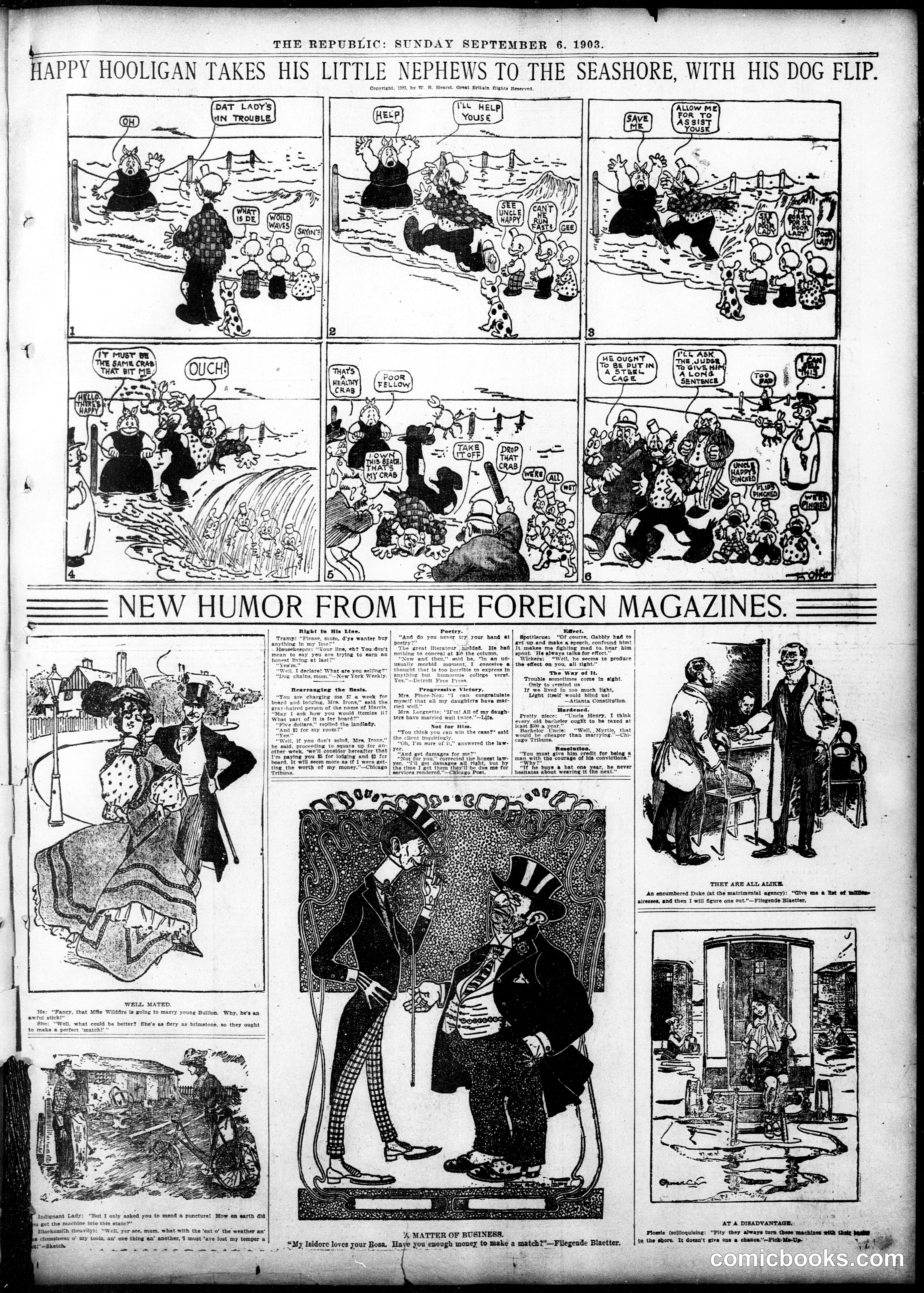
Six panels follow Happy Hooligan—tin-canned hat, ragged coat, eternally good-hearted—as he takes his small nephews to the seashore with his spotted dog Flip. A drowning woman triggers a chain of slapstick rescues; a crab bites; a policeman arrests Happy as usual despite his heroics. Frederick Opper's brushwork is loose and kinetic, speech balloons packed with dialect spelling, panel borders functioning as breathing room between gags. Opper had joined Hearst's New York American in 1899, and Happy Hooligan ran until 1932. These large-format Sunday color pages—here reproduced in the Republic's black-and-white syndication—were the direct ancestors of the comic book: recurring cast, sequential panels, standardized balloon grammar, cliffhanger structure resolved within a single sheet. The lower half of the page pairs the strip with illustrated jokes culled from European magazines, a common filler format that shows how fluid the early Sunday page still was between cartooning and illustrated text.
About this artifact
- Date
- Published September 6, 1903
- Rights
- Public domain — free to view, share, and reuse.
- Restoration
- Digitally restored and hosted by ComicBooks.com · high-resolution version available.
Part of our mission to preserve and restore the public-domain heritage of the medium.