
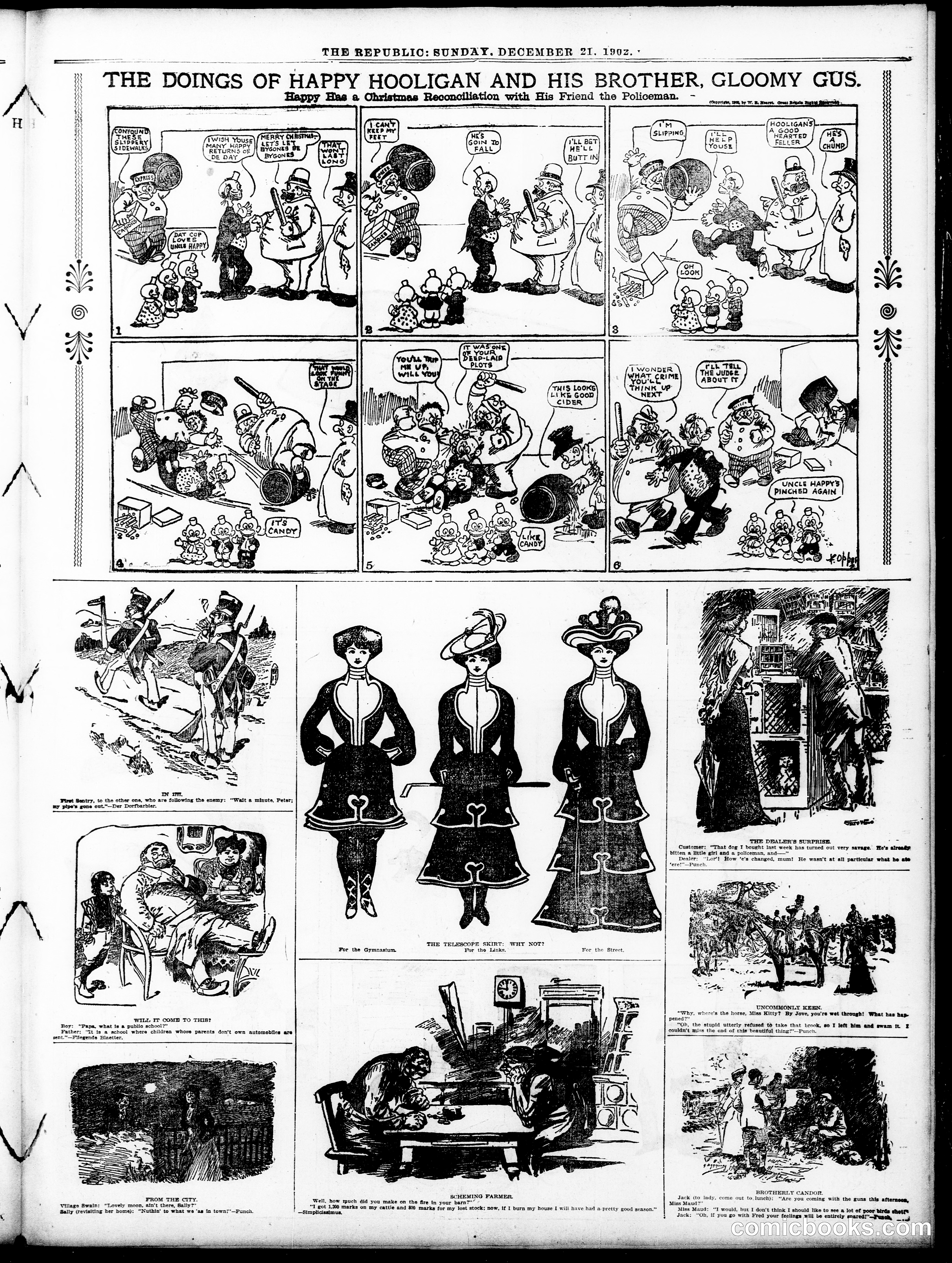
Six panels follow Happy Hooligan — the good-natured tramp identifiable by his tin-can hat — through a Christmas-week misadventure involving his dour brother Gloomy Gus, a policeman, and a jug of cider that ends, inevitably, with Happy pinched again. Frederick Opper's draftsmanship is loose and kinetic: figures tumble across gutters, speech balloons carry overlapping dialogue, and recurring visual cues (the tin can, the cop's billy club) do the work of continuity. Opper launched Happy Hooligan in 1900 for Hearst's syndicate, making it one of the earliest strip characters to sustain a recognizable personality across years of Sunday pages. Those pages — alongside Outcault's Yellow Kid and Dirks's Katzenjammer Kids — established the sequential grammar, the balloon, the recurring cast, and the weekly anthology format that comic books would inherit wholesale thirty years later.
About this artifact
- Date
- Published December 21, 1902
- Rights
- Public domain — free to view, share, and reuse.
- Restoration
- Digitally restored and hosted by ComicBooks.com · high-resolution version available.
Part of our mission to preserve and restore the public-domain heritage of the medium.