
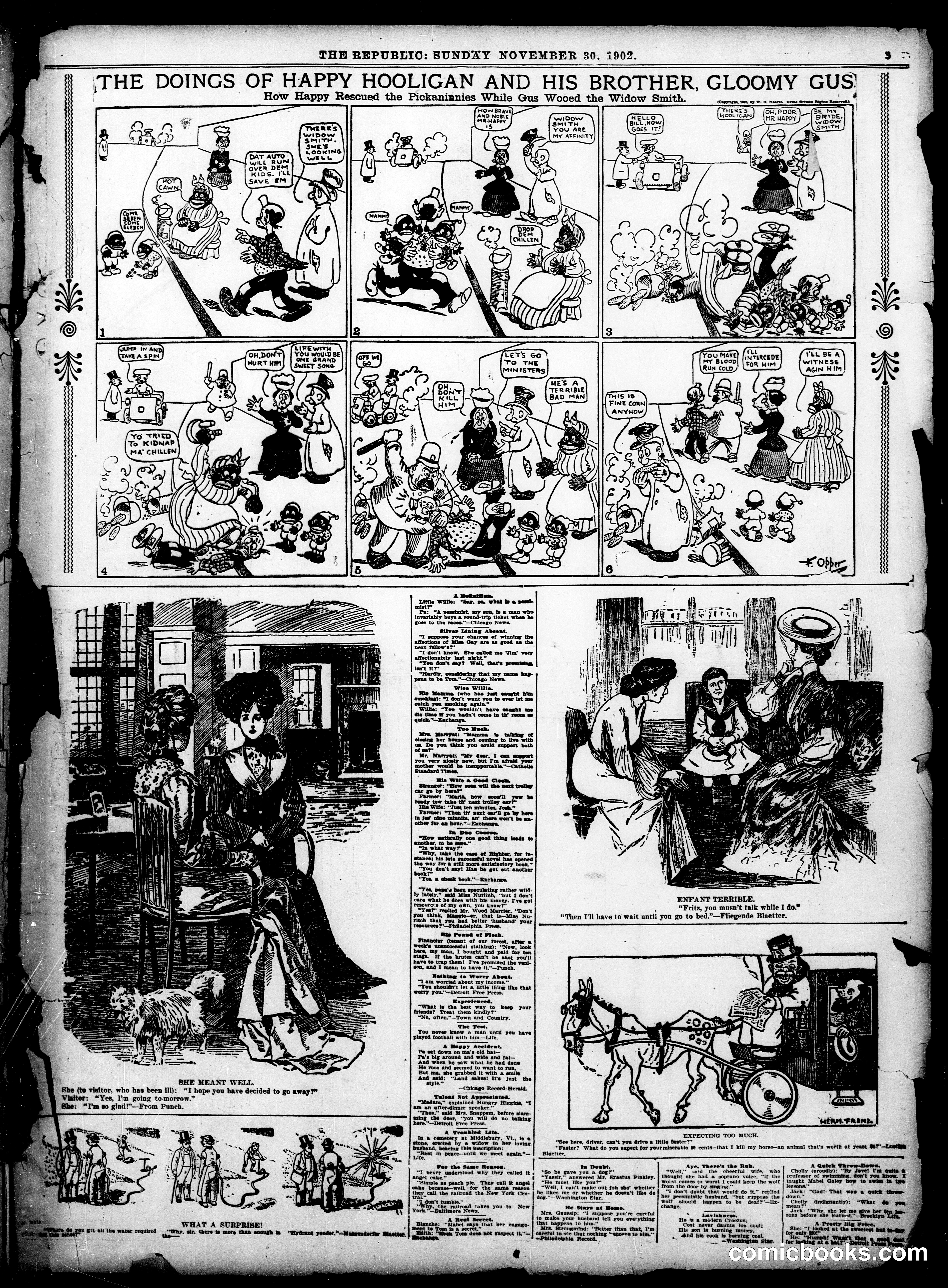
Frederick Burr Opper's Happy Hooligan runs six panels across two tiers on this Sunday page from the St. Louis Republic. The episode follows the tin-canned tramp and his brother Gloomy Gus through a slapstick rescue of children and a courtship subplot involving the Widow Smith — classic Opper structure: accumulating chaos, a final indignity, Hooligan taking the blame. Opper's line is loose and economical; his speech balloons carry distinct vernacular voices panel to panel. Launched in 1900 for Hearst's syndicate, Happy Hooligan was among the first strips with a fixed recurring protagonist, running continuously until 1932. Sunday pages like this one — full color broadsheets reproduced across dozens of papers simultaneously — were the direct commercial and formal ancestor of the comic book, establishing panel grids, sequential reading conventions, and character-driven serialization as a mass medium.
About this artifact
- Date
- Published November 30, 1902
- Rights
- Public domain — free to view, share, and reuse.
- Restoration
- Digitally restored and hosted by ComicBooks.com · high-resolution version available.
Part of our mission to preserve and restore the public-domain heritage of the medium.