
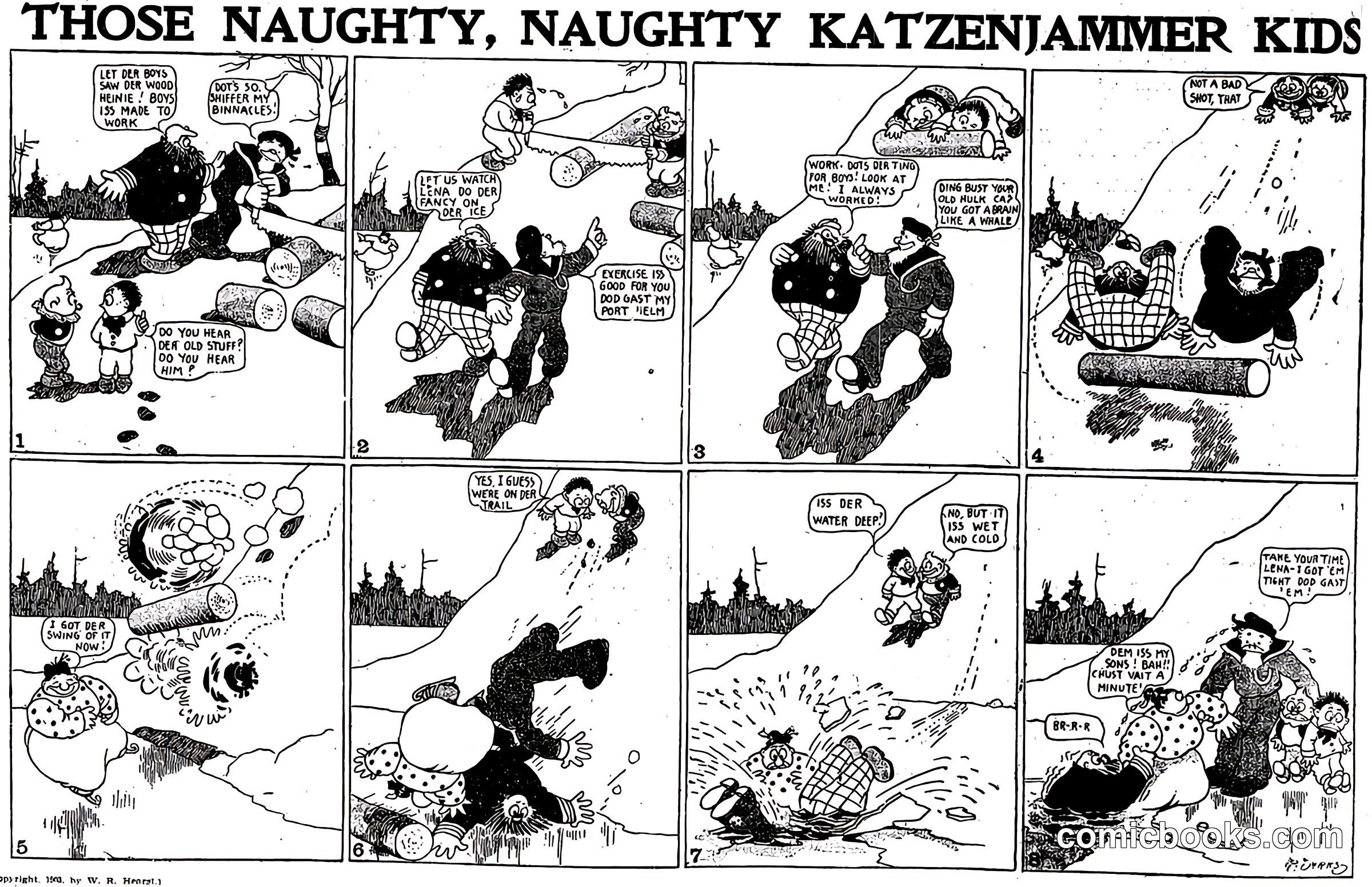
Eight panels follow Hans and Fritz, the incorrigible twins in their polka-dot sailor suits, as they engineer a pratfall scheme against Der Captain — here involving logs, a frozen pond, and an icy dunking — while Mama and a woman called Lena look on. Rudolf Dirks, who launched the strip in 1897 for Hearst's New York Journal, drew directly from Wilhelm Busch's German picture-story Max und Moritz, importing sequential panels and speech balloons into American Sunday pages. That combination — recurring cast, numbered panels, integrated dialogue — is the grammatical foundation on which the comic book would eventually be built. Dirks's bold ink line and physical slapstick set a template every gag-strip artist afterward either followed or argued with.
About this artifact
- Date
- c. 1903, Hearst Newspapers (copyright W. R. Hearst)
- Rights
- Public domain — free to view, share, and reuse.
- Restoration
- Digitally restored and hosted by ComicBooks.com · high-resolution version available.
Part of our mission to preserve and restore the public-domain heritage of the medium.