
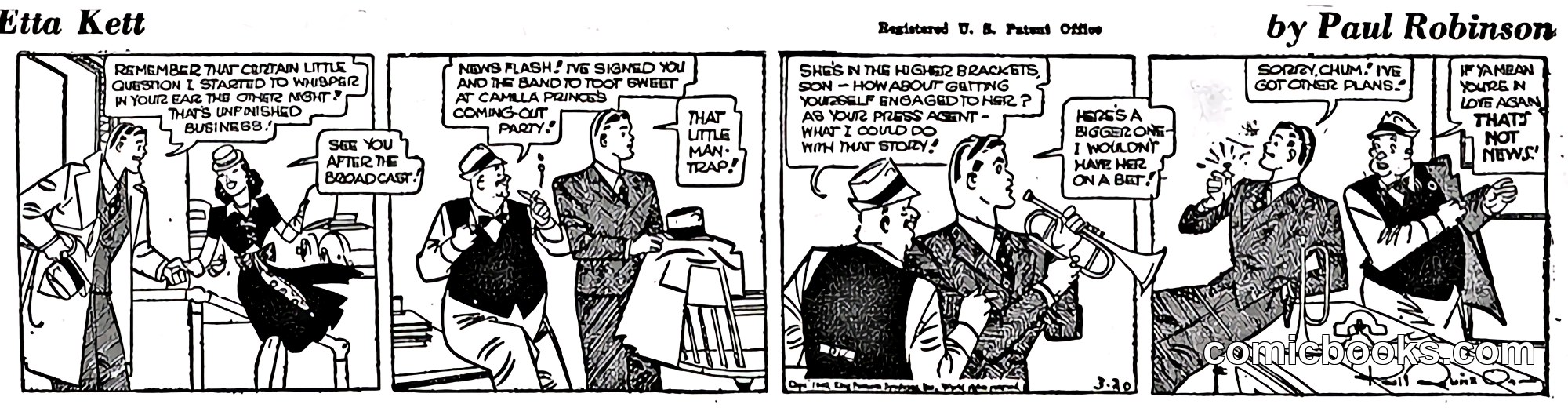
Paul Robinson's Etta Kett followed the daily adventures of a young woman navigating social life, romance, and family dynamics. The strip employs the standard grammar of newspaper comics: rectangular panels arranged left-to-right, speech balloons carrying dialogue and thought, and recurring characters whose personalities drive running gags. Here, Etta manages a social engagement, a broadcast audition, and romantic complications across four sequential moments. The strip's rapid-fire pacing and reliance on misunderstanding and social mishap typified the newspaper comic strips that emerged from the 1920s onward—works that established panel layout, lettering conventions, and character-driven humor as the foundation of commercial comics. These daily and Sunday strips in metropolitan papers reached millions and became the direct ancestors of the comic book form that would crystallize in the 1930s.
About this artifact
- Date
- 1920s–1930s
- Rights
- Public domain — free to view, share, and reuse.
- Restoration
- Digitally restored and hosted by ComicBooks.com.
Part of our mission to preserve and restore the public-domain heritage of the medium.