
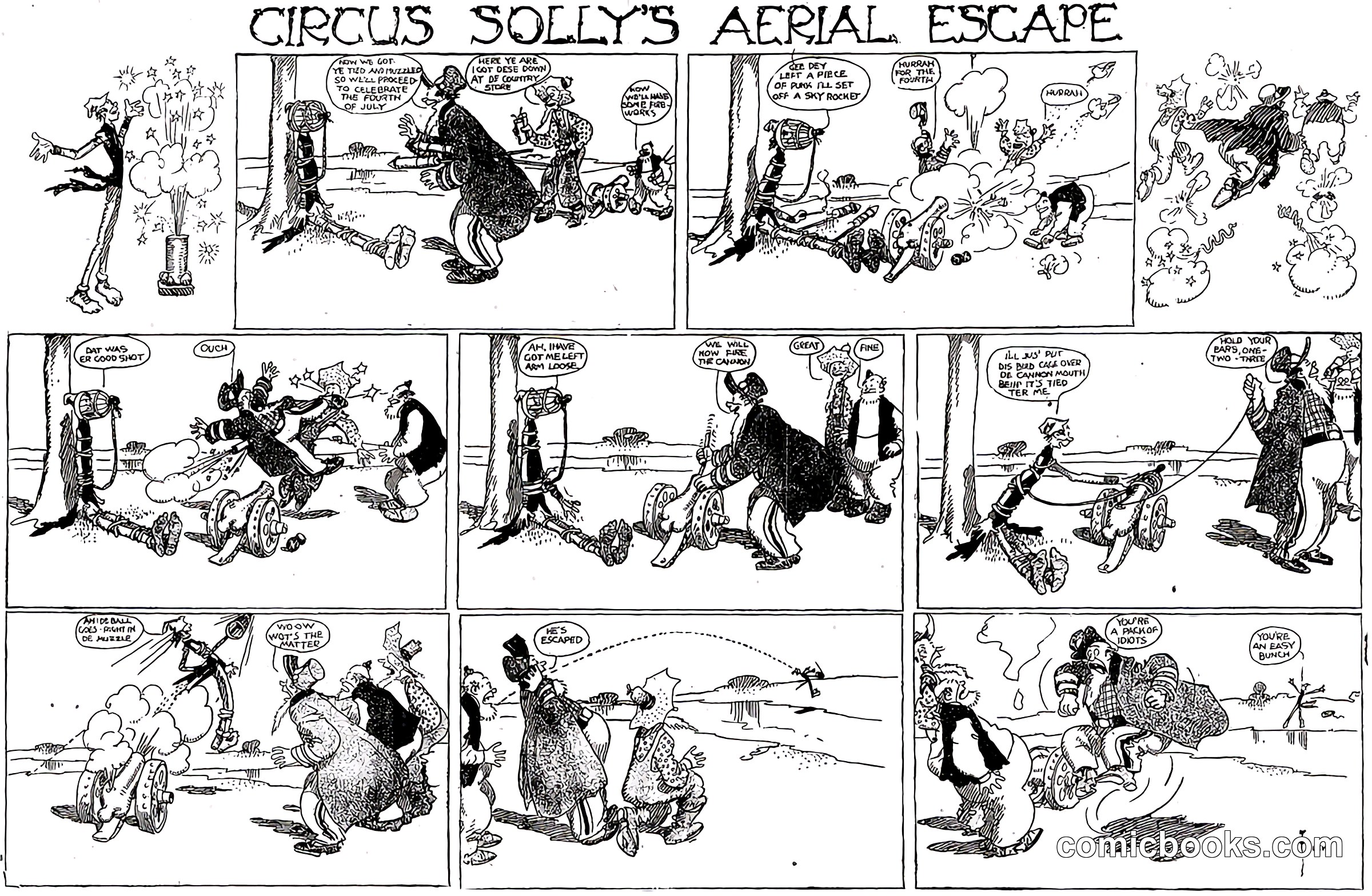
This Sunday strip follows a circus performer's attempted high-wire escape, told through sequential panels that guide the reader's eye across a landscape of comic misadventure. The artist employs speech balloons, varied panel sizes, and recurring characters to build narrative momentum—formal innovations borrowed directly from newspaper comic practice. By the early 1900s, Sunday funnies had become laboratories for visual storytelling, where artists experimented with layout and pacing. These pages, distributed through syndication to hundreds of newspapers, established the visual grammar that would define comic books: the panel grid, the speech balloon hierarchy, and the episodic gag structure. Circus acts and acrobatic mishaps were popular subjects, allowing artists to showcase dynamic figures and physical comedy across multiple frames.
About this artifact
- Date
- Early 1900s
- Rights
- Public domain — free to view, share, and reuse.
- Restoration
- Digitally restored and hosted by ComicBooks.com · high-resolution version available.
Part of our mission to preserve and restore the public-domain heritage of the medium.