
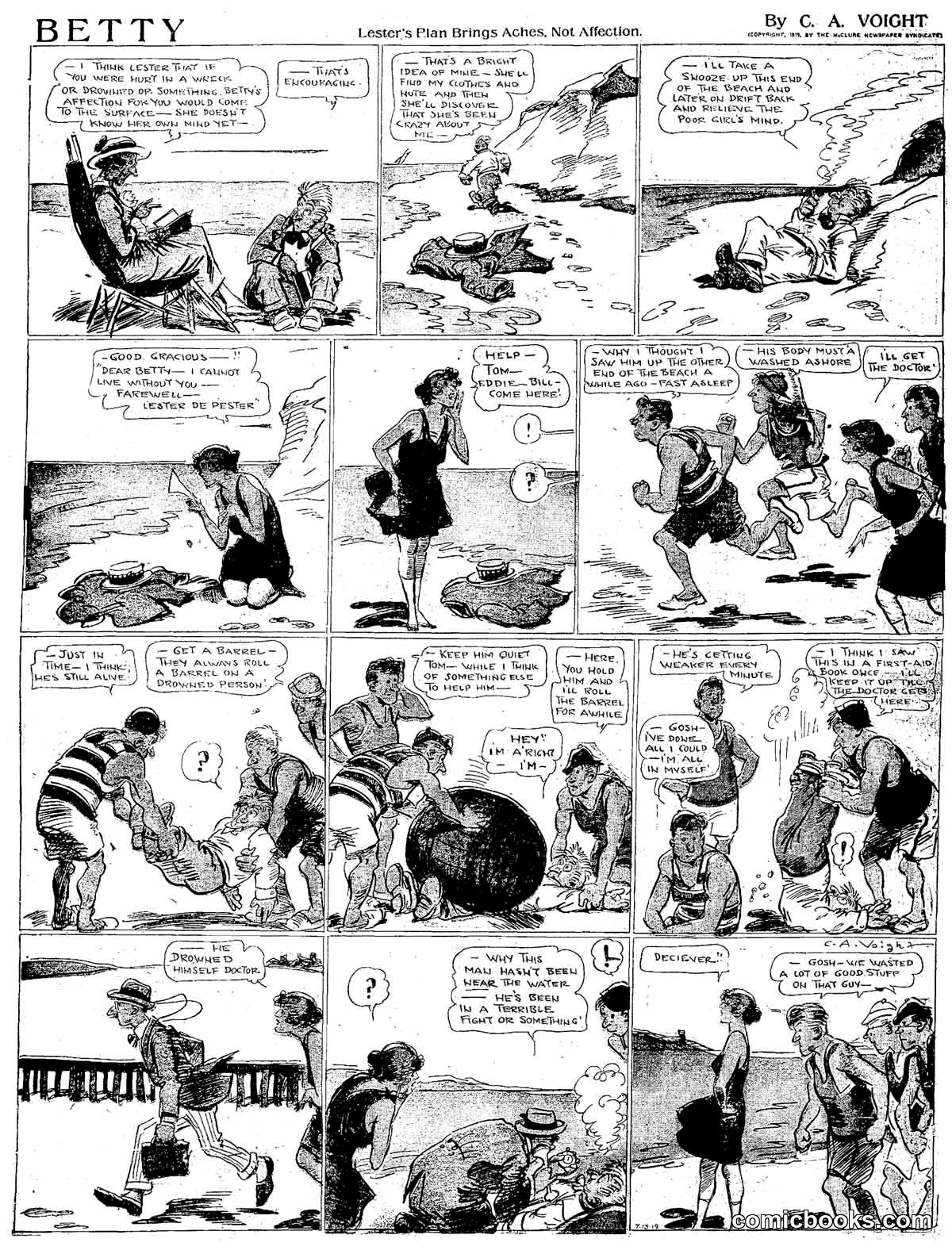
C. A. Voight's Betty follows a young woman through escalating beach mishaps: a conversation about a planned outing turns to disaster when Betty encounters a boy named Eddie in the water, leading to frantic rescue attempts and comic confusion among beachgoers. The strip employs the visual grammar that had crystallized by 1919—panel sequences advancing narrative time, speech balloons conveying dialogue and thought, and recurring characters in domestic or social settings. The composition moves from intimate two-character scenes to crowded group reactions, building comedic momentum through visual clarity and expressive figure work. Sunday newspaper comics like Betty established the formal vocabulary that would define the medium: sequential panels, character consistency, and humor derived from situation rather than caption alone.
About this artifact
- Date
- July 12, 1919
- Rights
- Public domain — free to view, share, and reuse.
- Restoration
- Digitally restored and hosted by ComicBooks.com.
Part of our mission to preserve and restore the public-domain heritage of the medium.