
The Union's Comic Weekly
Vanity Fair: New York's Civil-War Comic Weekly
Not the London portrait weekly of Spy and Ape — the American Vanity Fair, a New York humor paper that put a caricature on its cover every week through the secession crisis and the Civil War. For a time its editor was Charles Farrar Browne, 'Artemus Ward,' the deadpan humorist Lincoln liked to read aloud.
A Union Punch
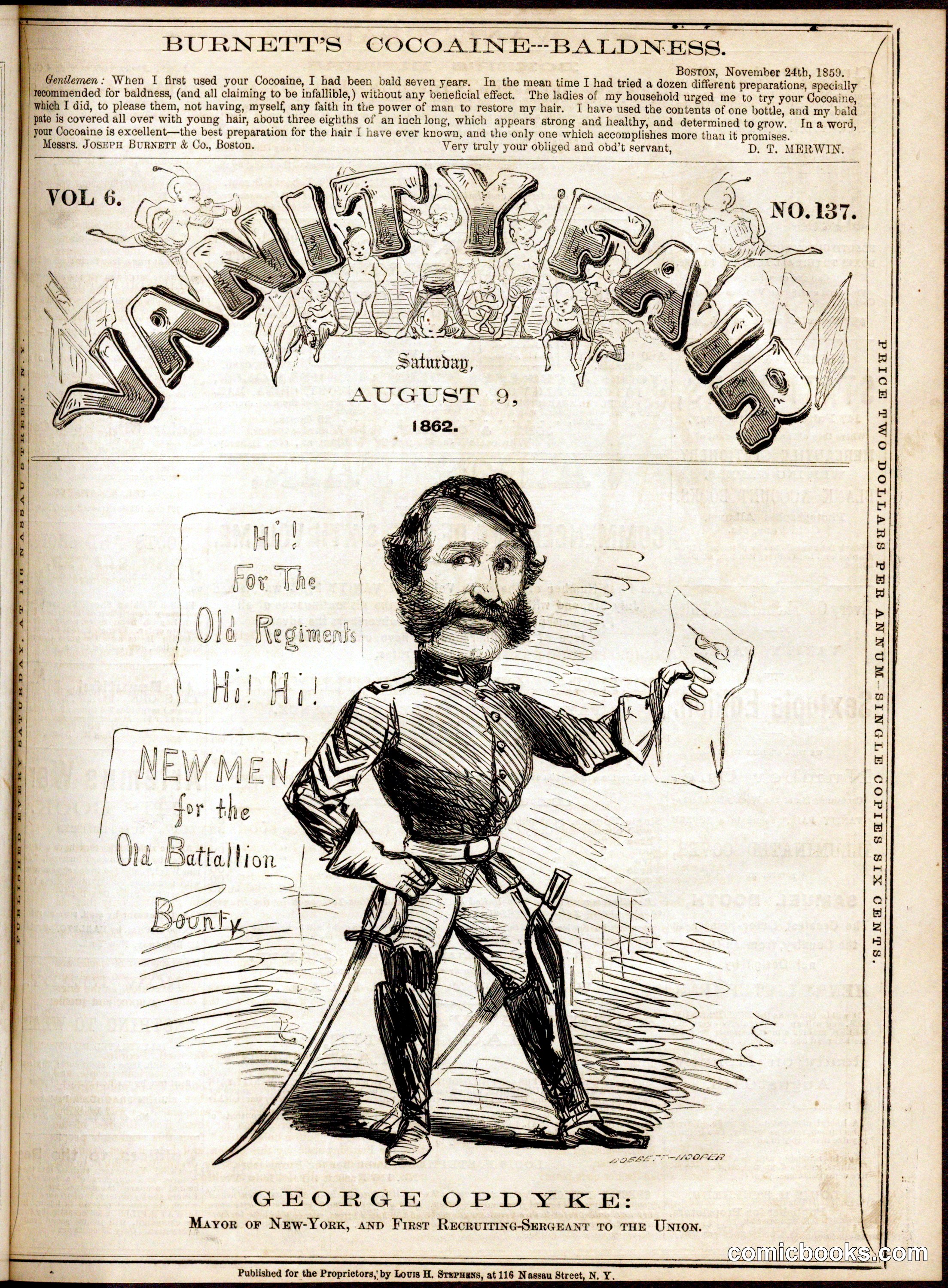
The comic weekly reached New York late. Britain had Punch from 1841; America tried and folded a dozen imitators before Vanity Fair, launched at the end of 1859, managed to stick. It arrived at the worst and best possible moment. Within a year and a half the country was at war, and a humor paper suddenly had a nation's worth of material: the fumbling of Union generals, the vanity of editors and politicians, the profiteers and recruiting sergeants, the whole cast of the home front. Vanity Fair put a caricature on its cover every week and filled the inside with comic verse, mock-official documents, and burlesque.
Its most famous name was its editor. Charles Farrar Browne wrote as Artemus Ward, a semi-literate showman whose misspelled monologues made him the most popular comic writer in America and, later, a touring platform star in England. Lincoln kept a volume of Ward on his desk and read a chapter aloud to the cabinet before presenting the Emancipation Proclamation. The paper he edited is an ancestor the American comic rarely gets credit for.
A timeline
- 1859Vanity Fair launches in New York, an American answer to London's Punch.
- 1861The Civil War begins; the humor weekly turns to the politics and personalities of the Union side.
- 1862Charles Farrar Browne — 'Artemus Ward' — serves as editor; the run preserved here dates to this year.
- 1862Lincoln reads a chapter of Artemus Ward aloud to his cabinet before presenting the Emancipation Proclamation.
- 1863Rising costs and a war-weary public close Vanity Fair after less than four years.
- 1867Browne dies in England at thirty-three, at the height of his fame as a platform humorist.
Vanity Fair lasted a little under four years and never made money. It was outrun by its own subject: the war it lampooned grew grim faster than a weekly could keep laughing, paper and printing costs climbed, and by the summer of 1863 the joke had gone out of the room. The paper closed. Its editor, Charles Farrar Browne — Artemus Ward — went on tour and died young, in 1867, at thirty-three.
What the weekly left behind is a peculiar and valuable thing: week-by-week caricature of the Union at war, drawn not by historians but by humorists working with the news still wet. The targets — Forney and Raymond and Opdyke, Welles as an ancient mariner, Vallandigham out in the cold — were the celebrities of 1862, and the cartoons assume you know them. Some of the humor has dated and some of it has soured, and both are here on the page as printed. The line that runs from these wood-engraved covers to the Sunday funnies and the comic book is short and direct: a picture, a caption, a target, and a public that would pay a few cents to laugh.