A complete issue · 50 pages · 1935
Life — September 1935
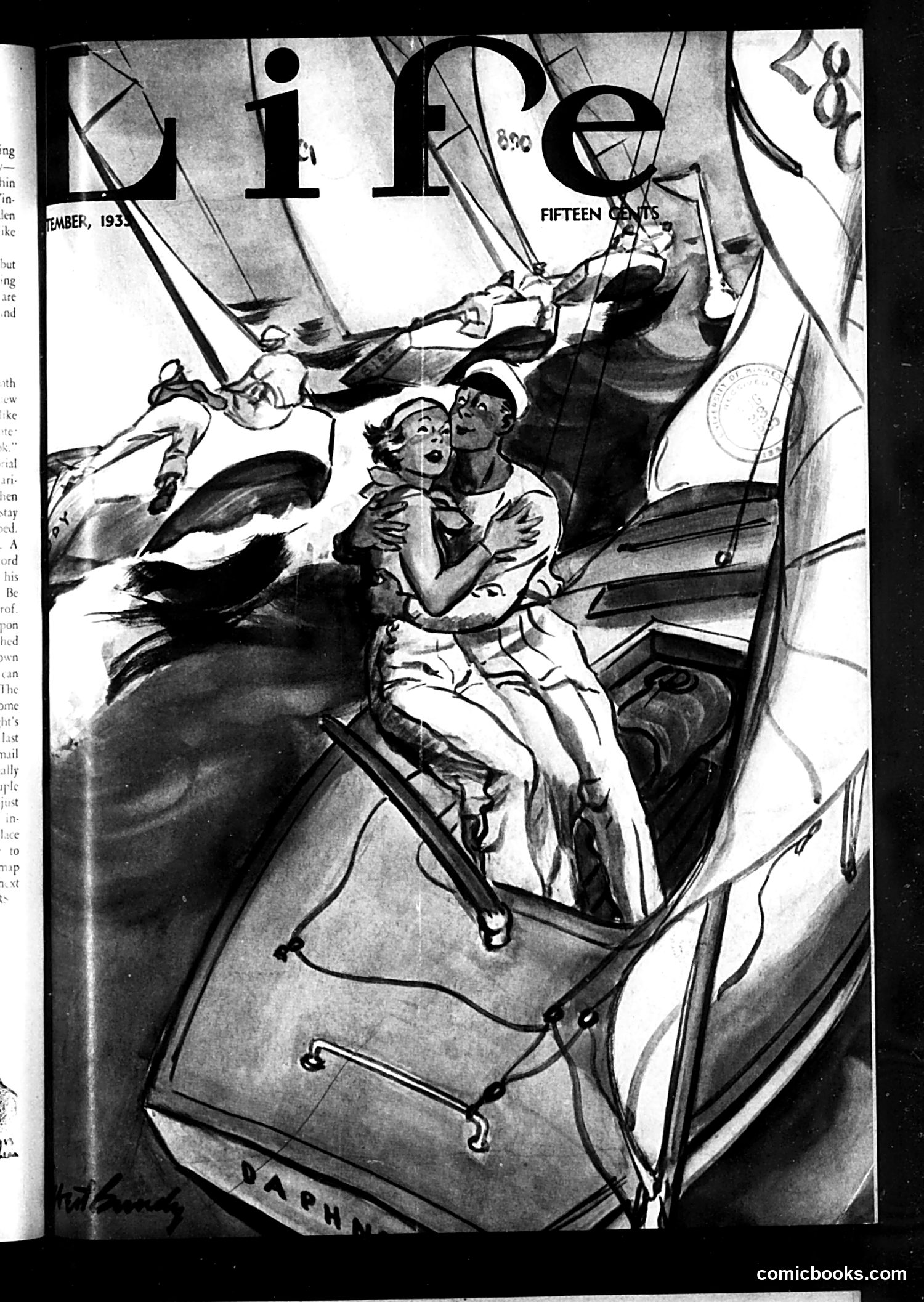
# Life Magazine Illustration Analysis This appears to be a cover or advertisement illustration from Life magazine (dated December 1935, visible in the margin). The image shows a dramatic scene of what looks like a flying car or aircraft with passengers in distress—people are shown reacting with alarm and excitement inside the vessel. The illustration likely satirizes either: 1. Futuristic transportation technology and early aviation excitement 2. A contemporary scandal or accident involving wealthy or prominent figures The "Fifteen Cents" price and art style confirm this is from the 1930s era. The dramatic composition and exaggerated expressions suggest Life's typical approach: using humor and caricature to comment on modern anxieties, technological innovation, or social follies. Without clearer text, the specific subjects remain unclear, though the scene suggests some form of chaotic or dangerous situation presented for satirical effect.
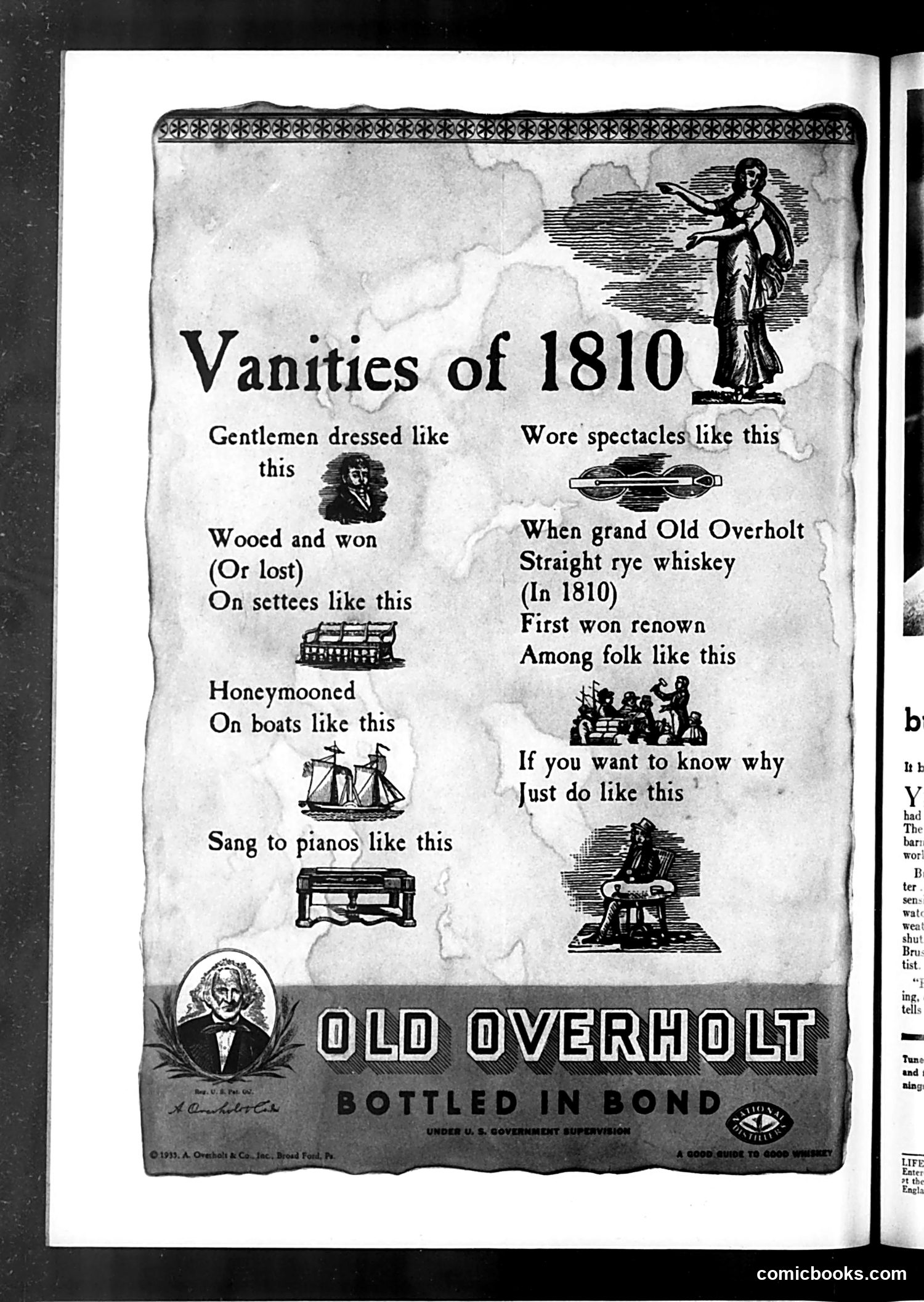
# "Vanities of 1810" - Old Overholt Whiskey Advertisement This is a whiskey advertisement disguised as social satire. It humorously catalogs fashions and customs from 1810—gentlemen's clothing styles, spectacles, sailing vessels, pianos, and social gatherings—with the punch line that Old Overholt Straight Rye Whiskey "first won renown / Among folk like this" in that era. The joke appeals to nostalgia: drinking this whiskey connects the 1810s consumer to that romanticized historical period. The final line—"If you want to know why / Just do like this"—with an image of someone drinking, suggests the whiskey's popularity explains itself. It's essentially using period-costume humor to market liquor as a product with authentic historical pedigree, bottled during Prohibition enforcement (noted at bottom).
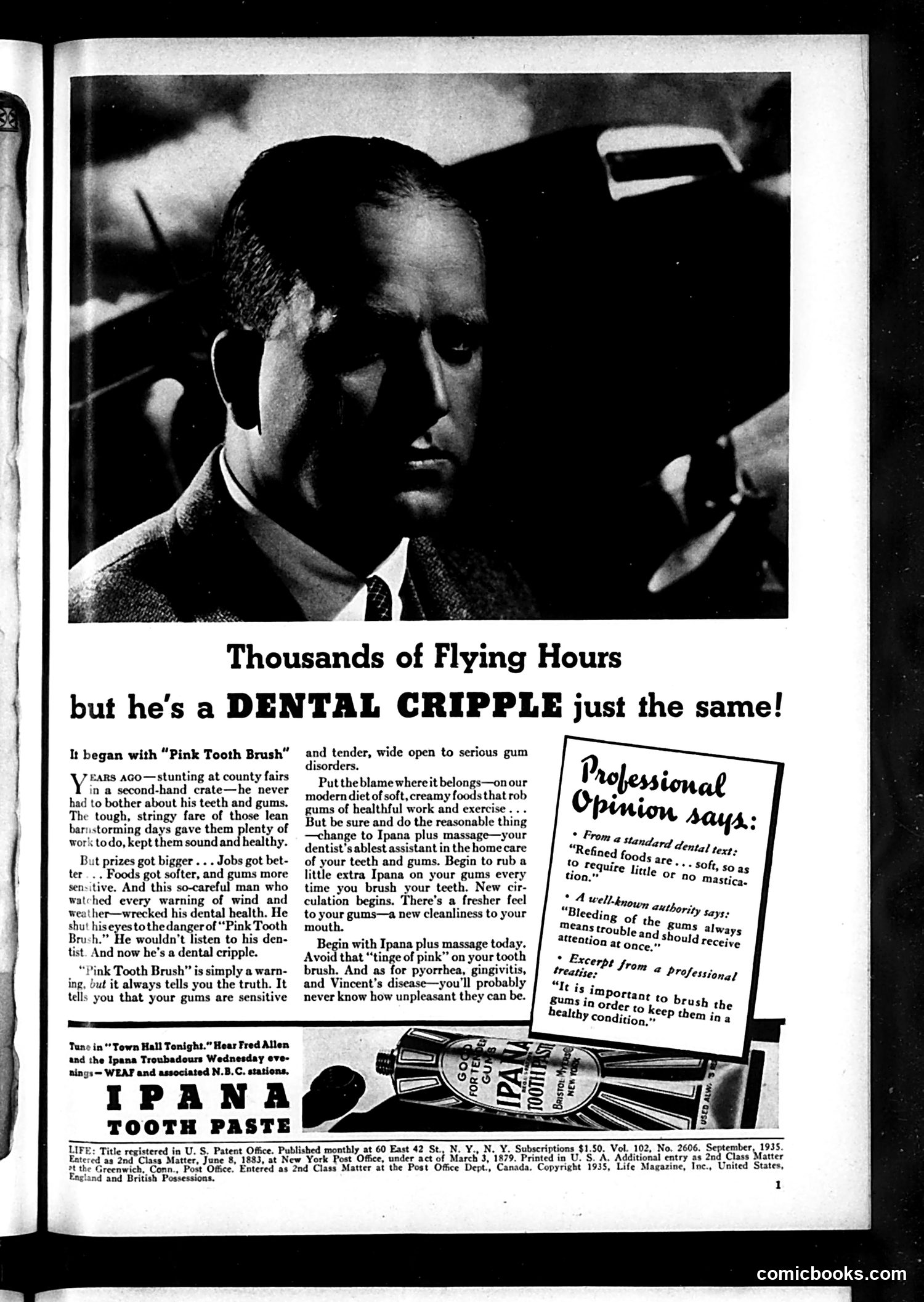
# Analysis This is a **toothpaste advertisement**, not political satire. The ad features a photograph of a man in professional attire (appears to be a pilot or aviator based on context) with the headline "Thousands of Flying Hours but he's a DENTAL CRIPPLE just the same!" The humor exploits a contrast: despite professional accomplishment and experience, the man suffers from poor dental health. The ad suggests that even successful, experienced people neglect oral hygiene—specifically gum disease ("pink tooth brush," gingivitis, pyorrhea). The product, **Ipana Tooth Paste**, is pitched as the solution. A sidebar offers "Professional Opinion" from dentists endorsing proper brushing and gum care. This reflects mid-20th-century advertising strategy: using relatable anxiety (poor teeth despite success) to sell health products. The "dental cripple" term, now considered offensive, was common medical vocabulary of that era.
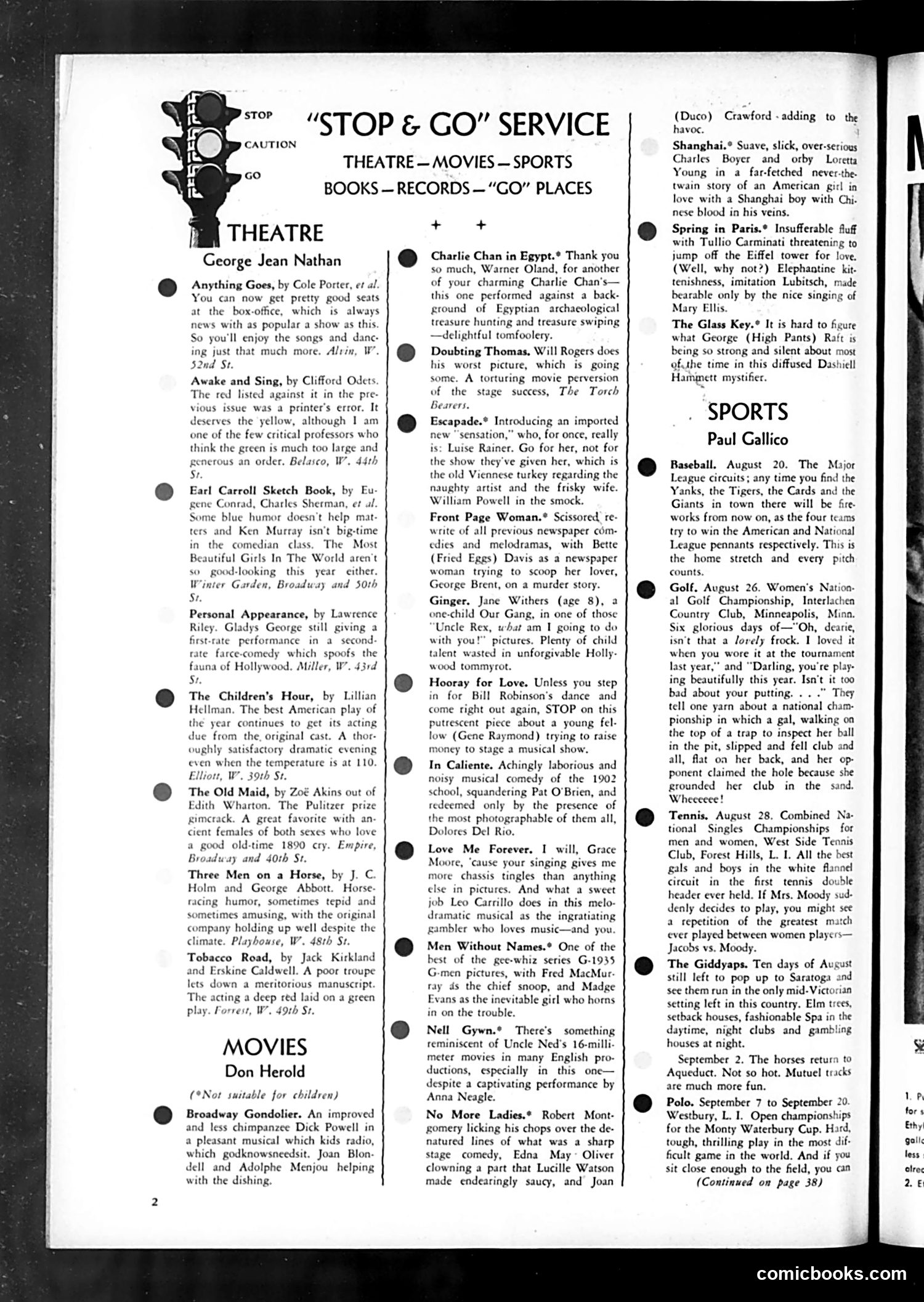
# Analysis This page is primarily **not a cartoon page**, but rather a **"Stop & Go" service guide** — a listing of entertainment recommendations organized by traffic-light categories (Stop, Caution, Go). The single visual element is a **traffic light illustration** at the top left, used as a visual metaphor for the rating system. The light itself contains no caricature or political content. The content consists of three sections — **Theatre, Movies, and Sports** — each with brief reviews and recommendations from critics (George Jean Nathan, Don Herold, and Paul Callico respectively). These are straightforward entertainment recommendations using the traffic-light rating system to indicate quality. There is **no political satire or social commentary** on this page. It's a utilitarian service feature typical of Life magazine's format.
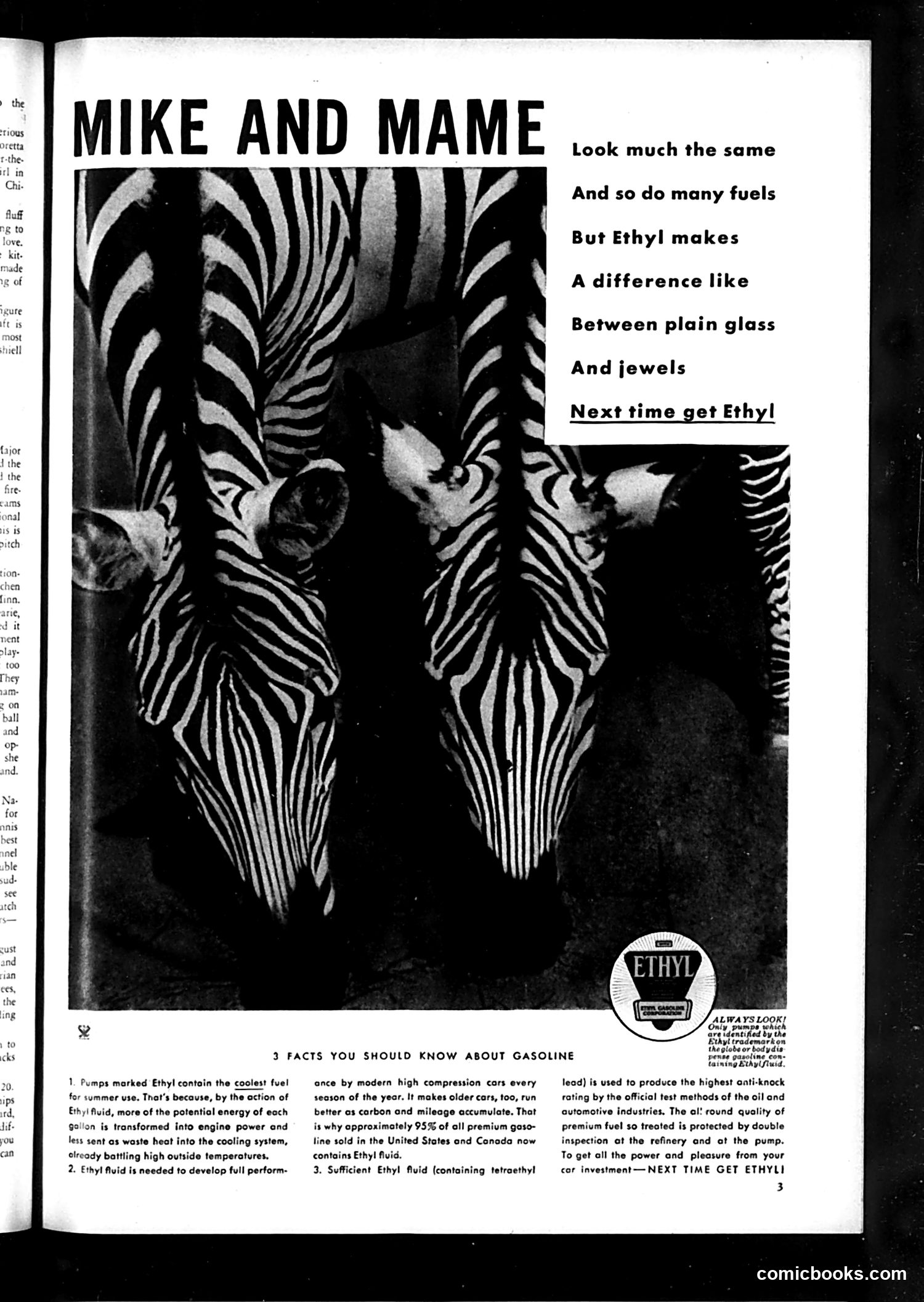
# Analysis This is an **advertisement for Ethyl gasoline**, not political satire. The page uses the phrase "Mike and Mame" (likely referencing common names for generic "everyman" characters) to present two zebras side-by-side as a visual metaphor. The ad's message: regular gasoline and Ethyl gasoline look similar, but Ethyl contains an additive (tetraethyl lead) that makes a crucial difference—likened to the contrast between "plain glass and jewels." The three facts listed below explain Ethyl's technical advantages: superior fuel quality, better performance in high-compression engines, and protection against engine knock. This appears to be vintage advertising from the era when leaded gasoline was standard and marketed as a premium product, before lead's health hazards were widely known.
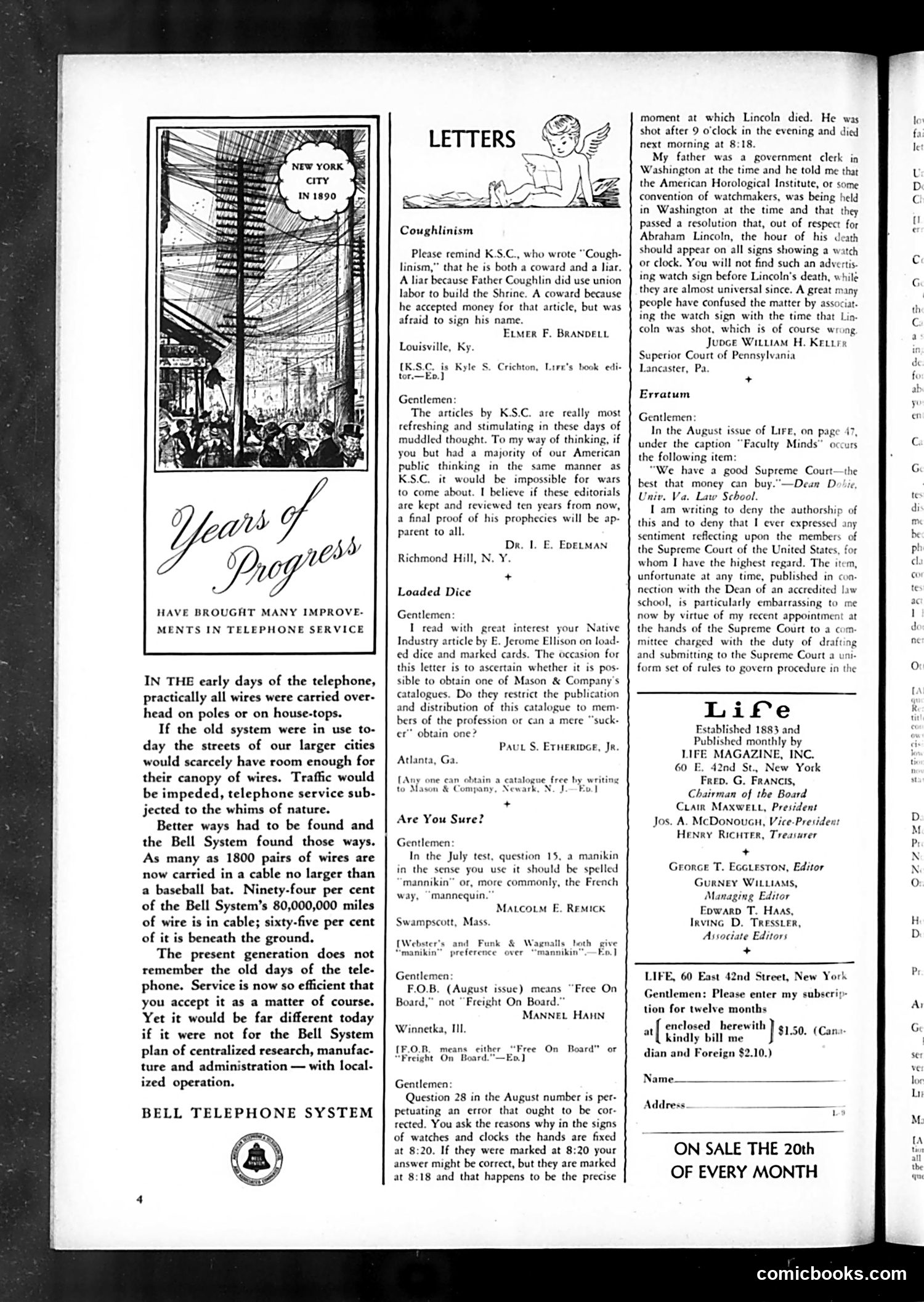
# Analysis of Life Magazine Page This page is primarily **letters to the editor and advertising** rather than editorial cartoons. The left side features a Bell System telephone advertisement with a historical illustration of New York City in 1890, emphasizing how telephone infrastructure has expanded from those early days. The letters section addresses reader inquiries about various topics: a debate over whether Father Coughlin was a "coward and liar"; confusion about Lincoln's death time; a question about Mason & Company's dice catalog; debate over "manikin" vs. "mannikin" spelling; and confusion about F.O.B. shipping terminology. The page reflects early 20th-century concerns about language precision, commercial practices, and historical accuracy among educated readers.
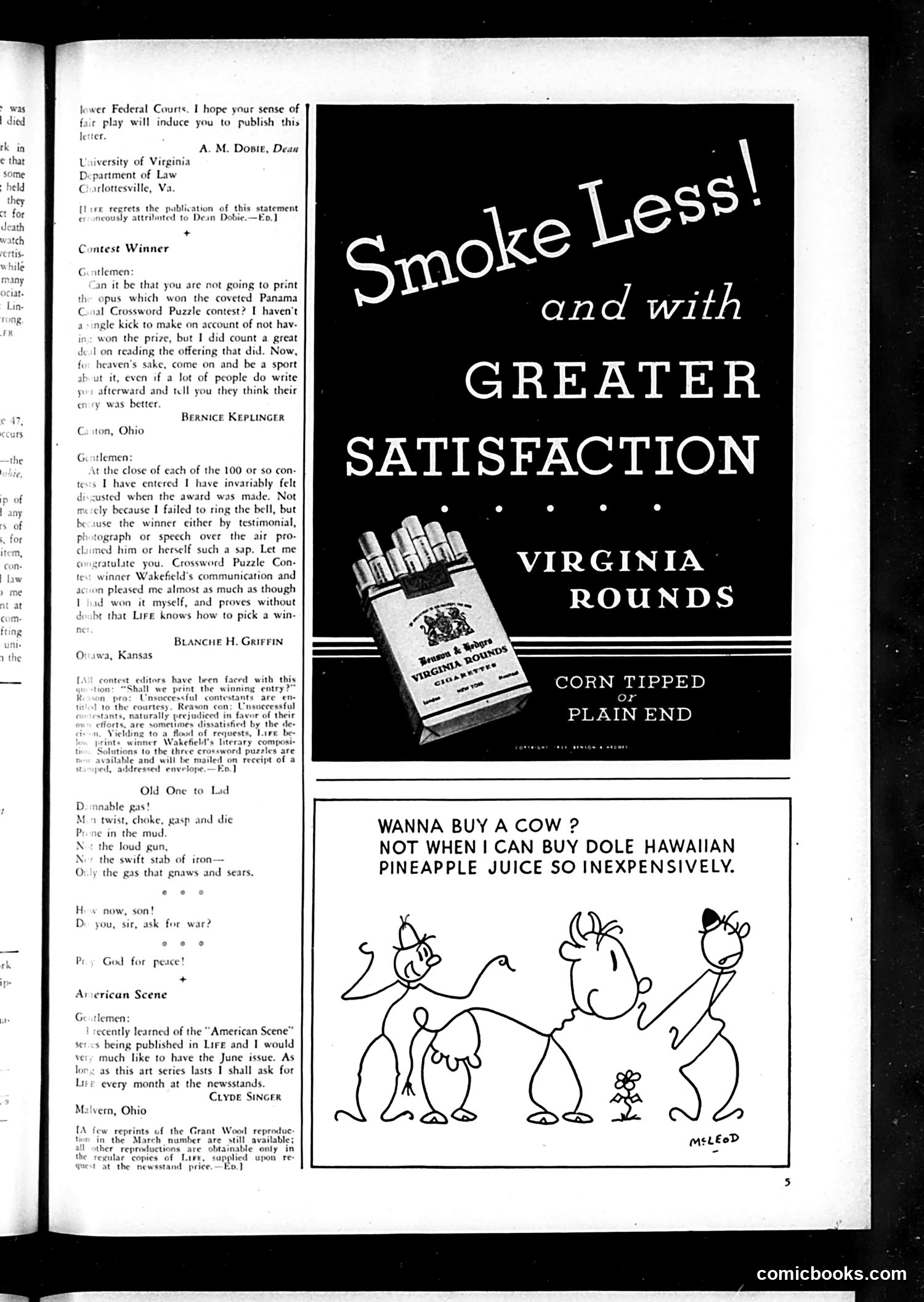
# Analysis This page contains primarily **advertising and reader correspondence**, not political satire. The main visual content is a **Virginia Rounds cigarette advertisement** featuring the slogan "Smoke Less! and with GREATER SATISFACTION" — marketing a filtered cigarette by emphasizing reduced smoking volume rather than health concerns (notable given mid-century tobacco advertising practices). Below is a **humorous cartoon** by McLeod depicting simple stick figures discussing dairy farming. The joke: someone asks "Wanna buy a cow?" and another replies "Not when I can buy Dole Hawaiian pineapple juice so inexpensively" — a non-sequitur absurdist humor contrasting livestock ownership with affordable tropical juice, likely commenting on consumer priorities or post-war abundance. The left column contains reader letters responding to previous Life magazine contests and content, representing typical magazine correspondence of the era.
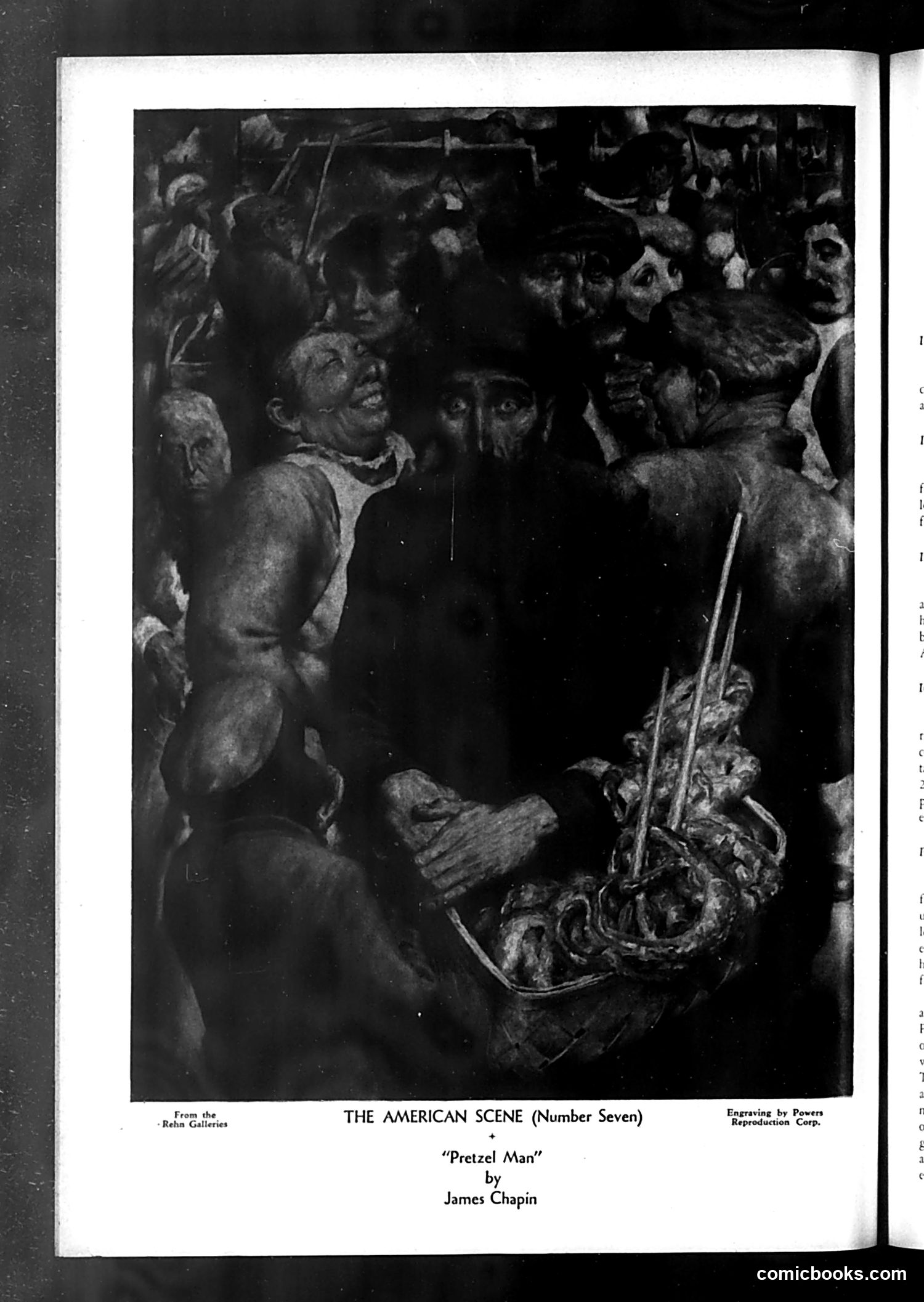
# Analysis: "Pretzel Man" by James Chapin This page reproduces an artwork titled "Pretzel Man" by painter James Chapin, credited to the Rehn Galleries. The black-and-white image depicts a crowded street scene with multiple figures gathered around a central vendor or street performer. The composition suggests working-class or immigrant urban life, with figures shown in close, somewhat chaotic proximity. Without additional context about the specific date or publication, the social commentary appears to address American street commerce and working-class scenes. The "pretzel man" likely references ethnic street vendors common in early-20th-century American cities. Chapin's inclusion in *Life* magazine suggests the artwork was presented as socially significant commentary on American urban culture and class dynamics of the period.
# "Some of the People" - Life Magazine Page Analysis This page contains brief satirical items about American figures and institutions. The "Lamentation on Board the Vestalia" is a poem attributed to Arthur L. Lippmann, likely a wealthy person complaining about the costs of maintaining luxury and status—references to "Soak the Rich" rhetoric, keeping yachts fueled, paying former wives' alimony, and maintaining estates. The complaint appears to mock the ultra-wealthy's self-pitying attitude during economically difficult times, particularly the popular "soak the rich" sentiment of the Depression era. The other items mock government inefficiency (multiple pens used by presidents for bills) and bureaucratic absurdity. The overall tone is satirical critique of both wealthy elites and governmental excess, typical of Life magazine's social commentary.
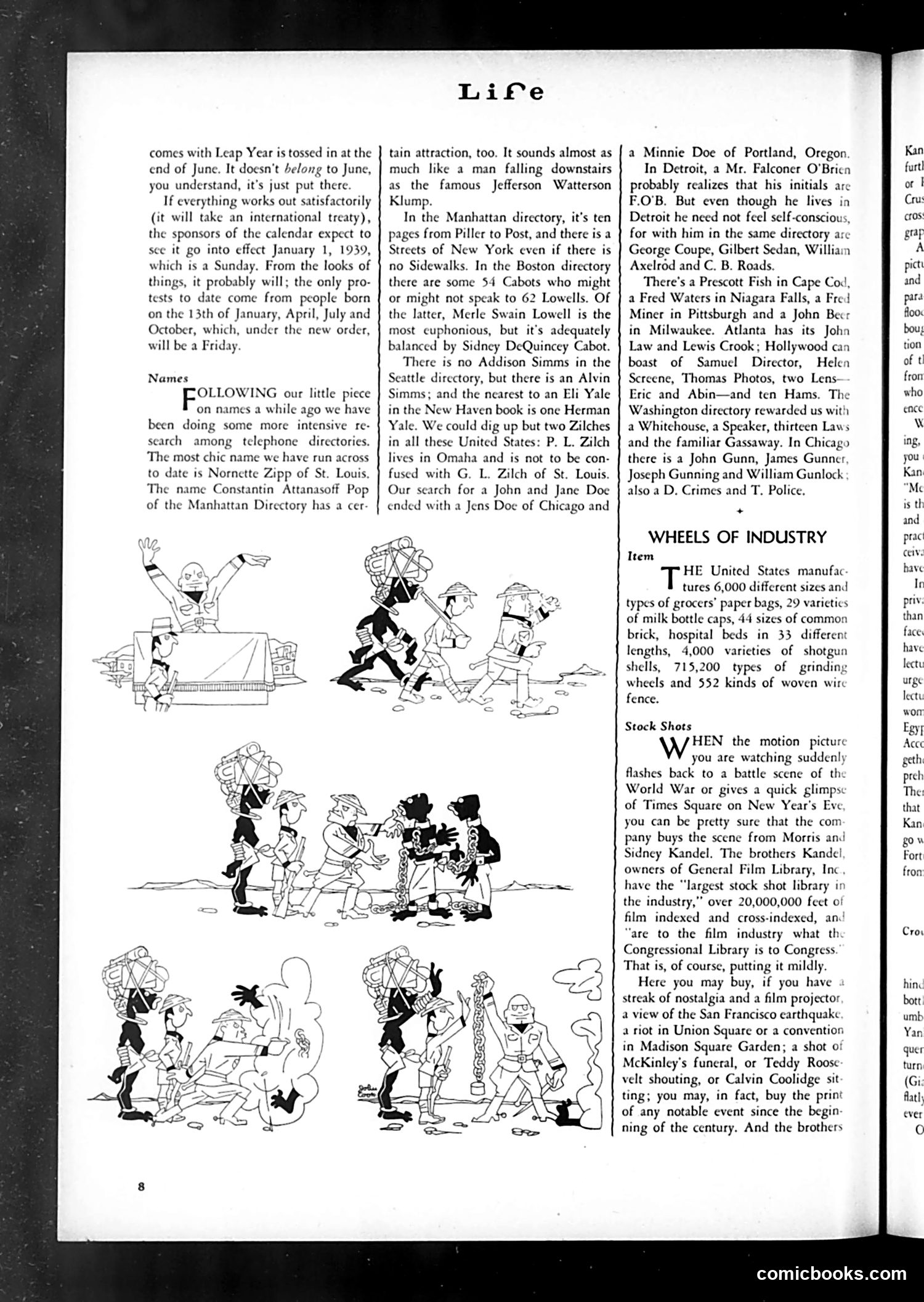
# Analysis of Life Magazine Page This page contains two distinct sections: **"Names" Section (left):** A humorous piece about searching telephone directories for unusual names. It celebrates finding "Nornette Zipp of St. Louis" as the most chic name discovered, then catalogs amusing variations like multiple "John and Jane Does" across American cities. The accompanying cartoons show playful character sketches. **"Wheels of Industry" Section (right):** A straightforward informational piece listing American manufacturing statistics—6,000 paper bag sizes, 29 milk bottle cap varieties, etc.—meant to illustrate industrial diversity and productivity. **"Stock Shots" Section:** Describes Morris and Sindey Kandel's General Film Library, a stock footage company holding 20 million feet of indexed film available for purchase by filmmakers needing pre-existing scenes. The page mixes humor with practical industry information typical of Life magazine's editorial approach.
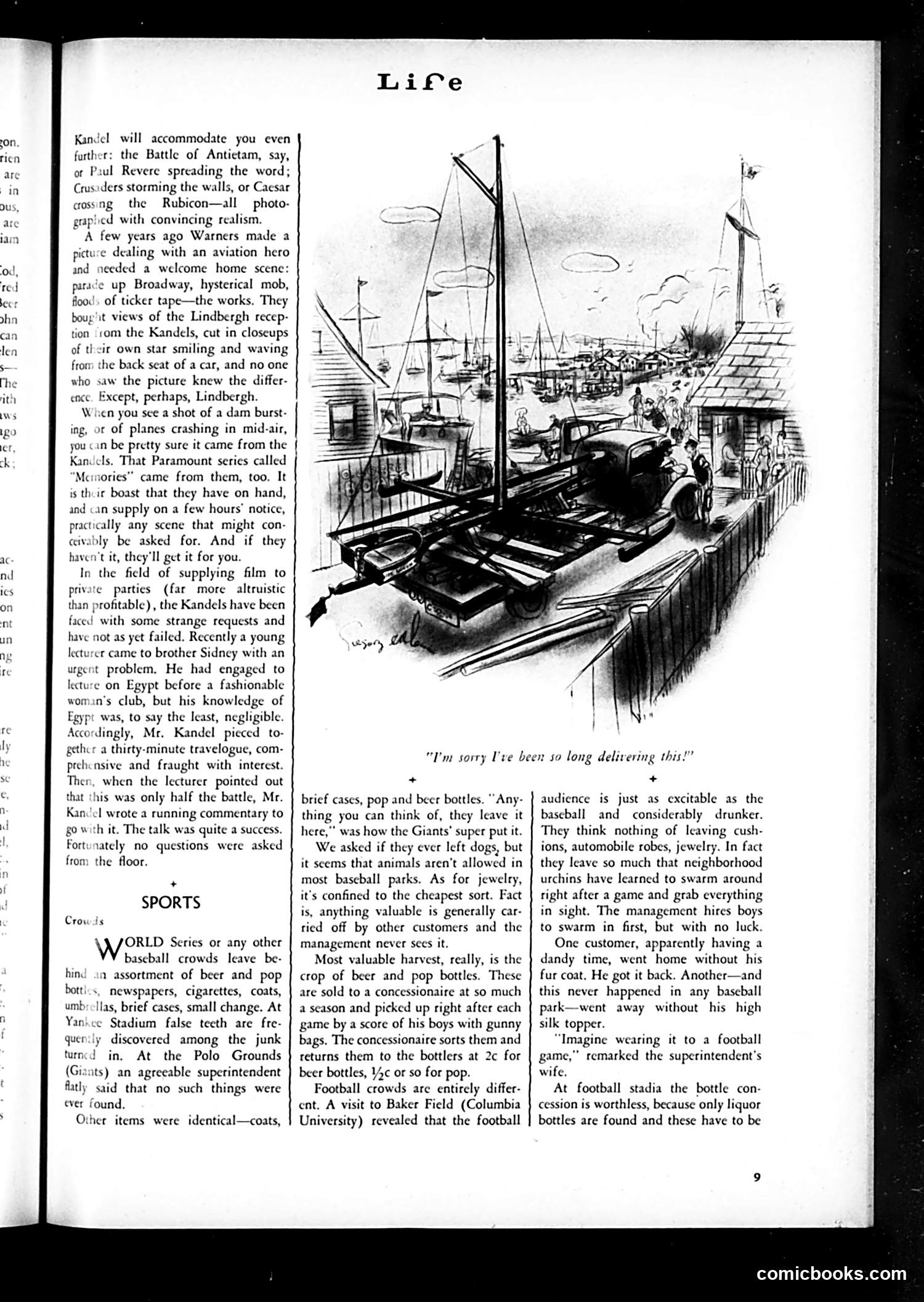
# Analysis of Life Magazine Page 9 This page contains a sketch of a harbor scene with moored sailing vessels and the caption "I'm sorry I've been so long delivering this!" The accompanying text discusses how the film industry (particularly Kandel, apparently a studio executive) accommodates requests for movie scenes—Battle of Antietam, aviation footage, etc. The satire critiques Hollywood's willingness to provide any cinematic content on demand, treating film production like a delivery service. The harbor sketch humorously illustrates this concept: a slow sailing vessel apologizing for late delivery, metaphorically representing how studios scramble to fulfill client requests, sometimes delivering scenes that seem incongruously sourced or hastily assembled. The "SPORTS" section below discusses World Series crowds and baseball park concessions, showing typical period magazine content mixing entertainment industry satire with leisure activities.
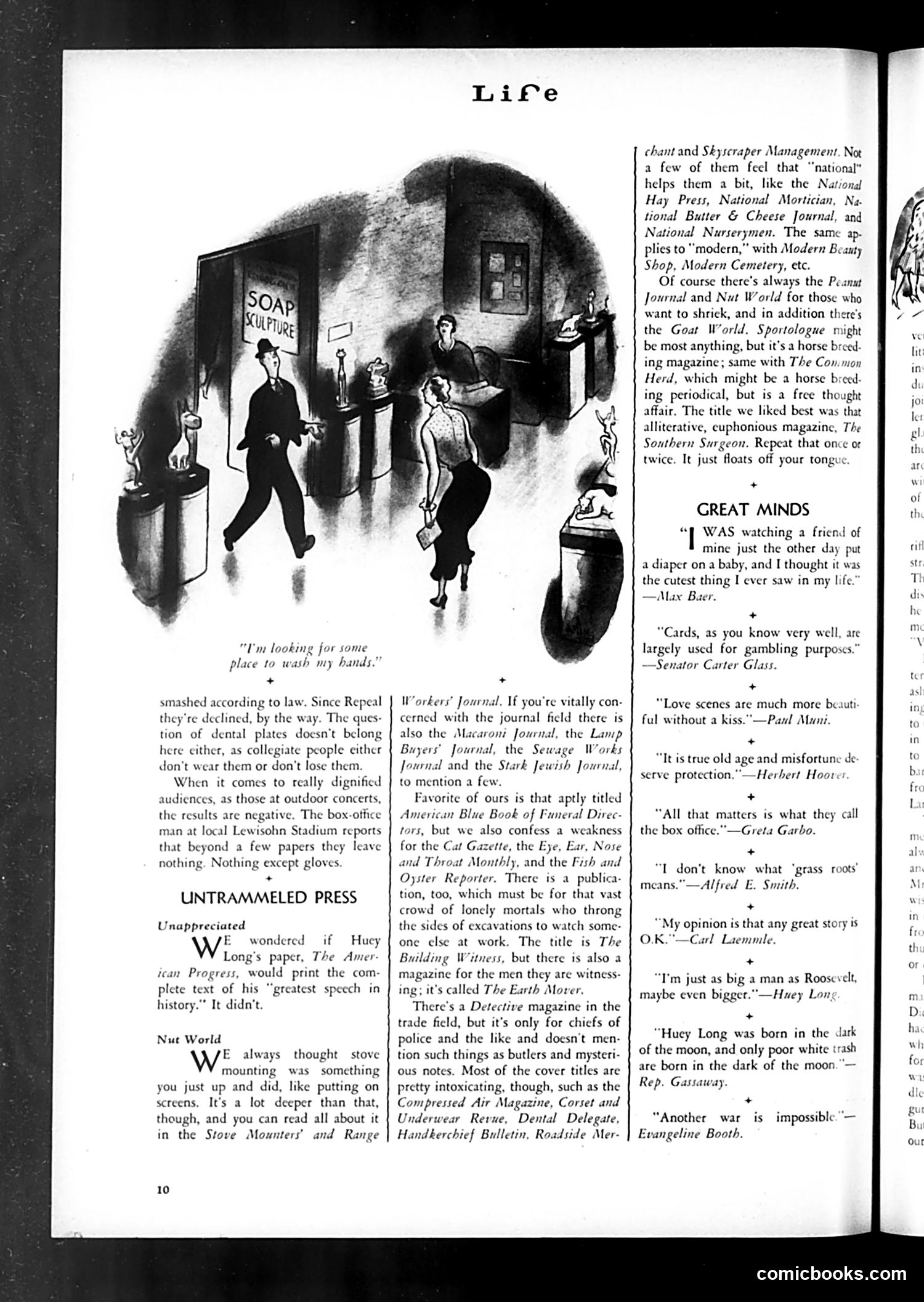
# Analysis of Life Magazine Page This page contains editorial commentary on American periodicals and magazines rather than a political cartoon. The main illustration shows people in what appears to be a subway or public space, with a "SOAP" advertisement visible—likely satirizing commercial culture. The text discusses the proliferation of specialized magazines, mocking titles like *Peanut Journal*, *Nut World*, *Detective* magazines, and trade publications. The satire targets how American publishing has fragmented into increasingly narrow niches—from funeral direction to dental care to livestock breeding. The "Great Minds" section quotes celebrities' observations, appearing to contrast elevated commentary with the mundane magazine landscape being criticized. Overall, the page satirizes both magazine proliferation and American consumer culture's obsession with specialized, often trivial publications.