A complete issue · 36 pages · 1930
Life — November 28, 1930
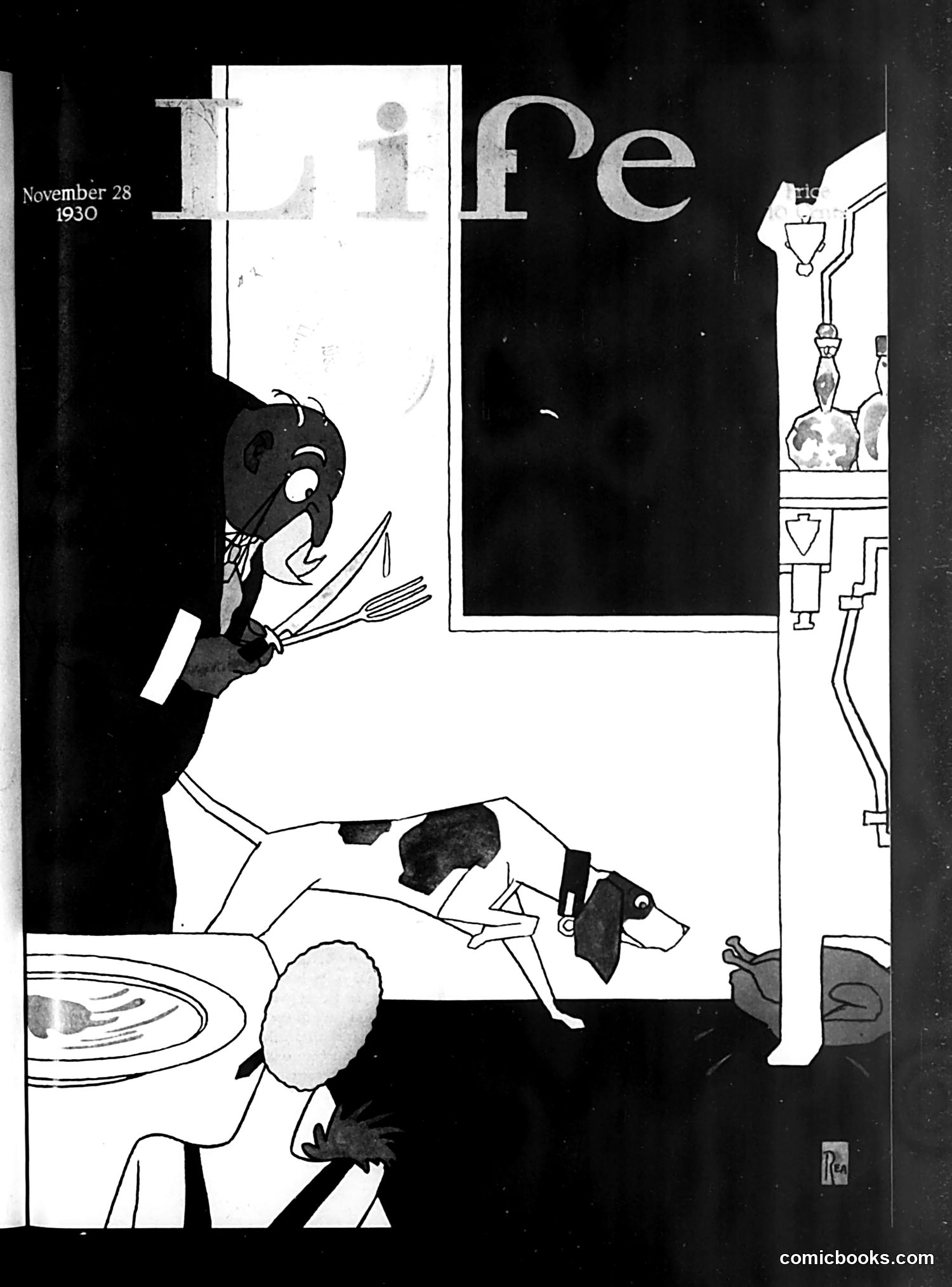
# Life Magazine, November 28, 1930 This is a satirical cartoon depicting a domestic kitchen scene. A caricatured figure with exaggerated features peers around a doorway holding what appears to be cooking utensils (fork and knife), while another figure lies on the kitchen floor. The style and racial caricature suggest this reflects 1930s-era stereotypes. The exact satirical meaning is unclear without additional context, but the scene appears to satirize domestic chaos or cooking mishaps. The laboratory equipment visible on the right suggests possible commentary on kitchen science or experimentation. The partial text "pe" (possibly "Life") is visible but incomplete. The illustration's style and caricature techniques are consistent with 1930s American satirical cartooning, though the specific social or political commentary intended remains ambiguous from the image alone.
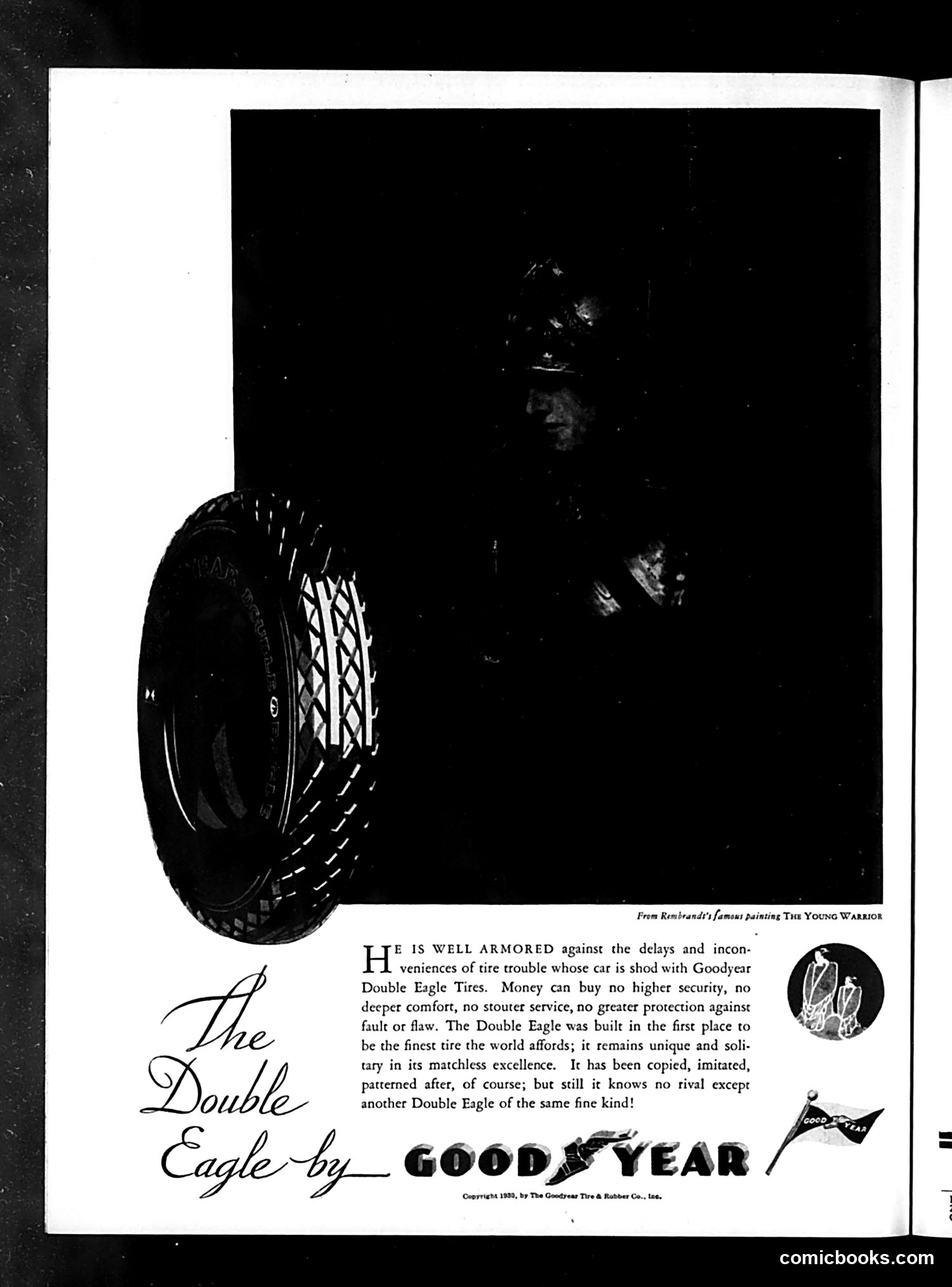
# Analysis This is a **Goodyear tire advertisement**, not political satire. The page features a large product image of a Goodyear Double Eagle tire on the left side. The advertisement's text emphasizes the tire's reliability and superiority, claiming it offers unmatched security against "delays and inconveniences of tire trouble." The copy asserts the Double Eagle is "the finest tire the world affords" and "remains unique and solitary in its matchless excellence," while acknowledging competitors have attempted imitation. A small illustration labeled "From Rembrandt's famous painting THE YOUNG WARRIOR" appears at top, though its connection to tire marketing is unclear—possibly suggesting timelessness or classical quality. This is straightforward commercial advertising with no satirical political content.
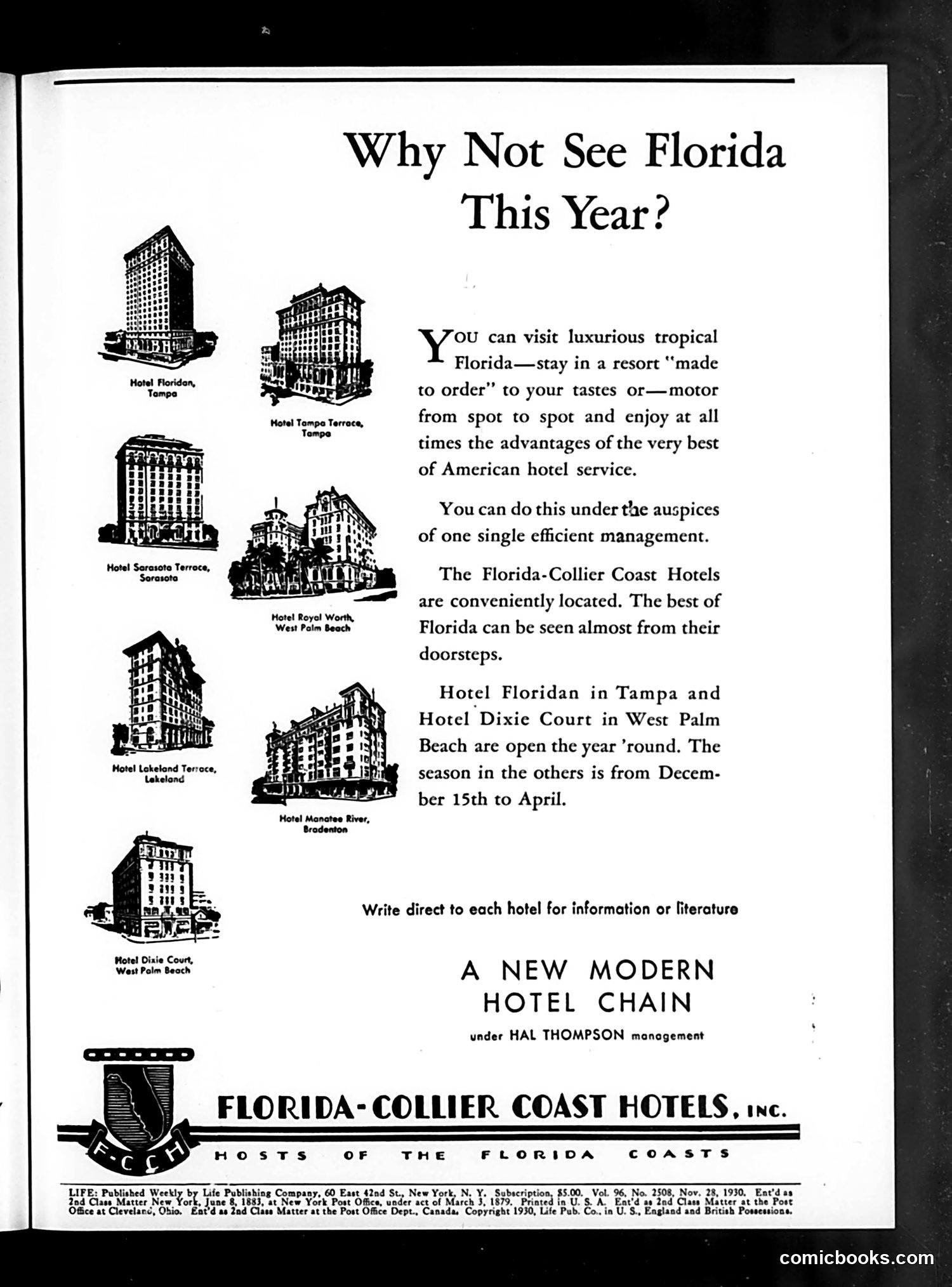
# Analysis This is **not a cartoon or satirical content** — it is a straightforward advertisement for Florida-Collier Coast Hotels, Inc., a hotel chain operating under manager Hal Thompson. The page promotes seven hotels located in Florida: Hotel Floridian (Tampa), Hotel Tampa Terrace, Hotel Sarasota Terrace (Sarasota), Hotel Royal Worth (West Palm Beach), Hotel Lakeland Terrace (Lakeland), Hotel Manatee River (Bradenton), and Hotel Dixie Court (West Palm Beach). The ad emphasizes convenience, luxury amenities, year-round availability (two hotels open year-round; others December 15–April), and centralized management. Small architectural illustrations accompany each hotel listing. The footer identifies this as appearing in *Life* magazine, Vol. 96, No. 2508, November 28, 1930.
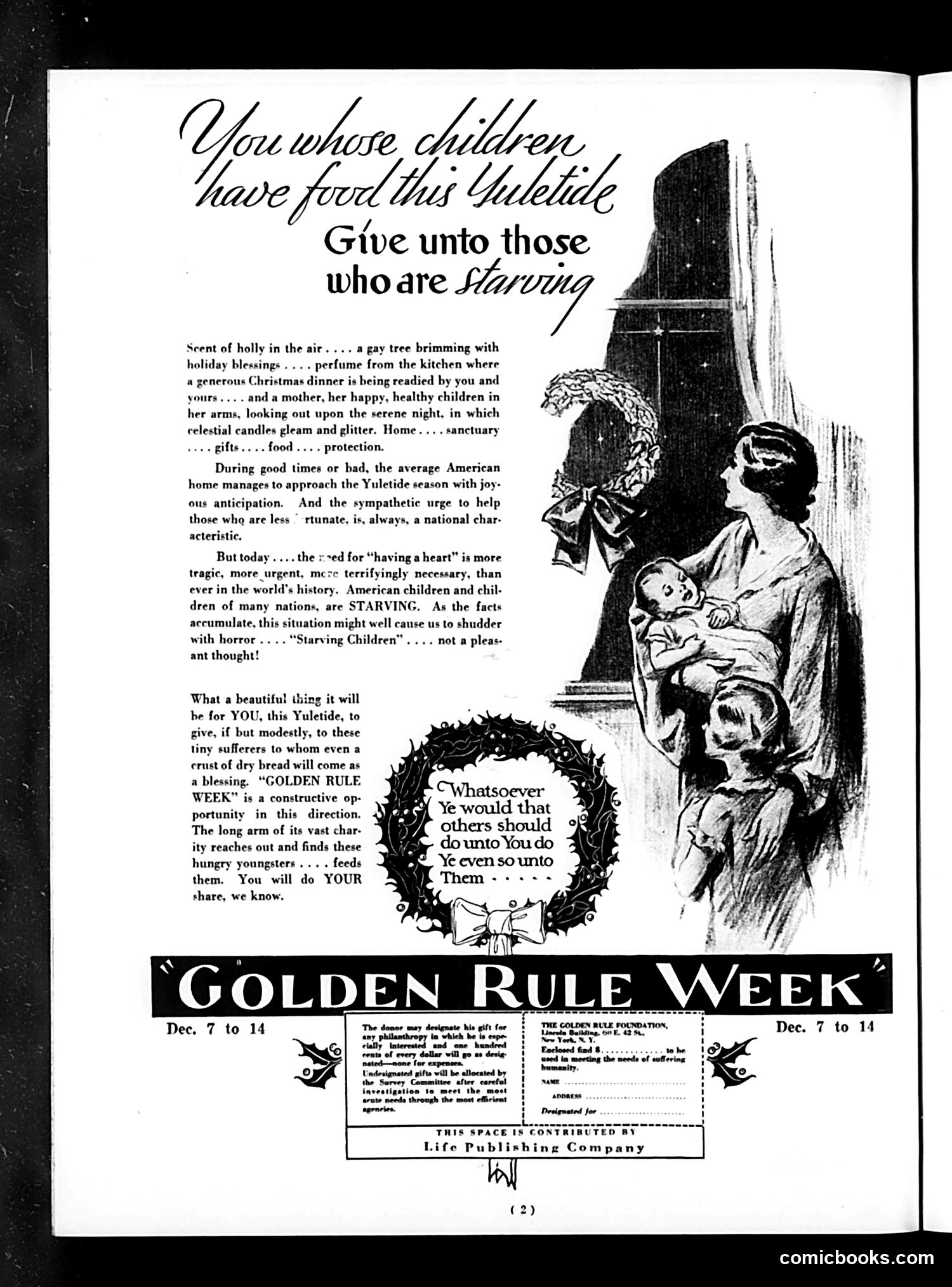
# Golden Rule Week Advertisement This is a **charitable appeal, not political satire**. The page advertises "Golden Rule Week" (December 7-14), a campaign promoting Christian charity during the holiday season. The central message appeals to affluent Americans: those whose children have food should donate to starving children elsewhere. The illustration shows a mother and child at a window with Christmas decorations, contrasting with the implicit image of hungry children outside. The campaign explicitly references international child starvation ("American children and children of many nations, are STARVING"), likely referencing post-WWI humanitarian crises in Europe and Asia. The "Golden Rule" framing ("Whatsoever ye would that others should do unto You...") invokes Christian obligation to wealthy readers, positioning charitable giving as both moral duty and practical response to global suffering.
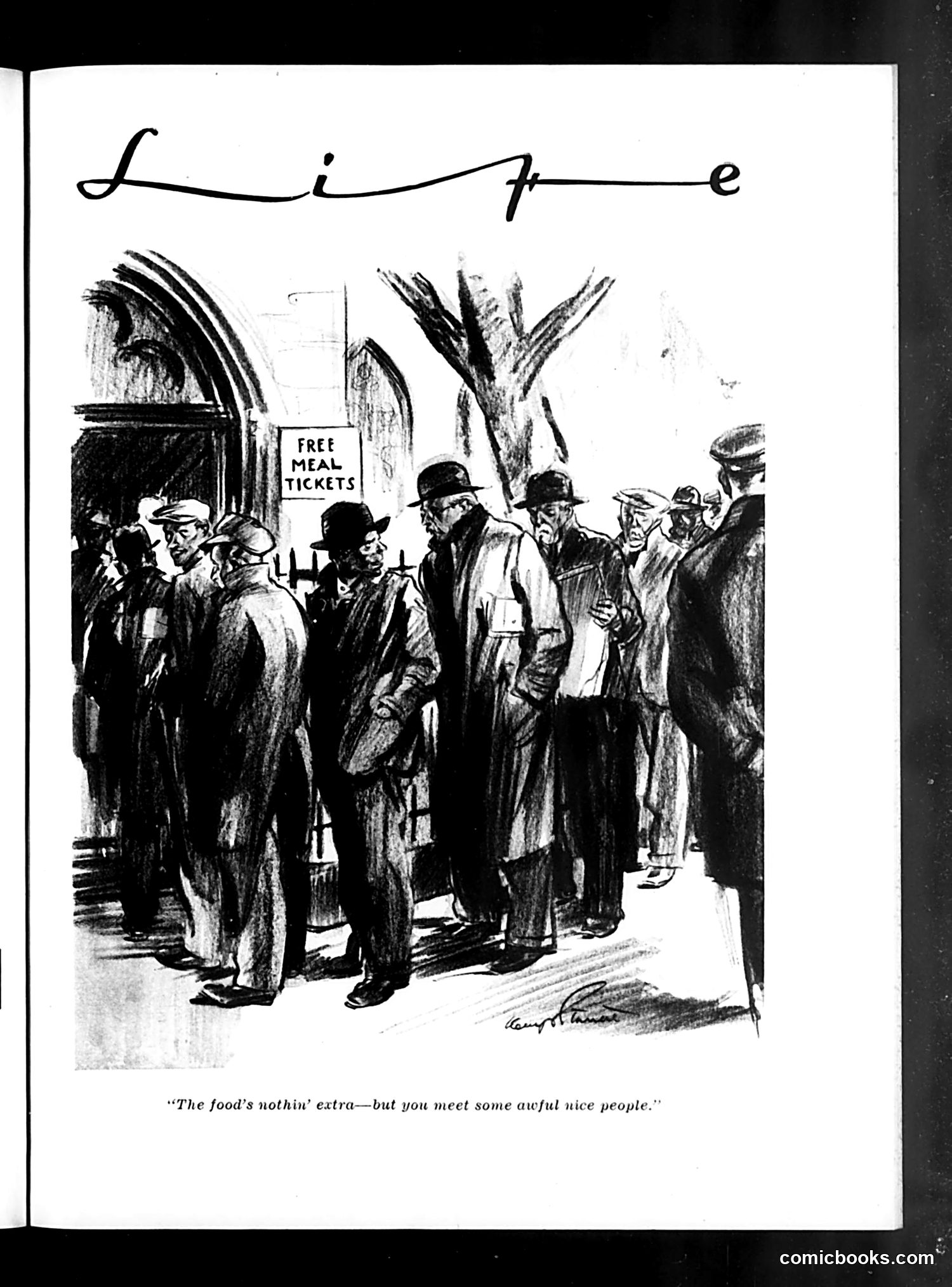
# "Life" Magazine Cartoon Analysis This single-panel cartoon depicts a queue of men outside a venue offering "FREE FAIR TICKETS." The caption reads: "The food's nothin' extra—but you meet some awful nice people." The satire targets Depression-era charitable institutions or public events that distributed free food and entertainment to the unemployed and poor. The joke's cynicism suggests that while the meal itself is unremarkable ("nothin' extra"), the real value lies in the social interaction—meeting fellow destitute citizens. The cartoon likely comments on how such charitable efforts, while well-intentioned, offered minimal material relief. Instead, attendees gained mainly companionship and the temporary dignity of a public gathering. The crowded queue emphasizes widespread need during economic hardship.
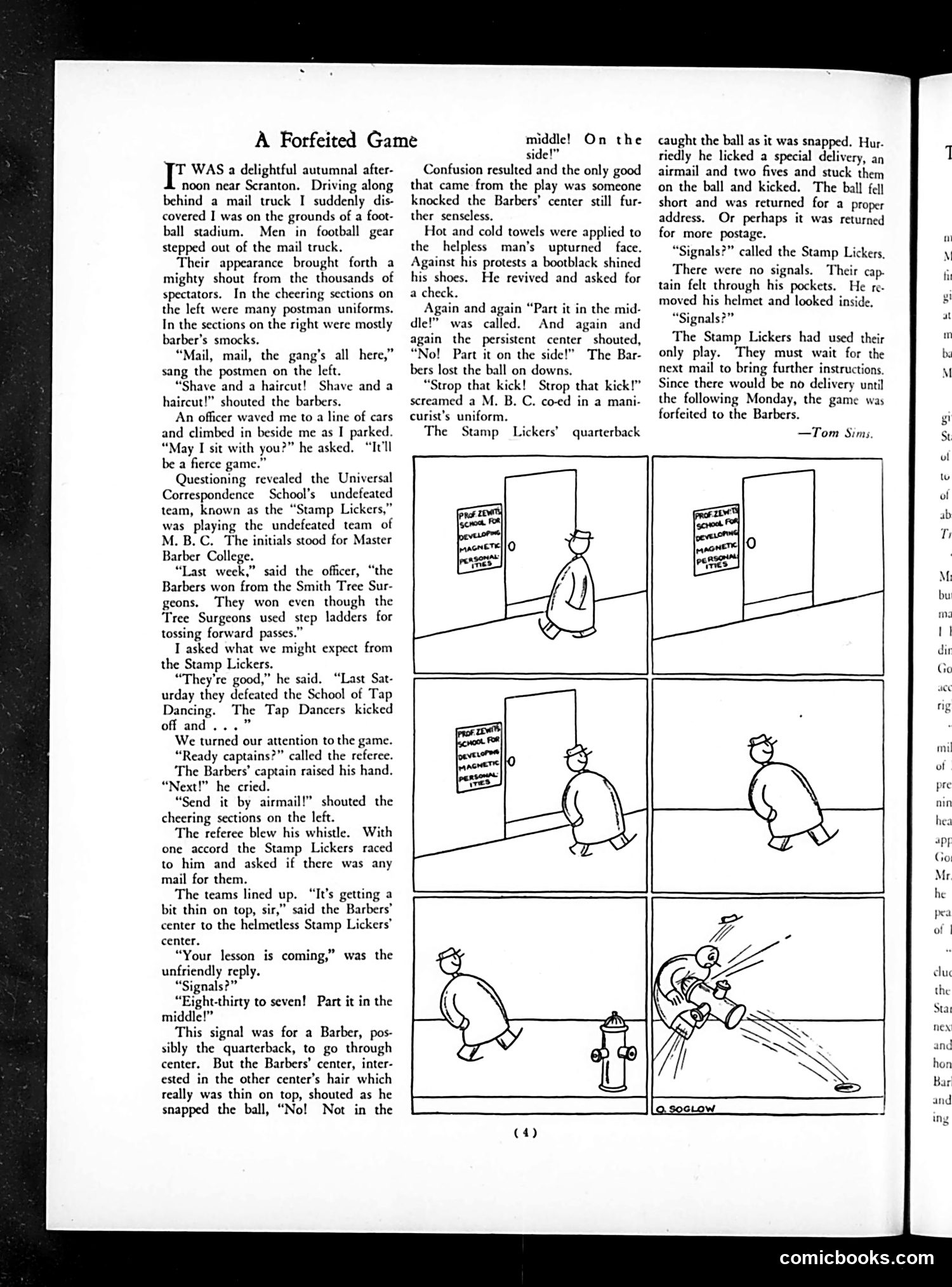
# "A Forfeited Game" - Explanation This is a humorous sports story about a football game between two schools: the "Stamp Lickers" (Universal Correspondence School) and the "Barbers" (Master Barbers College). The narrative describes confusion during the match that results in a forfeit. The accompanying comic strip shows the apparent cause: the Stamp Lickers' quarterback attempts to deliver a signal by mailing it, following the strip's literal interpretation of "airmail." The final panel depicts the signal arriving via mail carrier mid-game—too late to be useful. The satire mocks correspondence schools (then legitimate but widely ridiculed) by suggesting they conduct activities, even football, through mail delivery. The joke plays on "stamp lickers" (a derogatory term for mail workers) and the absurdity of time-delayed communication in real-time sports competition.
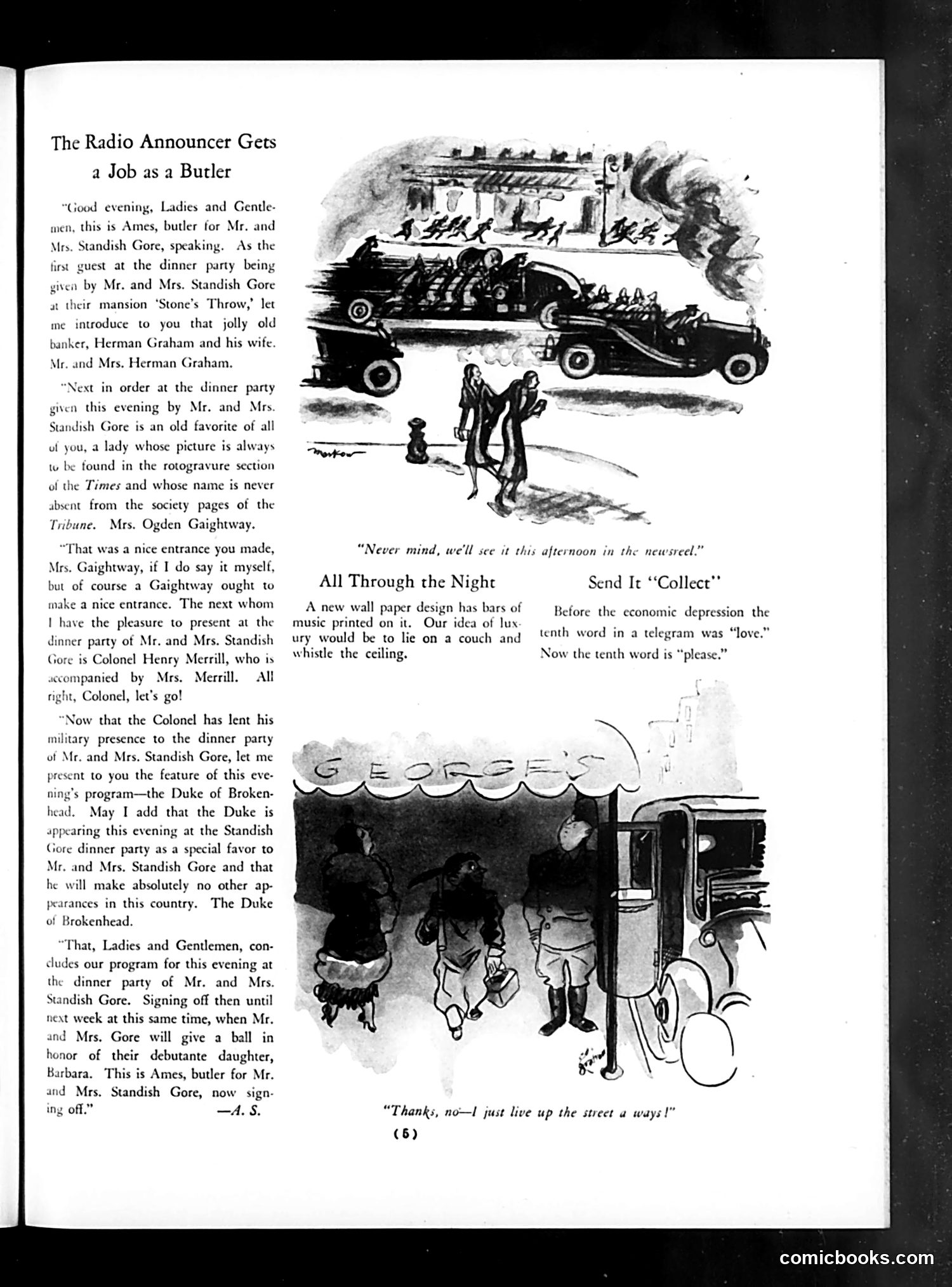
# Content Analysis This page contains two separate satirical pieces from *Life* magazine: **"The Radio Announcer Gets a Job as a Butler"** (top): A humorous story where a radio announcer named Ames, introducing guests at a dinner party, treats the occasion like a broadcast performance—over-dramatizing introductions for the Standish Gore household. The satire mocks radio announcers' theatrical delivery and pretension when applied to everyday social settings. **"All Through the Night" and "Send It 'Collect'"** (bottom): Two brief, unrelated items. The first discusses wallpaper with musical notes printed on it. The second references Depression-era economics, noting that "please" has become the tenth word in telegrams (people now asking politely rather than demanding), reflecting the economic hardship of the period. The cartoons use visual humor to accompany these social observations about broadcasting culture and economic conditions.
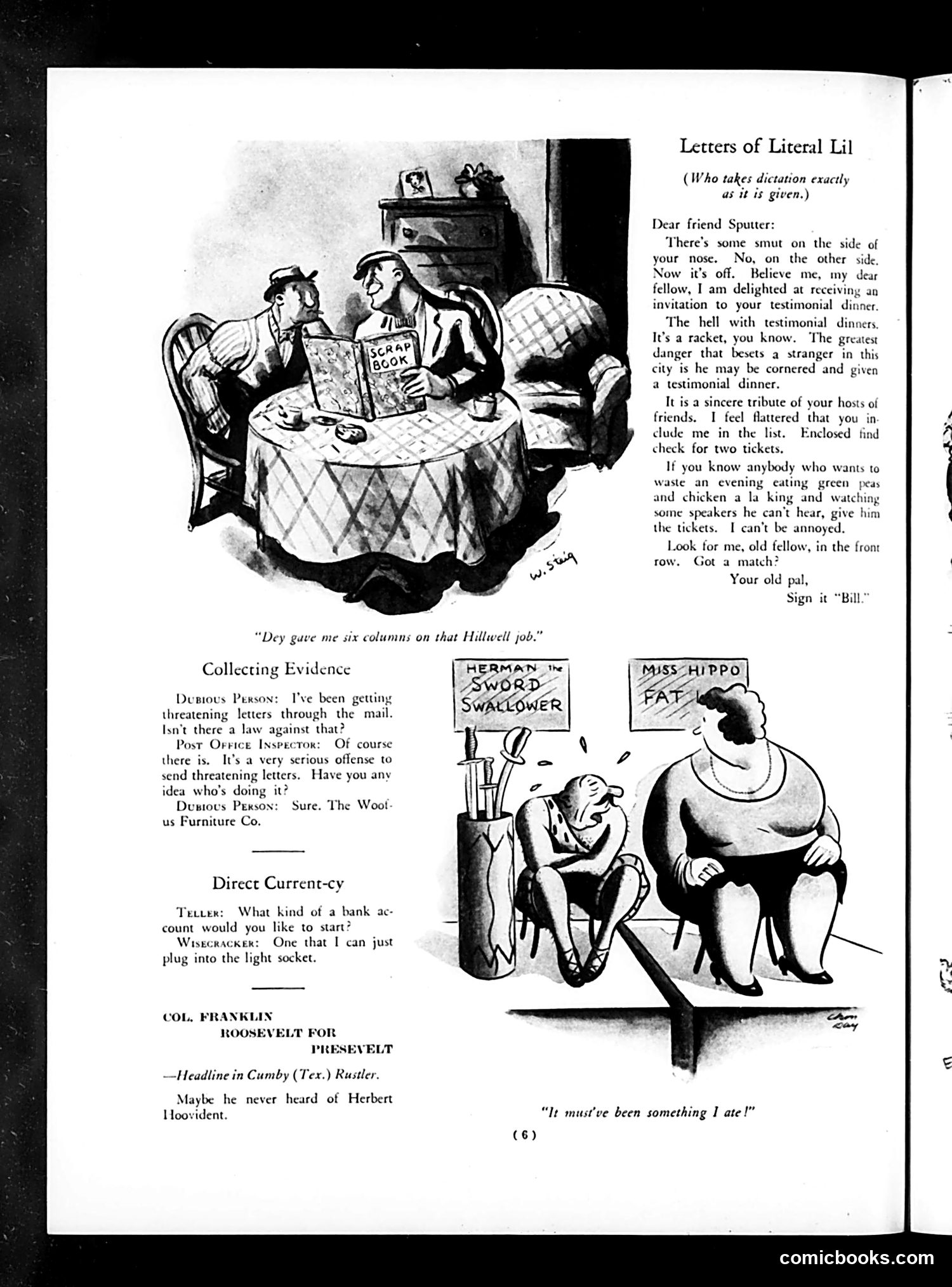
# Analysis of Life Magazine Page This page contains three separate humorous items typical of early 20th-century Life magazine: 1. **"Letters of Literal Li"** - A mock letter from "Bill" declining a testimonial dinner invitation with comic complaints about the event format. 2. **"Collecting Evidence"** - A brief dialogue between a Demon's Person and Post Office Inspector about threatening letters, satirizing bureaucratic response to threats. 3. **"Direct Current-cy"** - A banker/teller joke about opening a bank account with a plug-in socket. 4. **"Col. Franklin Roosevelt Presents"** - References a headline, possibly satirizing Theodore Roosevelt's political presence (though the OCR suggests "Hoosevelt"). The bottom cartoon shows two figures labeled "Herman the Sword Swallower" and "Miss Hippo Fat," appearing to be sideshow performers—satirizing circus attractions or vaudeville acts. These represent typical Life magazine humor: social commentary, wordplay, and caricature targeting public figures and contemporary absurdities.
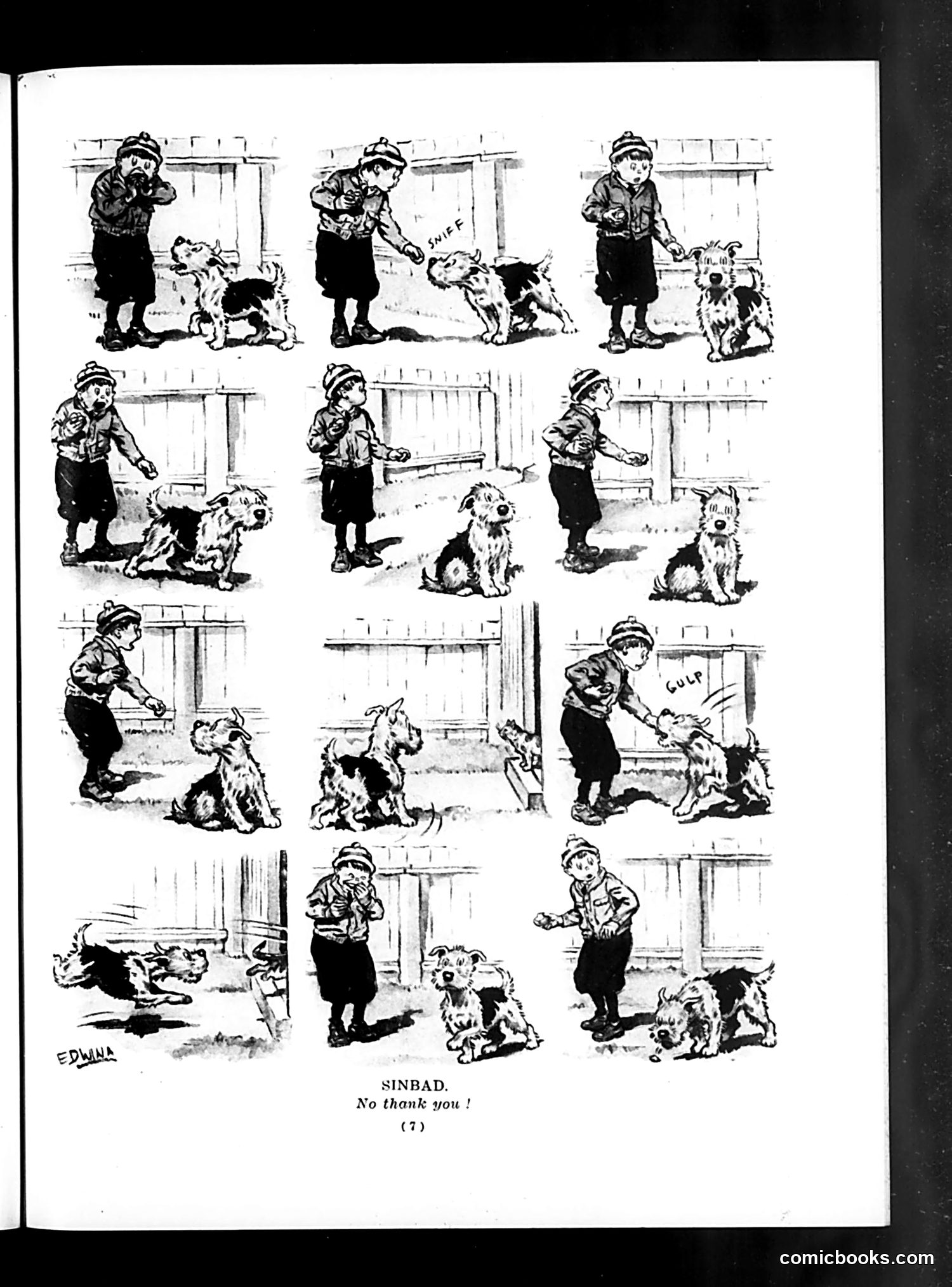
# "Sinbad: No thank you!" This comic strip by E. Pud (visible signature) depicts a child repeatedly refusing a dog's friendly advances and affection. In each panel, the child rebuffs the eager dog—pushing it away, turning aside, or declining interaction—while the dog persistently seeks the child's attention and companionship. The title "No thank you!" suggests the satire targets ingratitude or rudeness toward genuine kindness. For a modern reader, this appears to be gentle social commentary on how people (represented by the child) reject sincere, loyal devotion (the dog's behavior). It may mock those who spurn authentic friendship or assistance, portraying such rejection as foolish or ungracious. The repetition emphasizes the point through accumulated examples of the child's discourtesy.
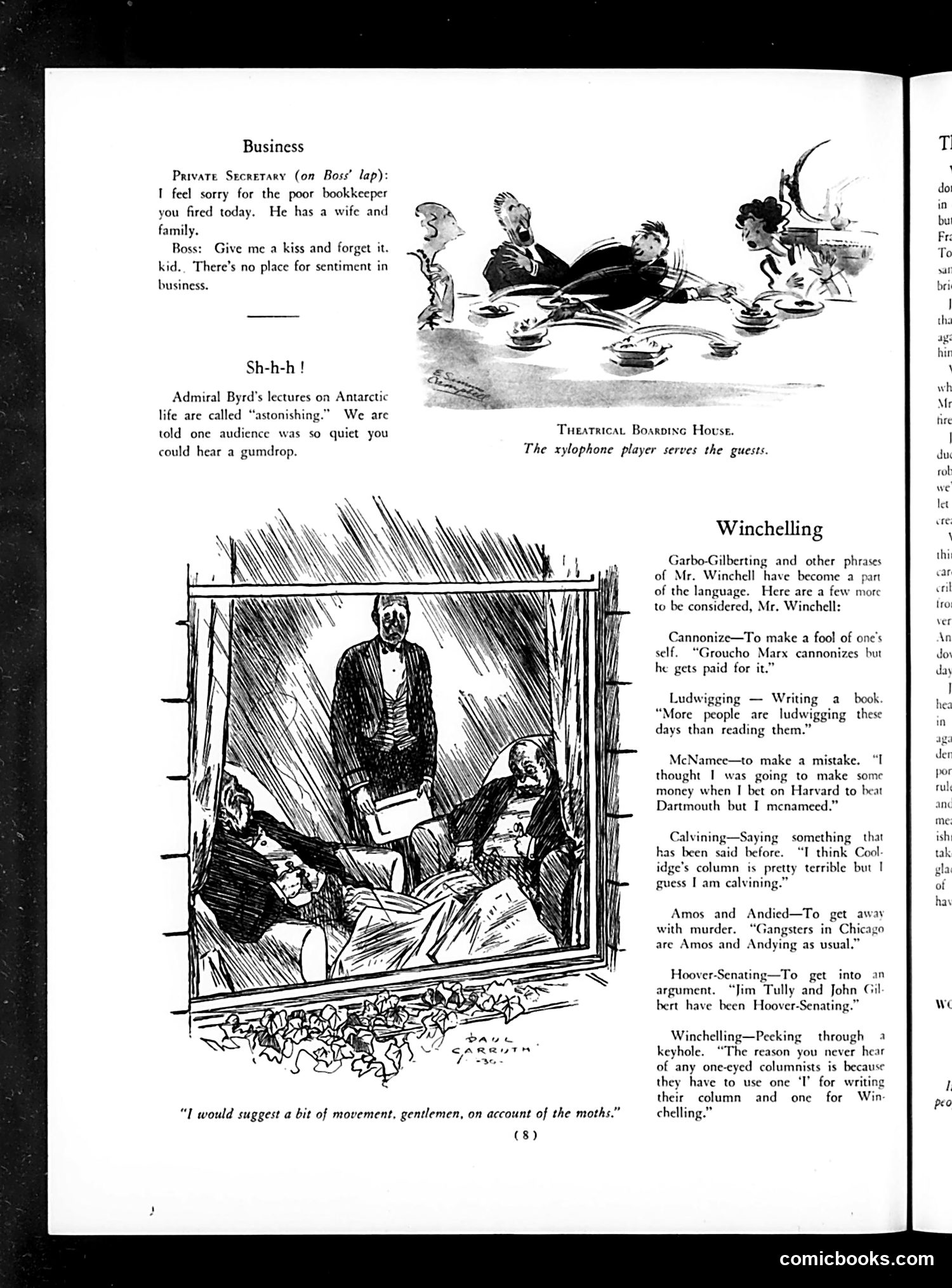
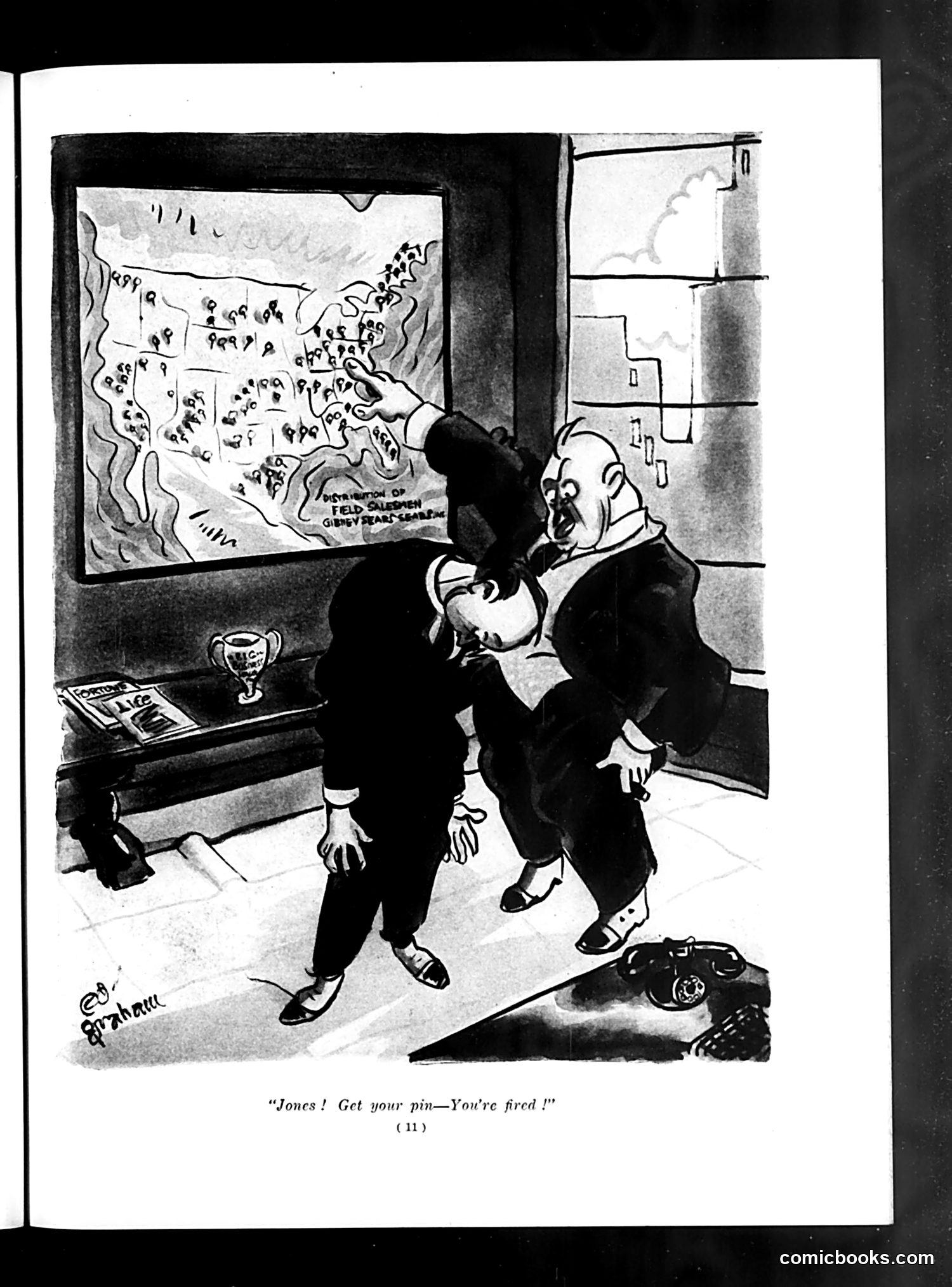
# Satire Explanation This page contains two unrelated humor pieces from *Life* magazine. **"Business"** (top): A brief satirical exchange where a boss callously fires a bookkeeper and tells him to forget sentiment—"There's no place for sentiment in business." The accompanying cartoon shows a xylophone player at a theatrical boarding house, illustrating the absurdist caption about serving guests. **"Winchelling"** (bottom): This defines slang terms associated with Mr. Winchell, apparently a prominent columnist or public figure. The cartoon depicts voyeurism through a window, illustrating "Winchelling" as peeping through keyholes. Terms like "Cannonize," "Ludwigging," and "McNamee" reference other well-known writers or personalities whose names have become verbs for their characteristic behaviors. The satire mocks how influential media figures' names become part of common speech.
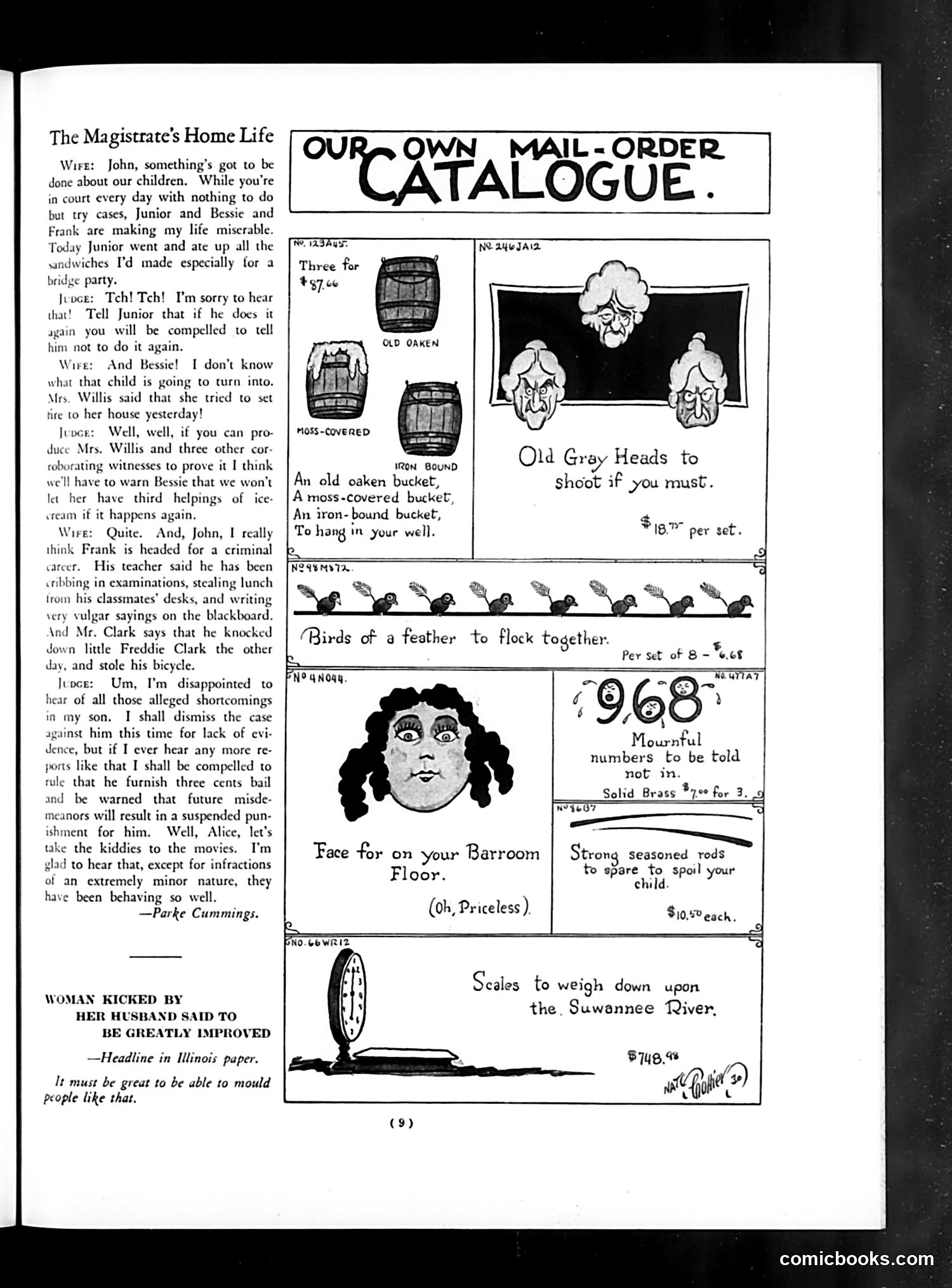
# "Our Own Mail-Order Catalogue" - Life Magazine Satire This is a humorous fake mail-order catalog parodying the popularity of actual mail-order shopping catalogs (like Sears or Montgomery Ward) in early-20th-century America. The items satirize parenting frustrations and domestic life: - "Old Gray Heads" to shoot if disciplining children fails - "Birds of a feather to flock together" (suggesting children are like unruly birds) - A "Face for on your Barroom Floor" (mocking drunken patrons) - "Strong seasoned rods to spare to spoil your child" (caning implements) - Scales to weigh children down in the Suwannee River (dark joke about drowning misbehaving children) The catalog format allows Life to mock contemporary parenting struggles, marital discord, and social anxieties through absurdist humor. The joke relies on readers' familiarity with actual catalogs and shared exasperation with family life.
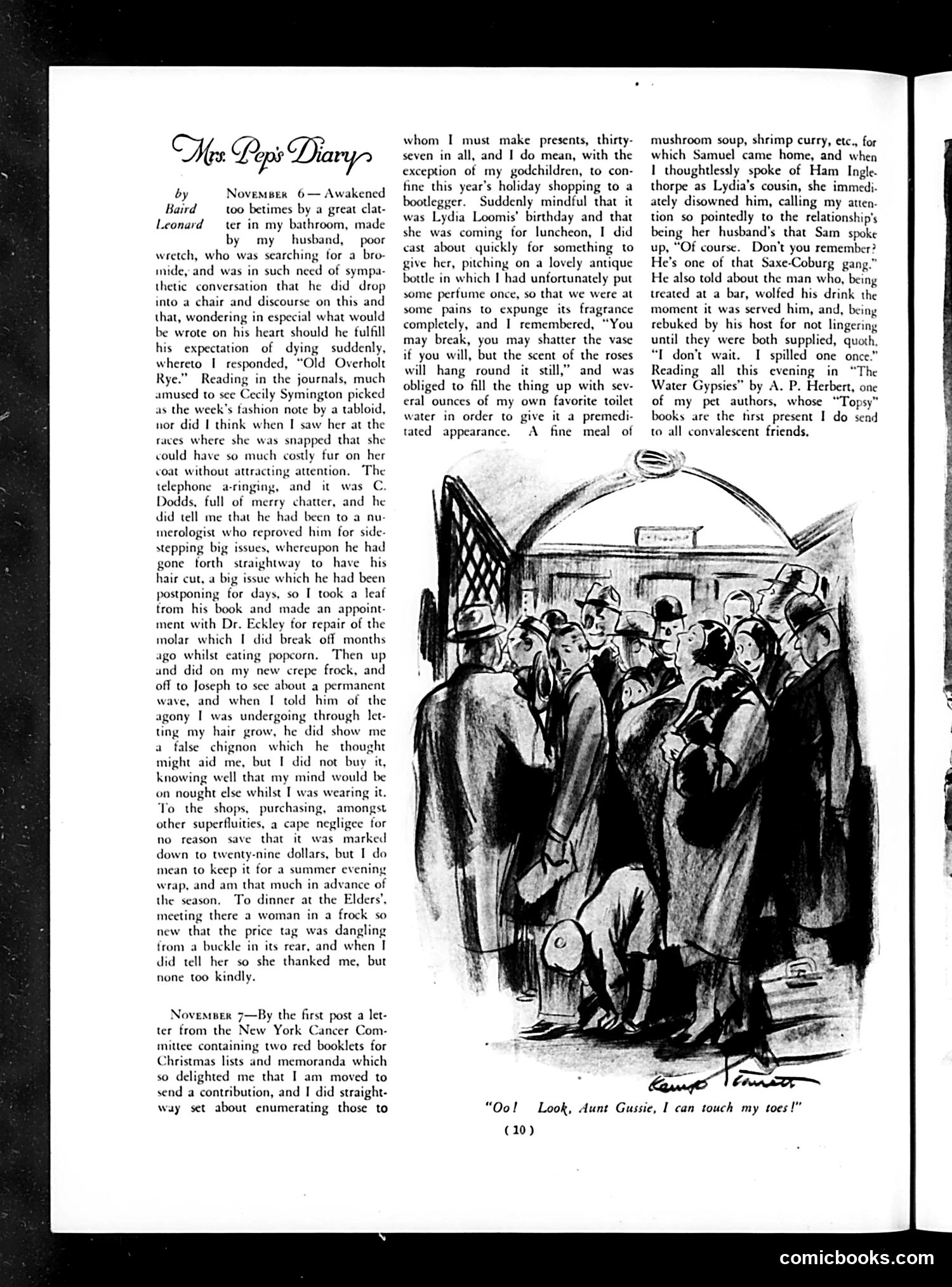
# Analysis of "Mrs. Pop's Diary" Page This is a humorous diary entry by Hazel Leonard, dated November 6-7, describing domestic life during the holiday shopping season. The accompanying cartoon illustrates a crowded, chaotic scene with the caption "Oo! Look, Aunt Gussie, I can touch my toes!" The humor targets: 1. **Holiday shopping madness** — the narrator's frantic gift-buying and attempts to manage a crowded schedule 2. **Spousal complaints** — her husband's various annoyances and demanding behavior 3. **Crowded department stores** — the cartoon depicts a sardine-like mass of holiday shoppers pressed together indoors, showing the physical chaos of seasonal retail 4. **Child behavior** — the child's gleeful observation about physical contact in the crush of bodies The satire gently mocks the stress, overcrowding, and absurdity of pre-Christmas shopping culture and domestic life.