A complete issue · 36 pages · 1930
Life — January 31, 1930
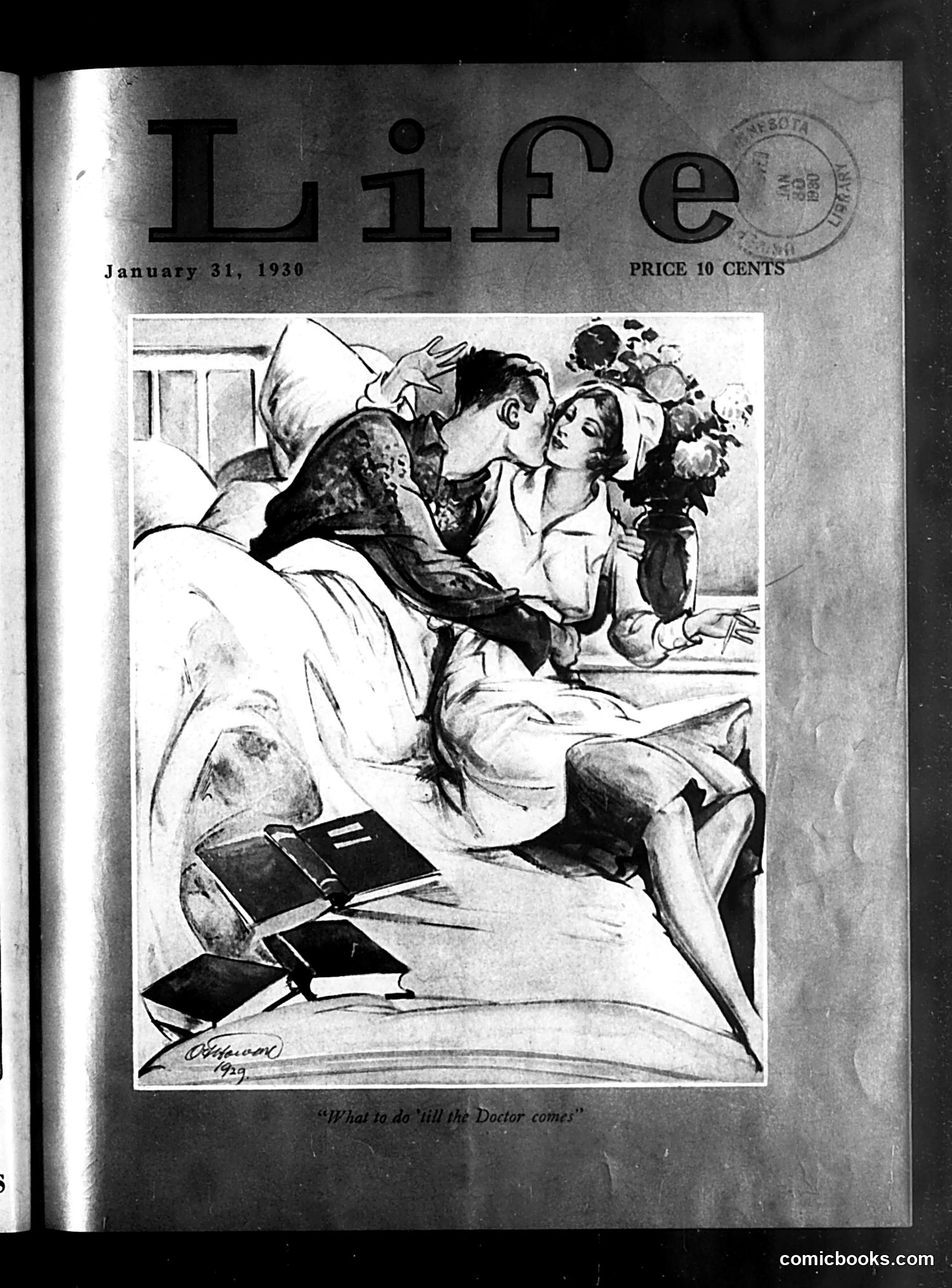
# Analysis of Life Magazine Cover, January 31, 1930 This is a suggestive romantic illustration rather than political satire. The caption "What to do 'till the Doctor comes" plays on the double entendre typical of Life magazine's humor in this era—the couple in bed appears to be engaging in flirtation or intimacy while awaiting a physician's visit. The illustration reflects 1930s attitudes toward romance and propriety, where such "naughty" innuendo was considered sophisticated humor for the magazine's adult readership. The scattered medical books on the bed floor may reference health/medical topics of concern to readers, but the primary joke relies on the suggestive situation rather than political commentary. This represents Life's characteristic blend of risqué humor and genteel presentation during the early Depression era.
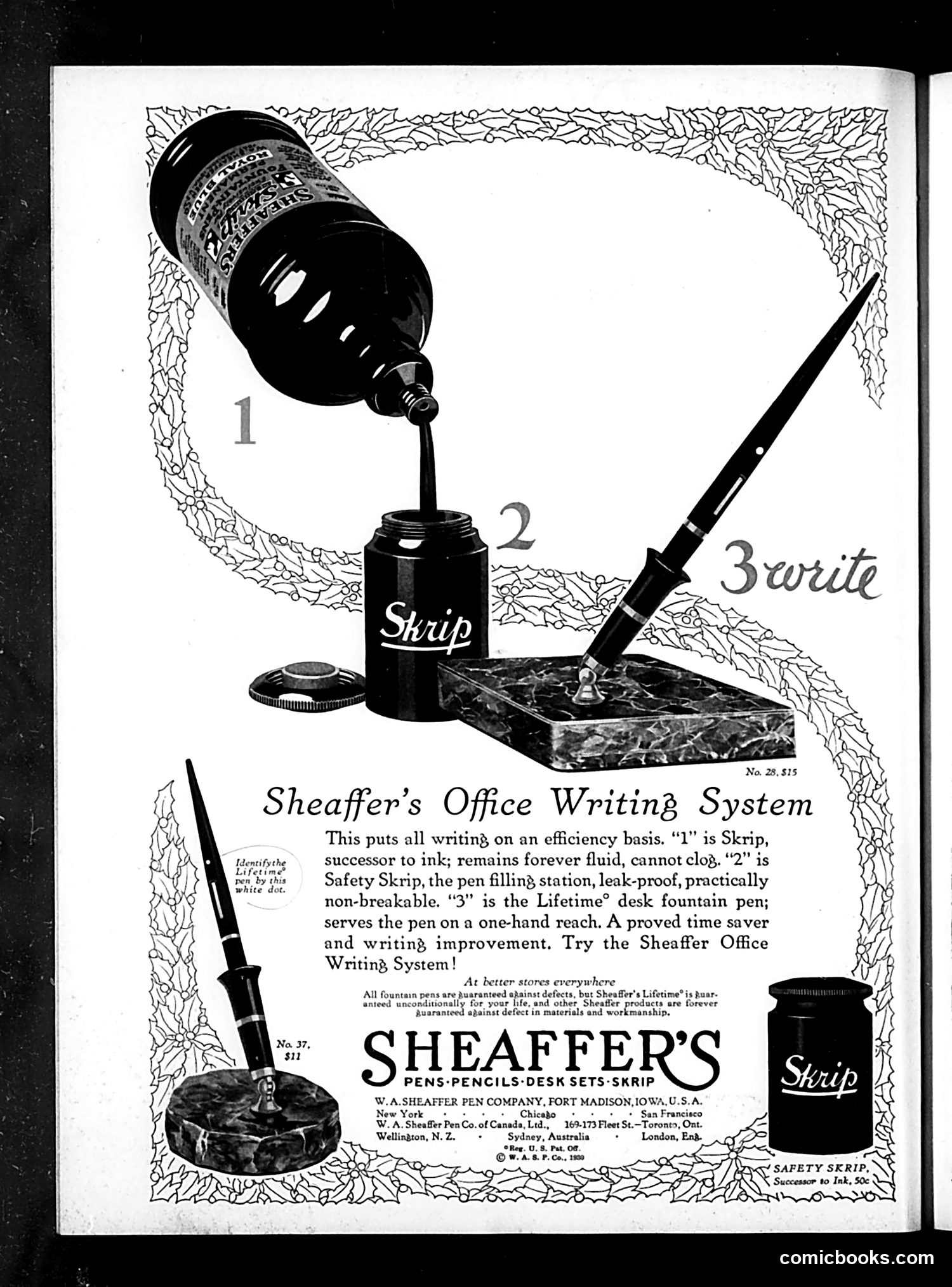
# Analysis This is **not a political cartoon or satire**—it's a straightforward product advertisement for Sheaffer's Office Writing System, published in *Life* magazine. The page advertises three items: 1. "Skip" ink bottle 2. "Safety Skip" pen-filling station 3. A "Lifetime" desk fountain pen The numbered diagram (1-2-3) demonstrates the system's efficiency for office work. The decorative leaf border is typical 1920s-30s design. The ad emphasizes practical benefits: leak-proof design, convenience ("one-hand reach"), durability ("Lifetime"), and time-saving for busy offices. The tagline promises "efficiency basis" for workplace writing tasks. This represents early 20th-century advertising aimed at professional office workers, before ballpoint pens became standard.
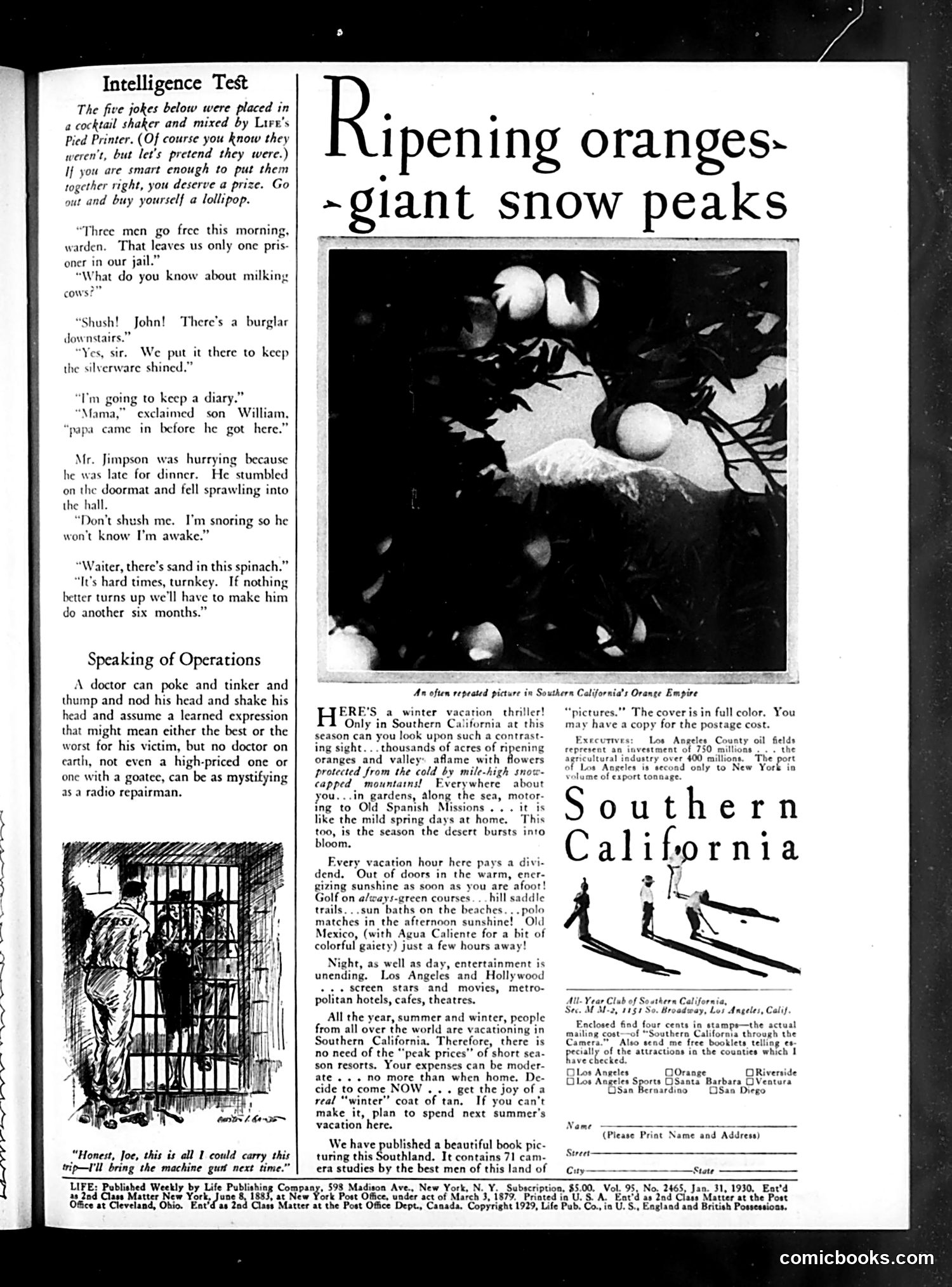
# Analysis This page contains two distinct sections: **Left side**: An "Intelligence Test" section presents a series of short anecdotes (about three men escaping jail, a burglar scare, Mr. Jimpson arriving late, etc.) designed as riddles or logic puzzles for readers to solve. The accompanying sketch shows a guard at a prison cell door. This appears to be lighthearted entertainment rather than political satire. **Right side**: A travel advertisement for Southern California, featuring an photograph of ripe oranges on trees and promotional text about winter vacation opportunities—golfing, beaches, skiing nearby. The page includes contact information for the All Year Club of Southern California. Neither section contains recognizable political cartoons or figures. The content is primarily recreational: puzzles for entertainment and tourism marketing.
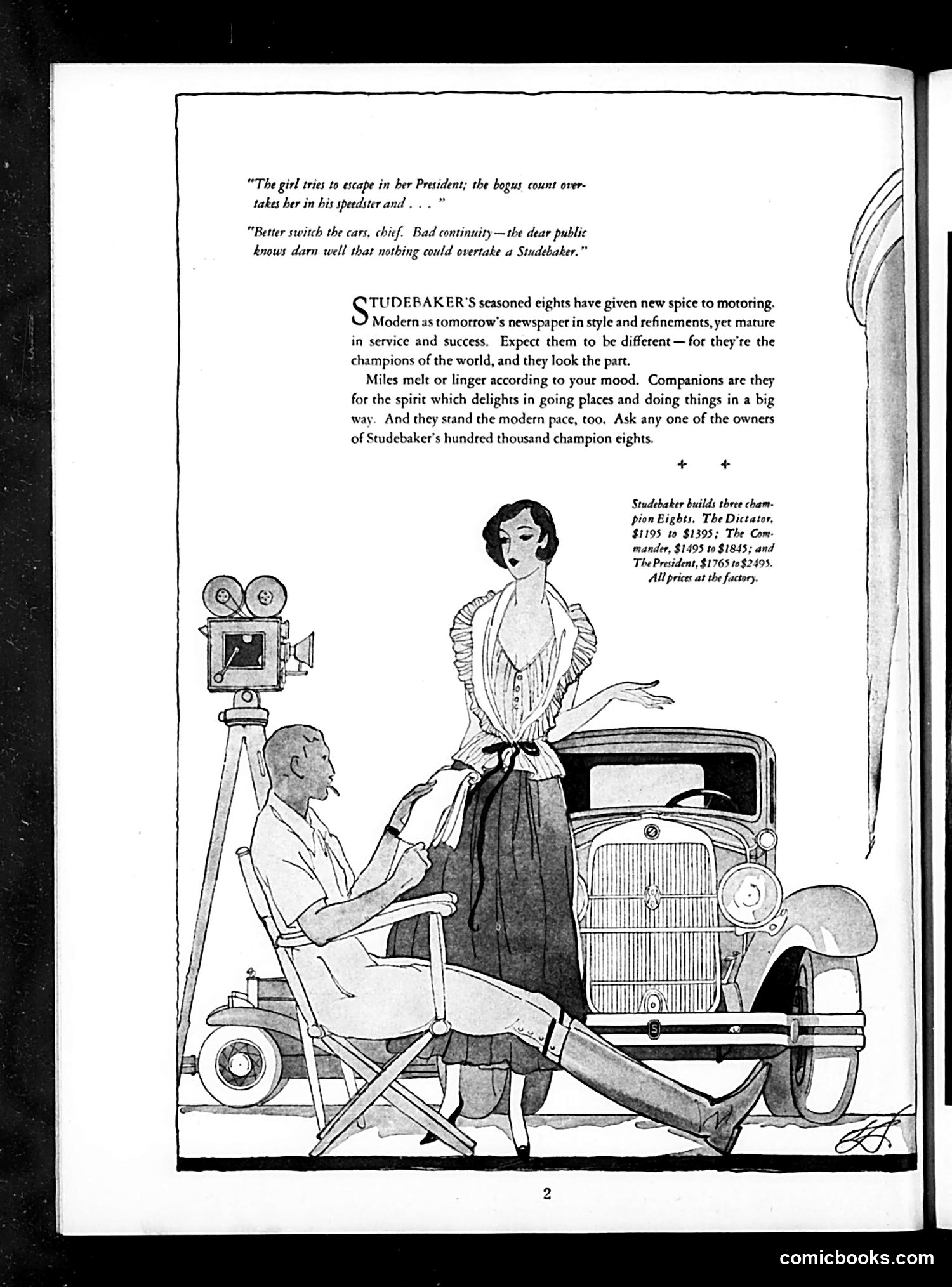
# Studebaker Advertisement with Satirical Frame This is primarily a **Studebaker automobile advertisement** dressed up as satire. The opening quotes mock a melodramatic film scene—a "President" (likely referencing a Studebaker model) being overtaken by a faster vehicle, with commentary on "continuity" and "Sidelakers." The main illustration depicts a **film director** shooting a scene with an actress and a Studebaker automobile, presenting the car as modern, stylish, and successful—"champion eighths" in the automotive world. The text emphasizes the Studebaker's modern design and reliability, listing four model types with prices ranging from $1,193 to $2,495. The "satire" is thin—it's essentially using Hollywood film production imagery to sell cars as glamorous and contemporary consumer products to 1920s readers.
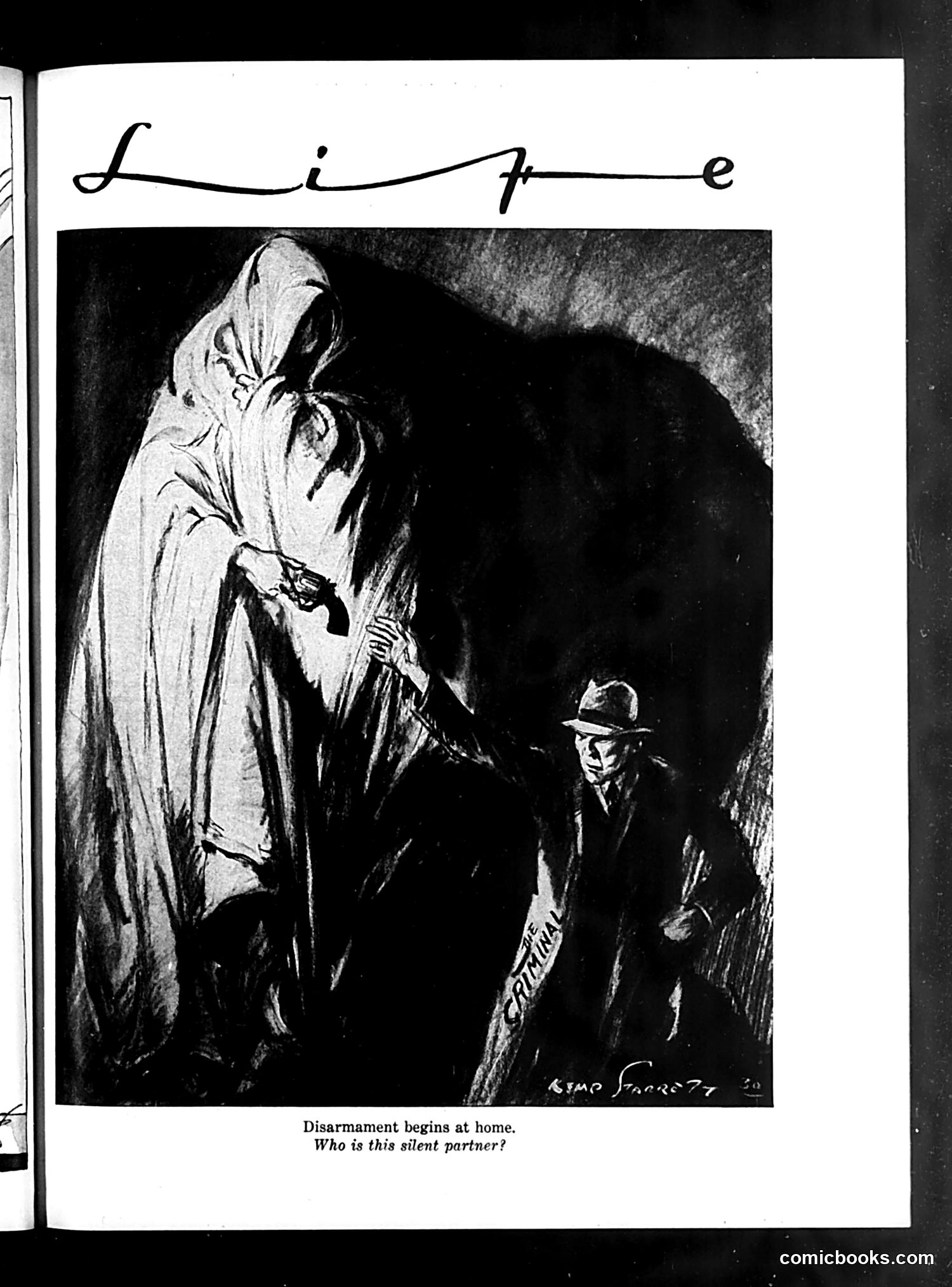
# Analysis of "Life" Magazine Cartoon Page This political cartoon depicts a cloaked figure presenting a weapon to a smaller man in a hat, illustrating the caption "Disarmament begins at home. Who is this silent partner?" The satire critiques domestic gun violence and the failure of disarmament efforts. The "silent partner" likely represents an unnamed force—possibly government inaction, the arms industry, or societal indifference—that enables violence despite public disarmament rhetoric. The ghostly, shrouded figure suggests death or violence itself as an accomplice to the smaller figure (appearing to represent ordinary citizens or perhaps a specific political leader). The cartoon's message: true disarmament must address root causes at home before international peace efforts succeed. The "silent partner" metaphor suggests complicity in allowing violence to persist.
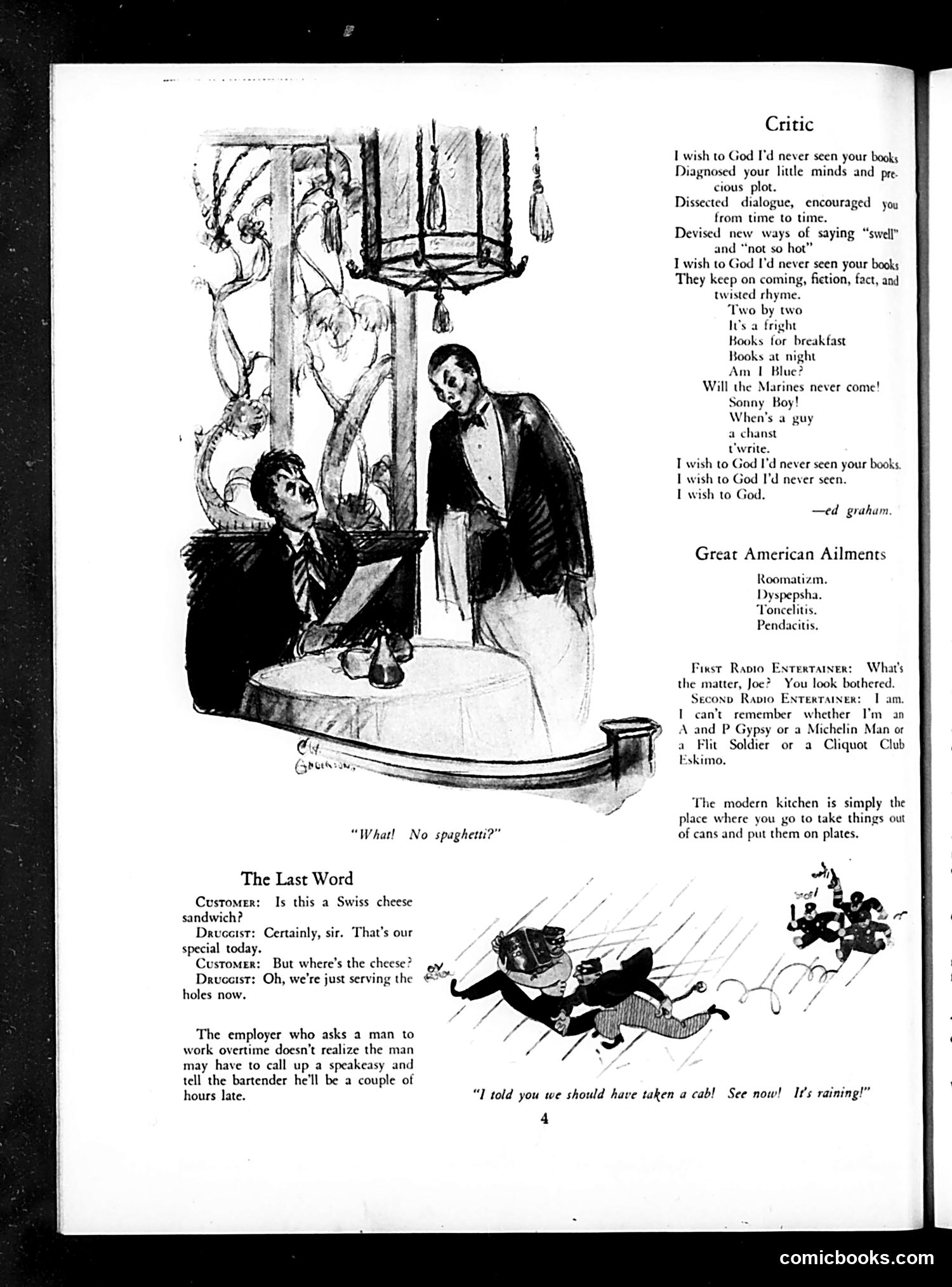
# Analysis This page from Life magazine contains three separate satirical pieces: **"Critic"** (top right): A poem by ed graham mocking popular fiction and authors, listing book titles like "Am I Blue?" and "Sonny Boy!" The critic wishes he'd never seen these books, suggesting contempt for commercial, lowbrow literature of the era. **"The Last Word"** (bottom left): A dialogue joke where a druggist serves a customer "Swiss cheese sandwiches" but has run out of cheese—they're just serving "the holes now." It satirizes commercial shortcuts and business dishonesty. **"Great American Ailments"**: A brief list mocking contemporary afflictions like "Roomatizm" and "Dyspepsia." The bottom cartoon shows a figure in rain with text about taking a cab, appearing to comment on workplace dynamics or commuting frustrations. These represent typical Life magazine humor: social criticism through wordplay and visual gags targeting commercial culture, poor writing, and business practices.
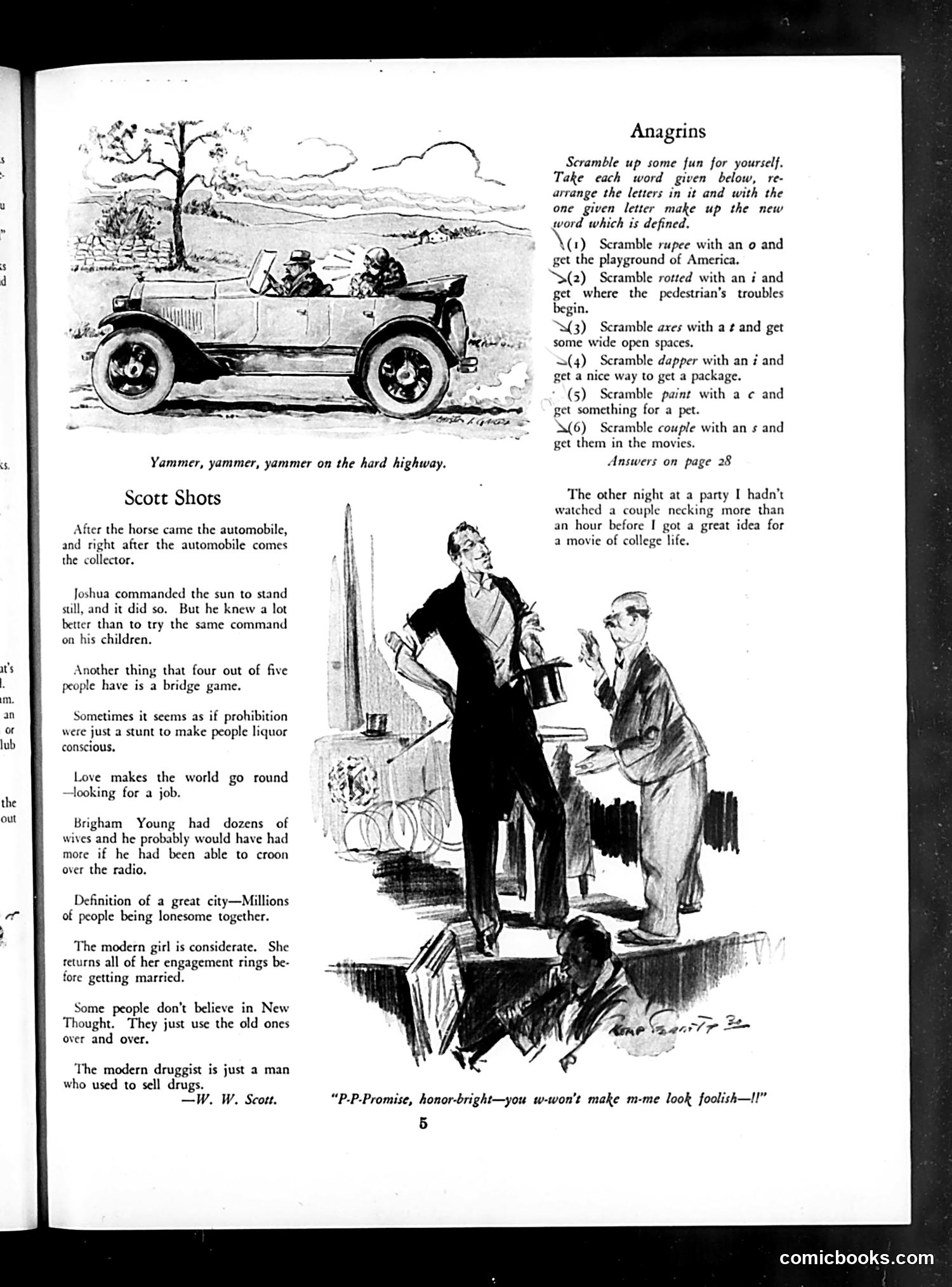
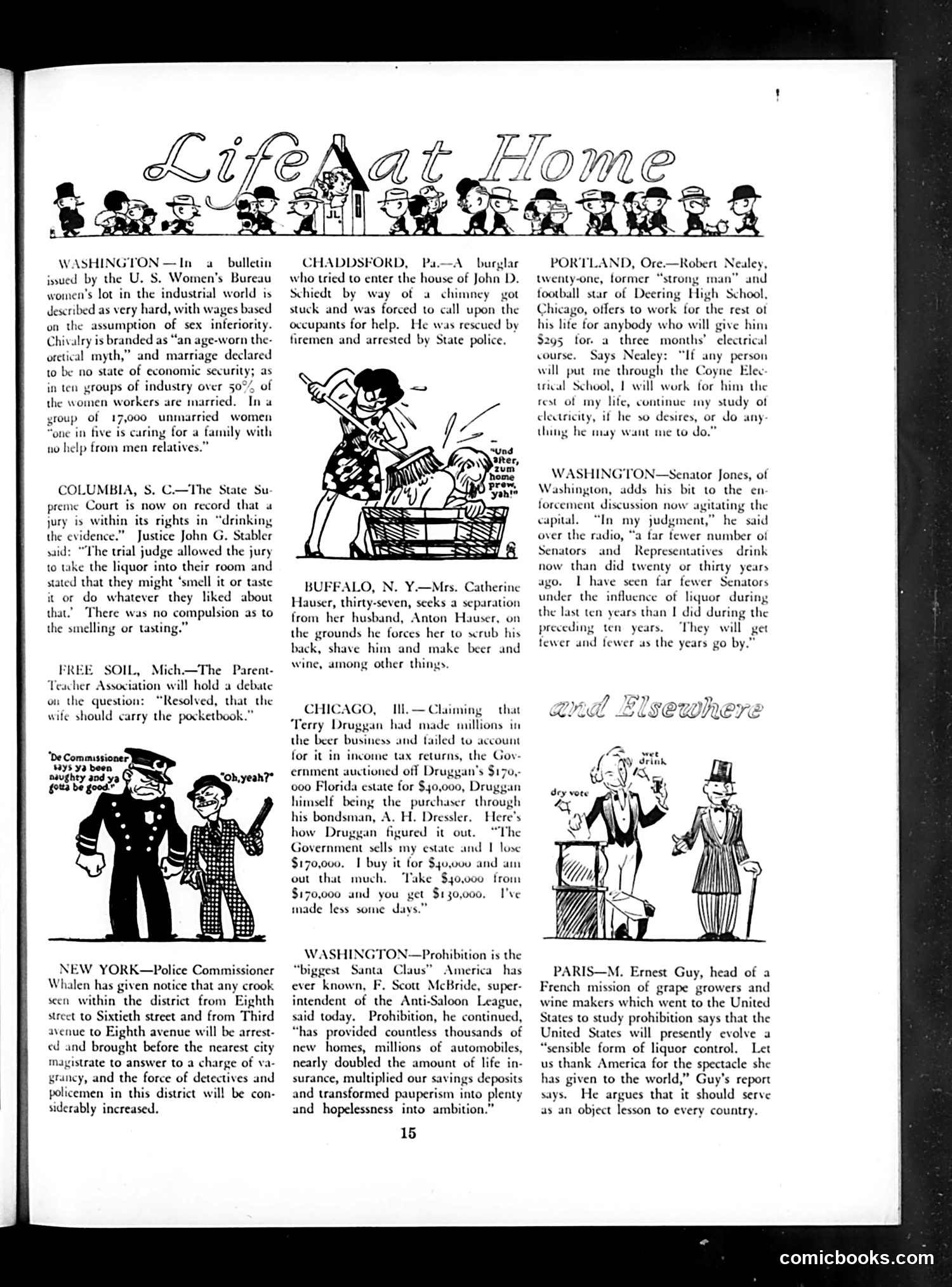
# Analysis This page contains **Scott Shots**, a collection of short satirical observations by W.W. Scott (credited at bottom). These are brief, cynical quips about American society rather than a narrative cartoon. The single illustration depicts a man in formal attire speaking to two workers, with the caption: **"P.P.Promise, honor-bright—you u-won't make m-me look foolish—!!"** The cartoon satirizes someone (likely a politician or public figure) attempting to buy silence or complicity from workers, stammering nervously as he makes promises. The joke suggests corruption, backroom deals, or hypocrisy—someone worried about their public image pressuring others to keep secrets. The short quips below mock various American institutions: automobiles replacing horses, prohibition, marriage, Brigham Young's polygamy, and modern druggists—reflecting 1920s concerns.
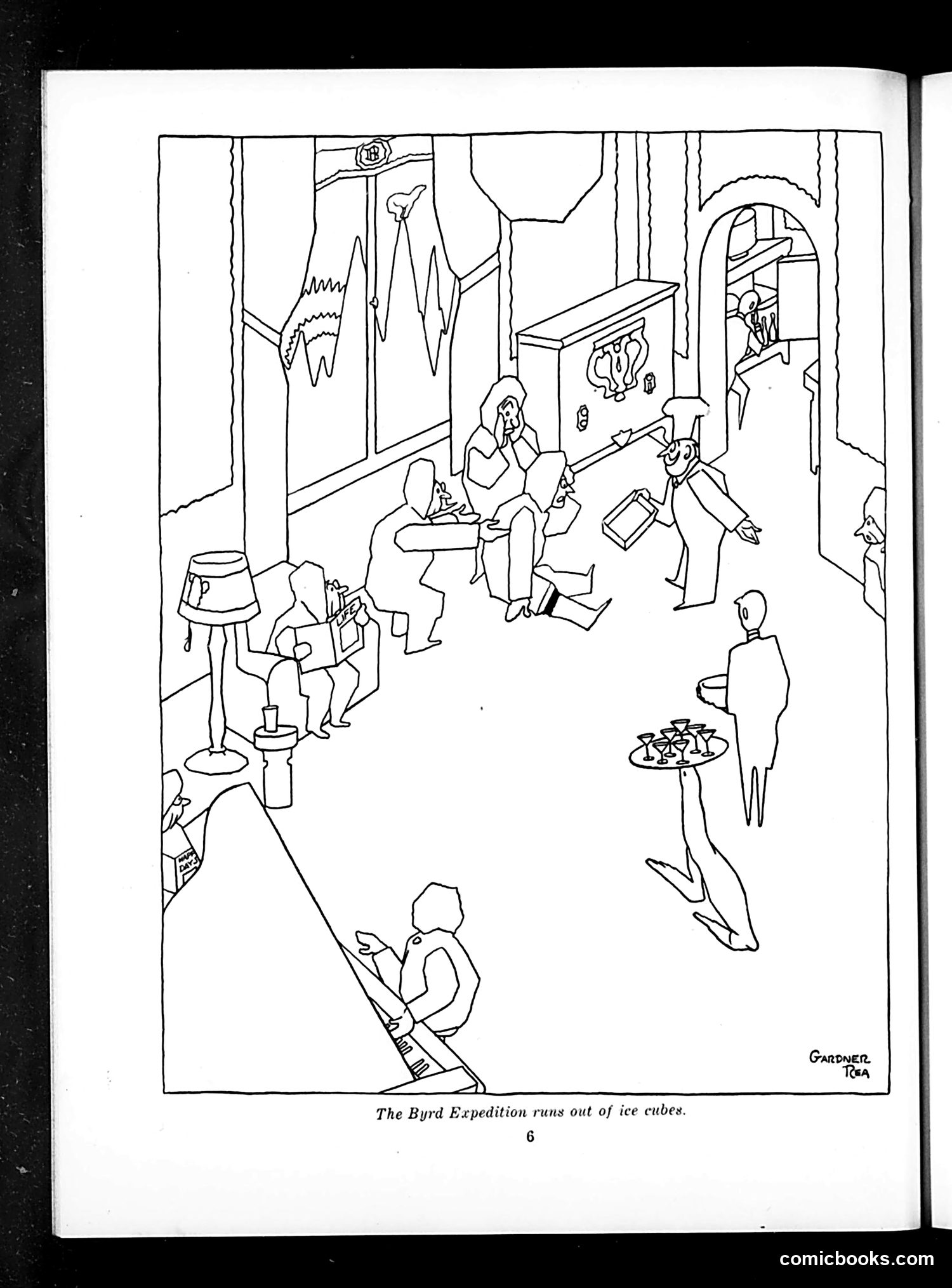
# "The Byrd Expedition Runs Out of Ice Cubes" This cartoon by Gardner Tead satirizes Admiral Richard E. Byrd's Antarctic expedition (likely the 1928-1930 expedition, one of the earliest major Antarctic ventures). The joke plays on the absurd notion that explorers on an ice-covered continent would run out of ice—a humorous commentary on expedition logistics and planning. The cartoon depicts what appears to be an expedition party in dire straits, with figures scrambling inside a building. The humor derives from the ironic incongruity: explorers surrounded by unlimited ice yet facing supply shortages. This likely mocks either Byrd's expedition's actual supply problems or satirizes the expedition's ambitious but potentially poorly-planned nature, which was a subject of public discussion during this period of polar exploration.
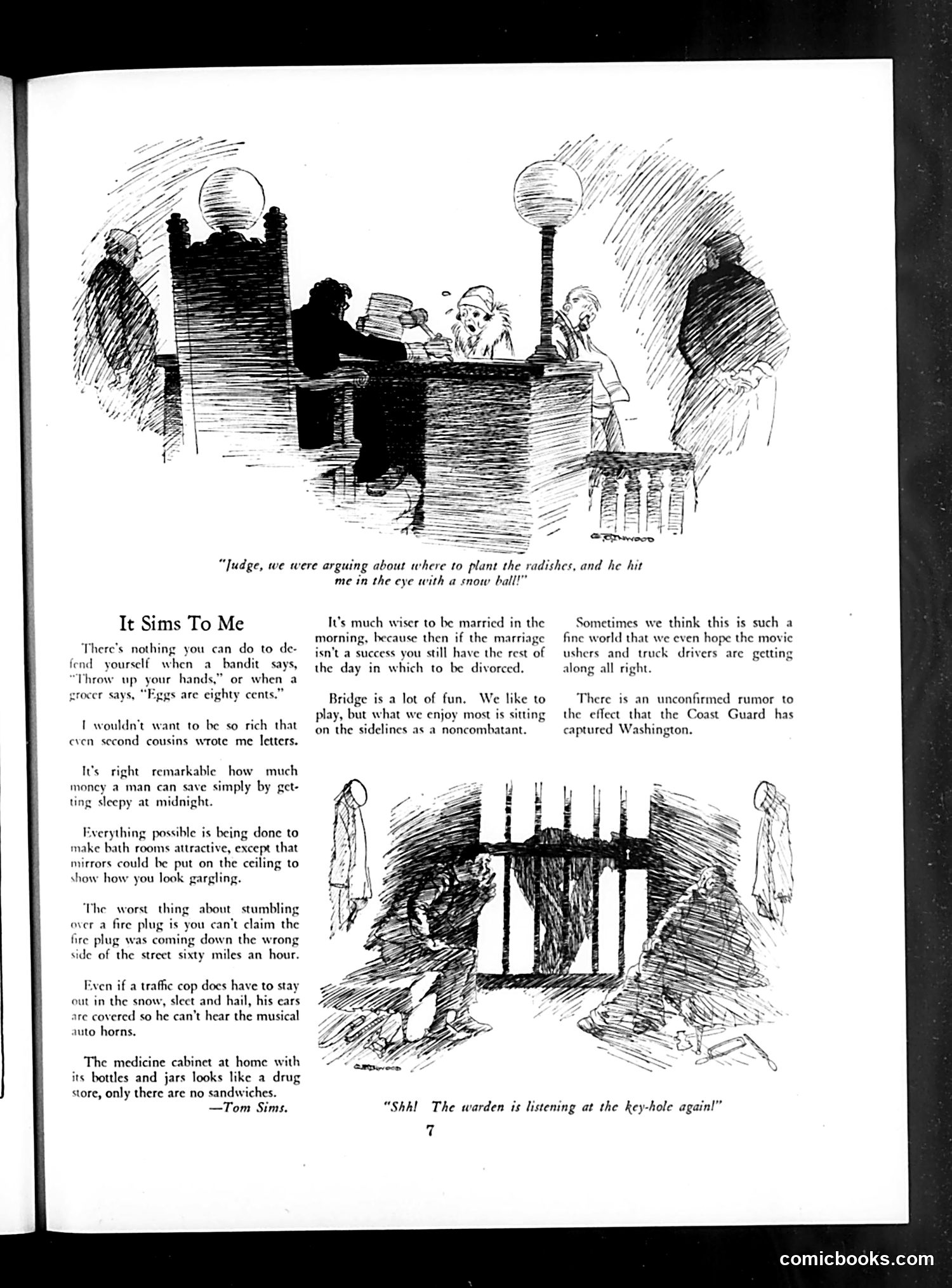
# Analysis of "It Sims To Me" Page This is a humor column by Tom Sims from *Life* magazine. The top cartoon shows a courtroom scene where someone complains to a judge about being hit with a snowball during an argument about planting radishes—a absurdist joke about petty domestic disputes. The text below consists of brief satirical observations about everyday American life: marriage timing, bridge as entertainment, bathroom mirrors reflecting unflattering angles, the cost of electricity left on, fire plugs blocking street parking, traffic cops in snow, and home medicine cabinets resembling pharmacies. The bottom cartoon depicts a prison or jail with a guard listening at a keyhole, captioned "Shal The warden is listening at the key-hole again!"—suggesting paranoia or surveillance concerns. The humor is gentle, observational satire about mundane modern inconveniences and social absurdities.
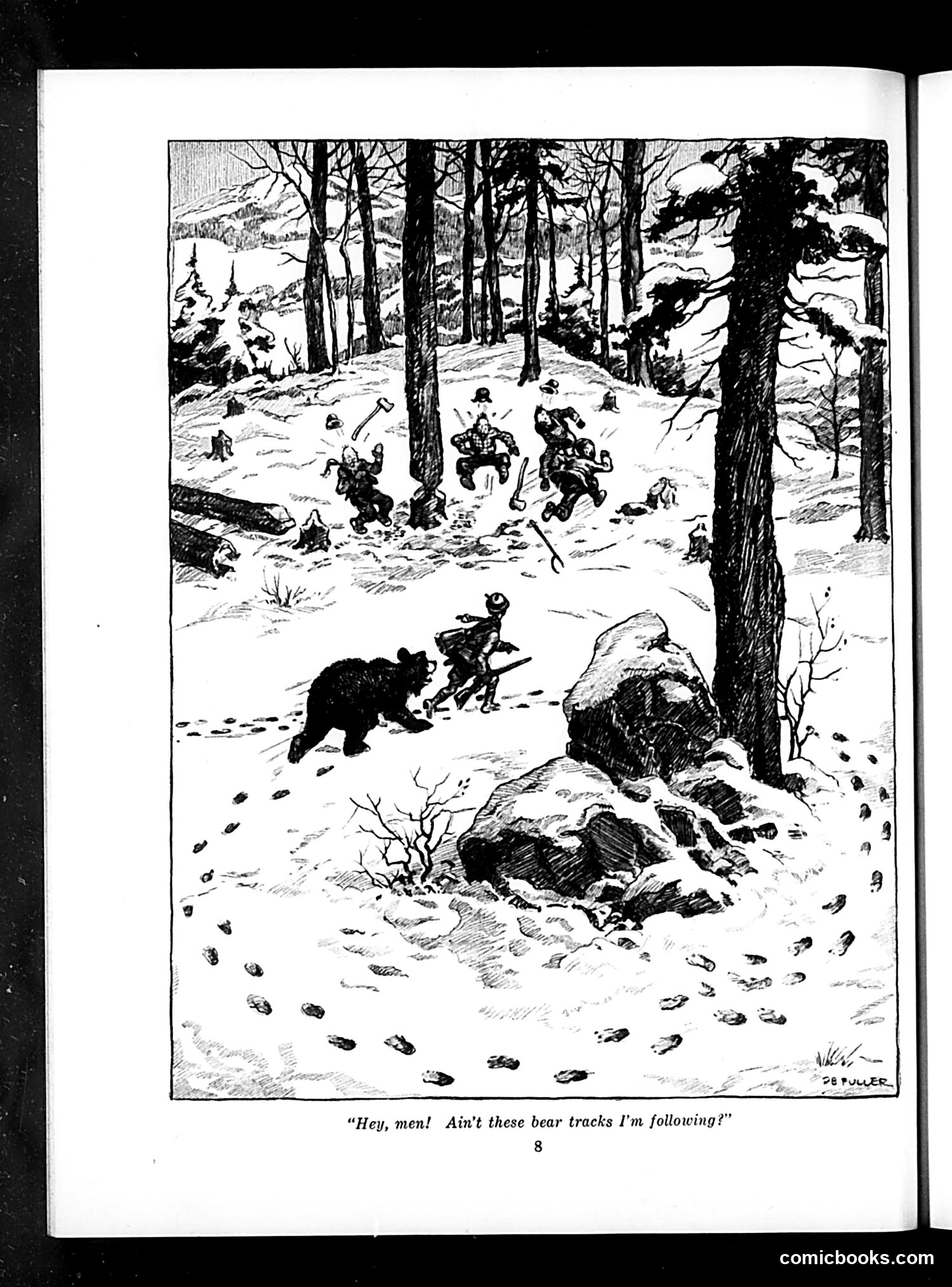
# Analysis This is a humorous wilderness illustration showing a hunter following animal tracks in snow, unaware that he's actually trailing a **bear**—visible in the foreground left. The hunter's dialogue, "Hey, men! Ain't these bear tracks I'm following?" suggests he's confidently (and incorrectly) identifying the tracks while other hunters wait in the background. The joke is ironic situational humor: the hunter believes he's skillfully tracking a bear, when in fact the bear is right there, and he's walking directly toward danger while remaining oblivious. This plays on common sporting/hunting mishaps and the gap between hunters' self-perceived competence and actual situational awareness. The cartoon is signed "Fuller" and appears to be a full-page illustration rather than political satire—it's entertainment humor typical of *Life* magazine's content during the early-to-mid 20th century.
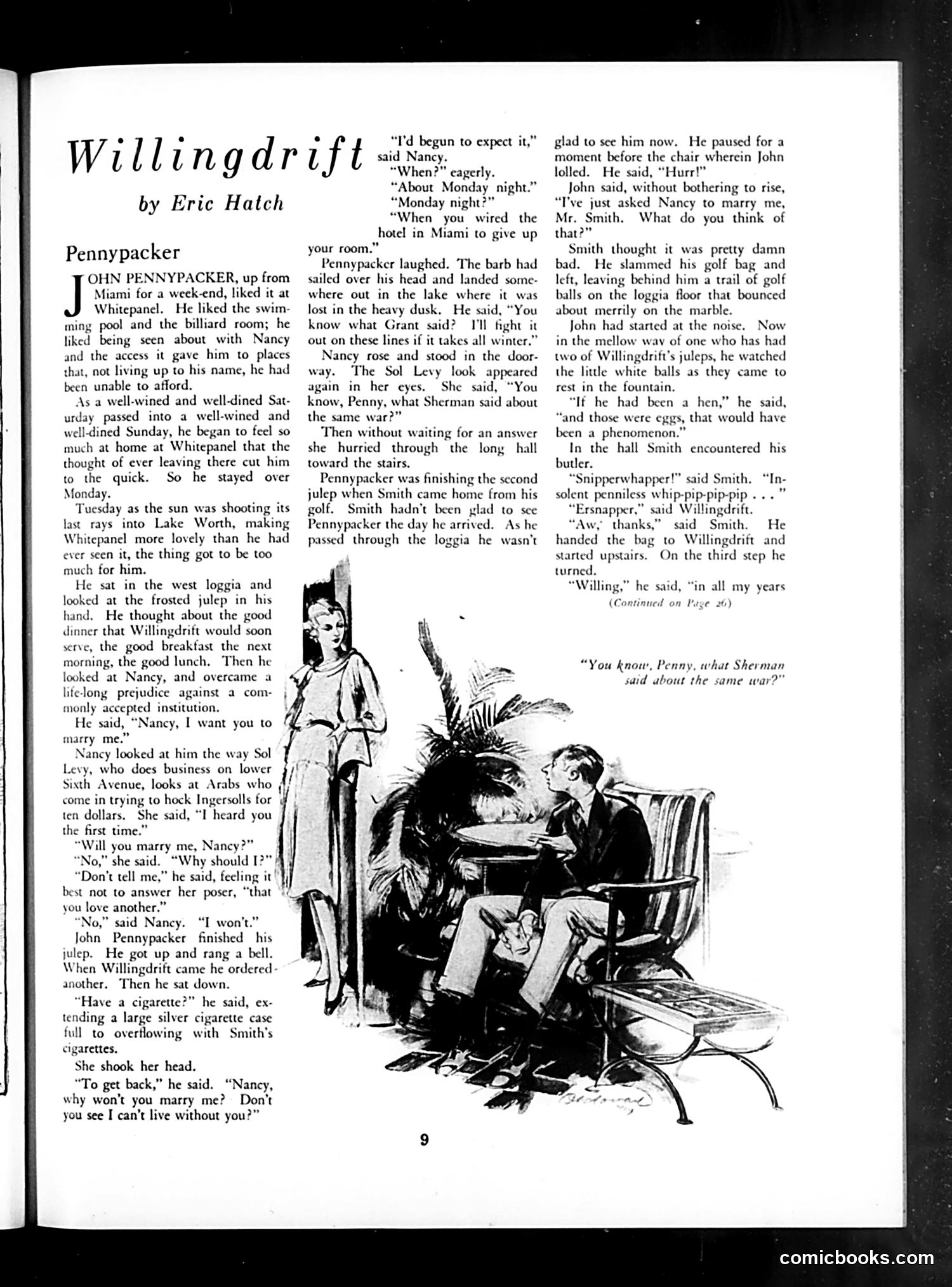
# Analysis of "Willingdrift" by Eric Hatch This is a humorous short story, not political satire. The narrative concerns John Pennypacker, a wealthy man from Miami who proposes marriage to Nancy while visiting Whitepapel. Nancy repeatedly refuses him, citing his inability to live within his means—he's wealthy but perpetually broke. The illustration shows the domestic scene of Pennypacker's proposal attempt. The story's satire targets upper-class excess and romantic persistence: Pennypacker assumes wealth entitles him to Nancy's affection, yet his financial irresponsibility undermines his position. The humor derives from Nancy's practical rejection of romantic grand gestures when the suitor cannot manage basic finances. This reflects 1920s-30s social commentary on wealth without substance.
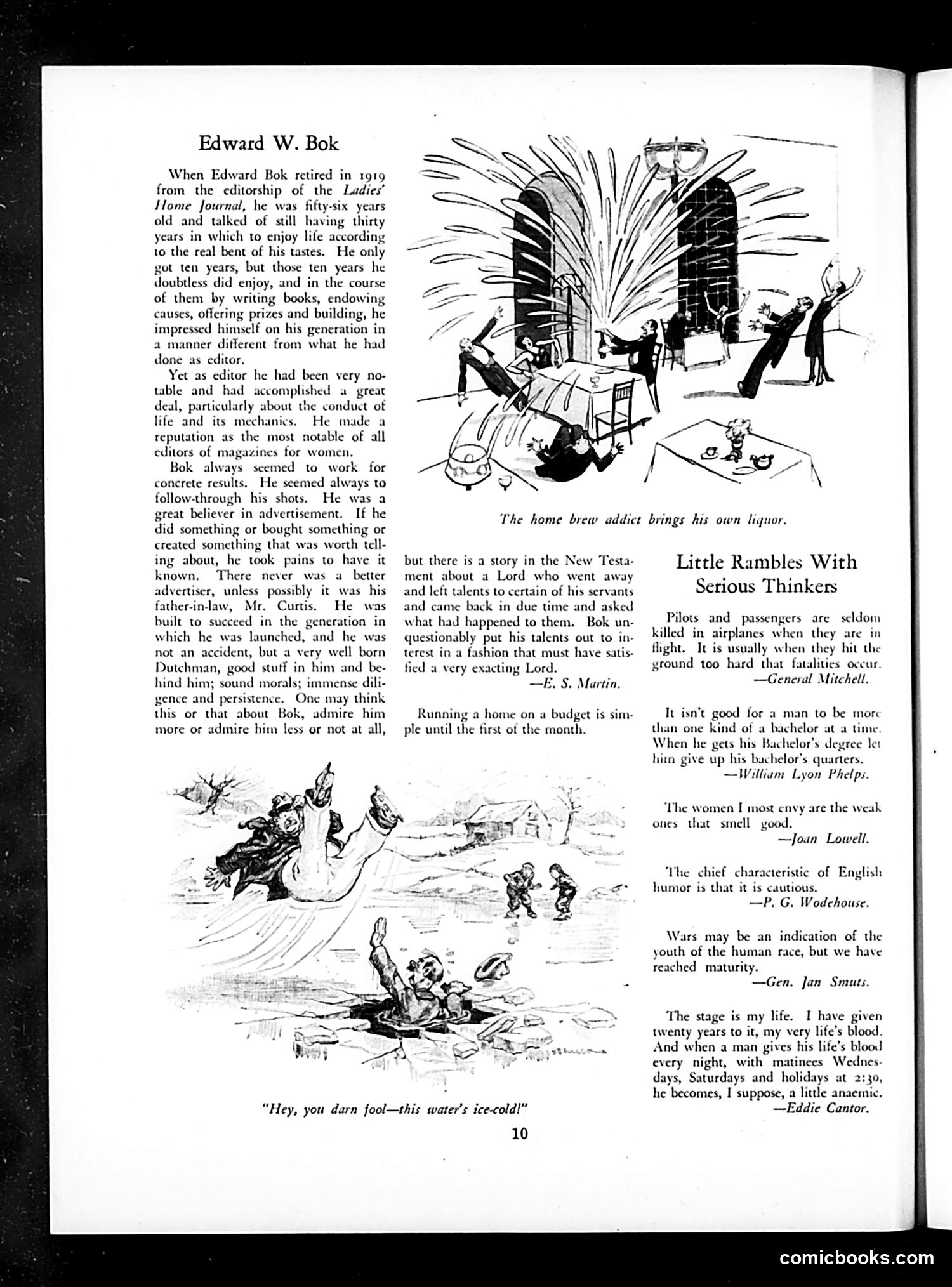
# Edward W. Bok and "Little Rambles With Serious Thinkers" This page celebrates **Edward W. Bok**, editor of *Ladies' Home Journal*, who retired in 1919 after 30 years. The upper cartoon satirizes his domestic focus—showing a chaotic home scene with the caption "The home brew addict brings his own liquor," likely referencing Prohibition-era tensions. The lower section, "Little Rambles With Serious Thinkers," presents witty quotations from public figures (General Mitchell, William Lyon Phelps, Joan Lowell, P.G. Wodehouse, and others) on topics like bachelorhood, humor, war, and theater. The skating scene cartoon illustrates one quote with the caption "Hey, you darn fool—this water's ice-cold!" The page celebrates Bok's editorial legacy of combining practical home advice with cultural commentary.