A complete issue · 36 pages · 1936
Judge — November 1936
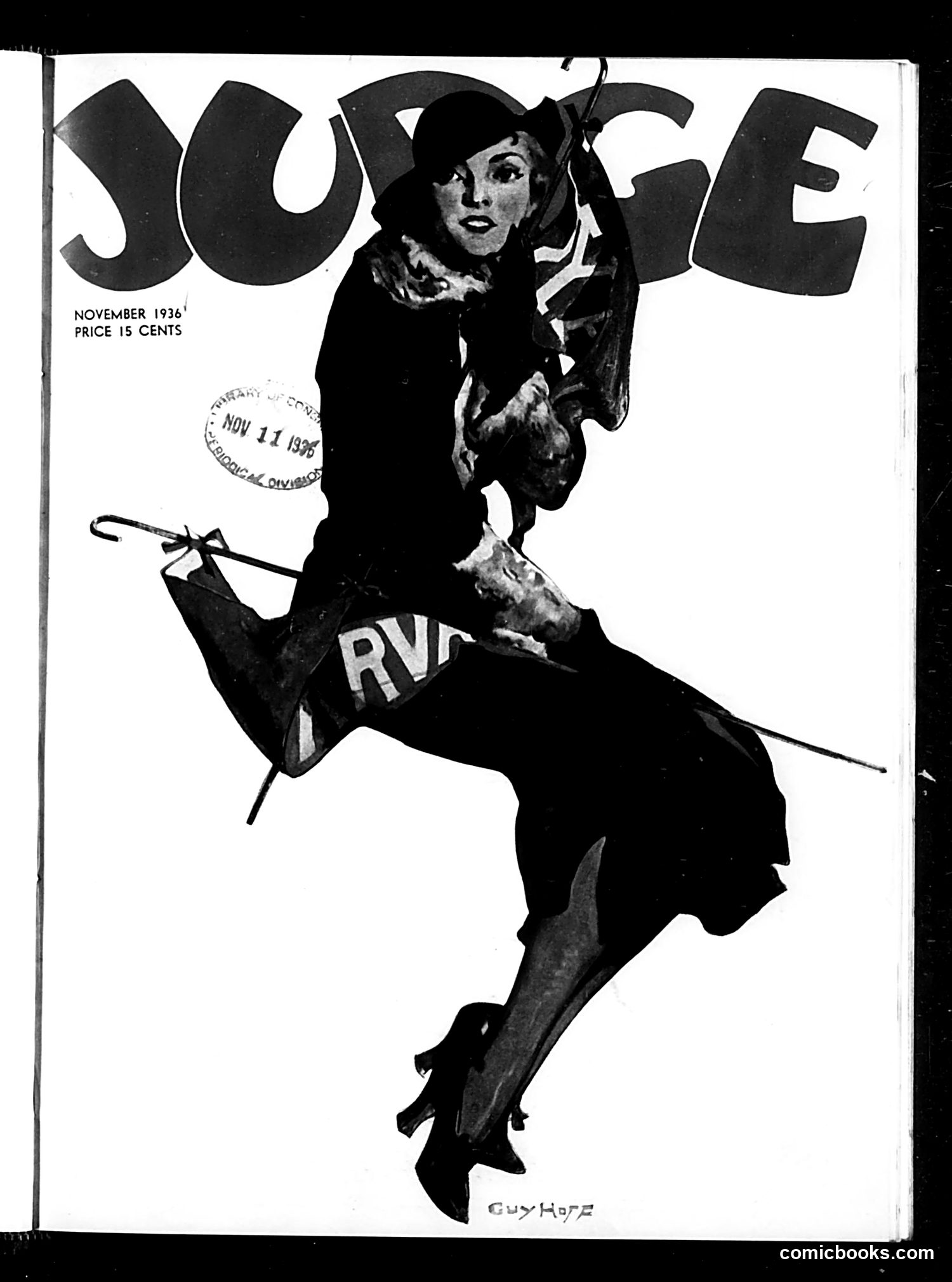
# Judge Magazine, November 1936 This is the **cover of Judge magazine** from November 1936, priced at 15 cents. The illustration shows a woman in stylish 1930s attire—coat, hat, and heeled shoes—posed dynamically while skiing, with her skis labeled "RVD" (likely referring to a brand or product). The satire appears to target **winter fashion and leisure culture** among affluent Americans during the Depression era. The playful, energetic pose suggests Judge was mocking either the impracticality of fashionable winter wear for actual skiing, or perhaps satirizing wealthy Americans' carefree spending on luxury activities while the economy struggled. The artist's signature reads "GUY HOFF," a notable Judge cartoonist of the period.
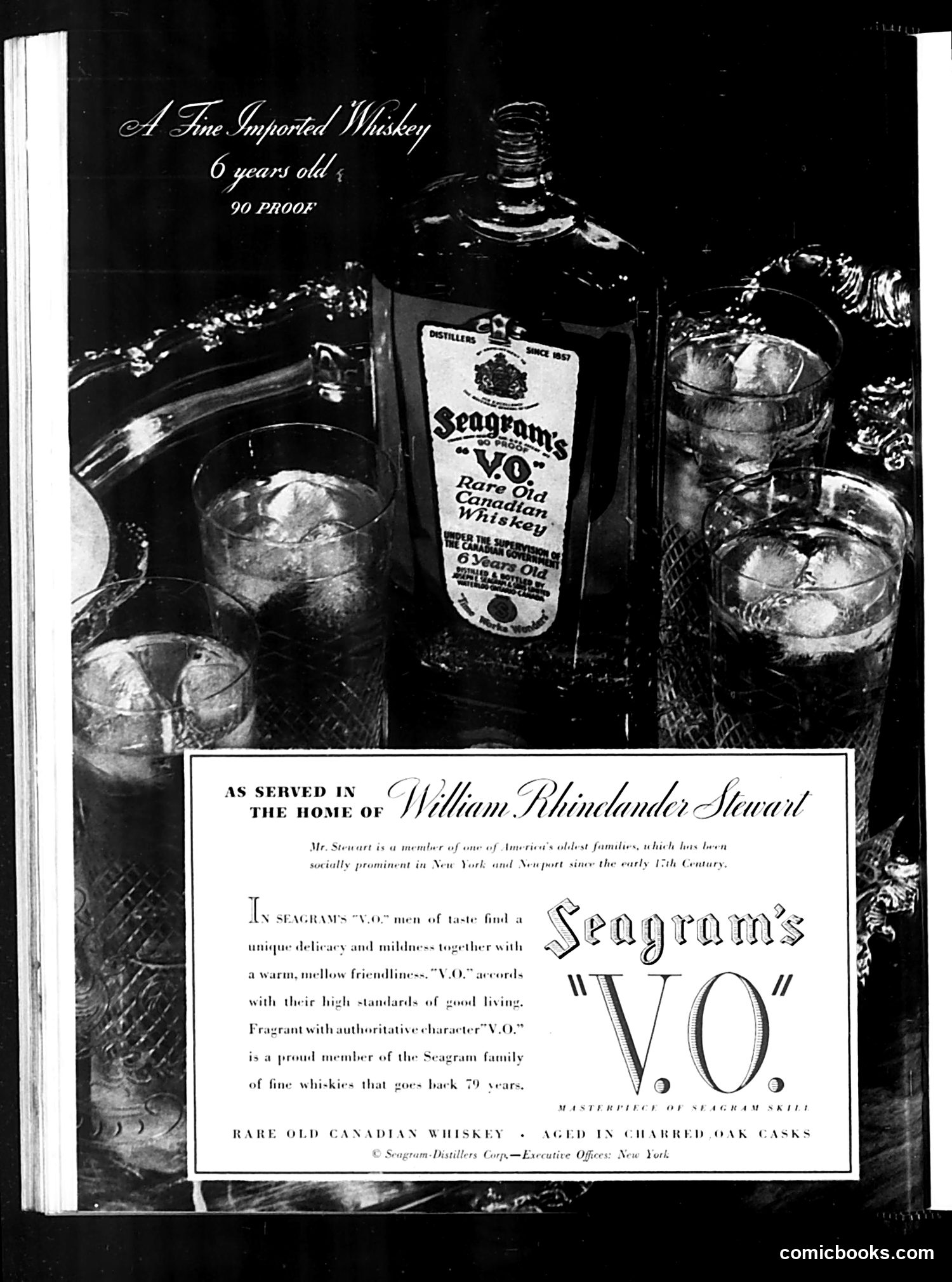
# Content Analysis This page is **primarily an advertisement**, not political satire or a cartoon. It advertises Seagram's V.O. whiskey—a "Fine Imported Whiskey, 6 years old, 90 PROOF"—featuring a bottle displayed with glasses of the drink. The ad uses a prestige endorsement strategy by claiming the product is "AS SERVED IN THE HOME OF William Rhinelander Stewart," described as a member of one of America's oldest prominent families in New York and Newport since the early 18th century. The marketing appeals to aspirational consumers by associating the whiskey with old-money, upper-class respectability and "high standards of good living." This appears to be from the pre-Prohibition or early post-Prohibition era based on the advertising style and design.
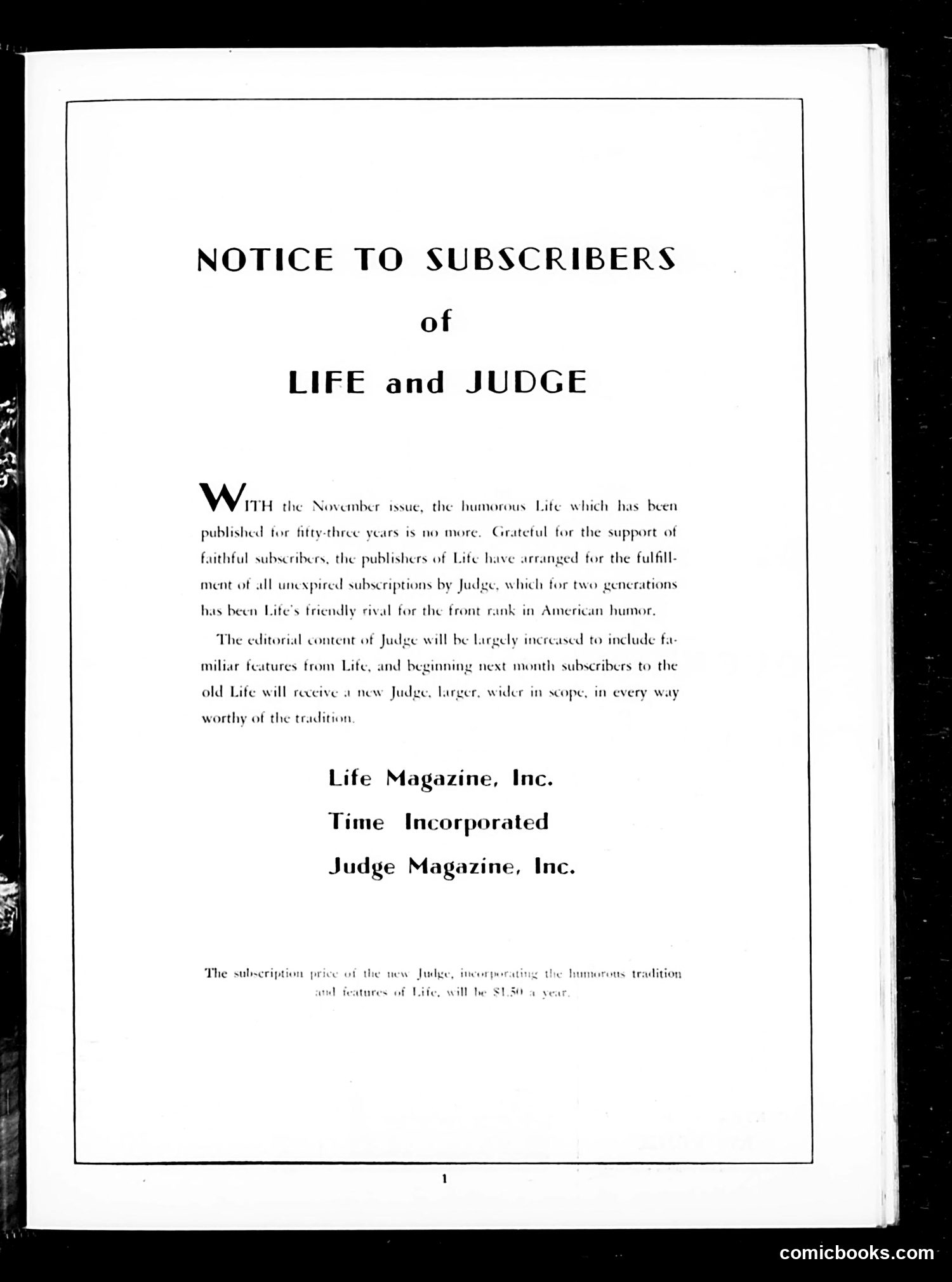
This page is primarily a **notice to subscribers**, not a cartoon. It announces that *Life* magazine (which had run for 53 years) is discontinuing, and its successor will be *Judge* magazine—which will absorb *Life*'s "humorous tradition" and "familiar features." The notice indicates that starting next month, *Life* subscribers will receive the new *Judge* instead, described as "larger, wider in scope, in every way worthy of the tradition." The subscription price for the combined publication is listed as $1.50 per year. This represents a **merger or rebranding** of two competing American humor magazines. The text emphasizes continuity with *Life*'s established reputation to reassure loyal readers during the transition. There are no cartoons or satirical content visible on this particular page.
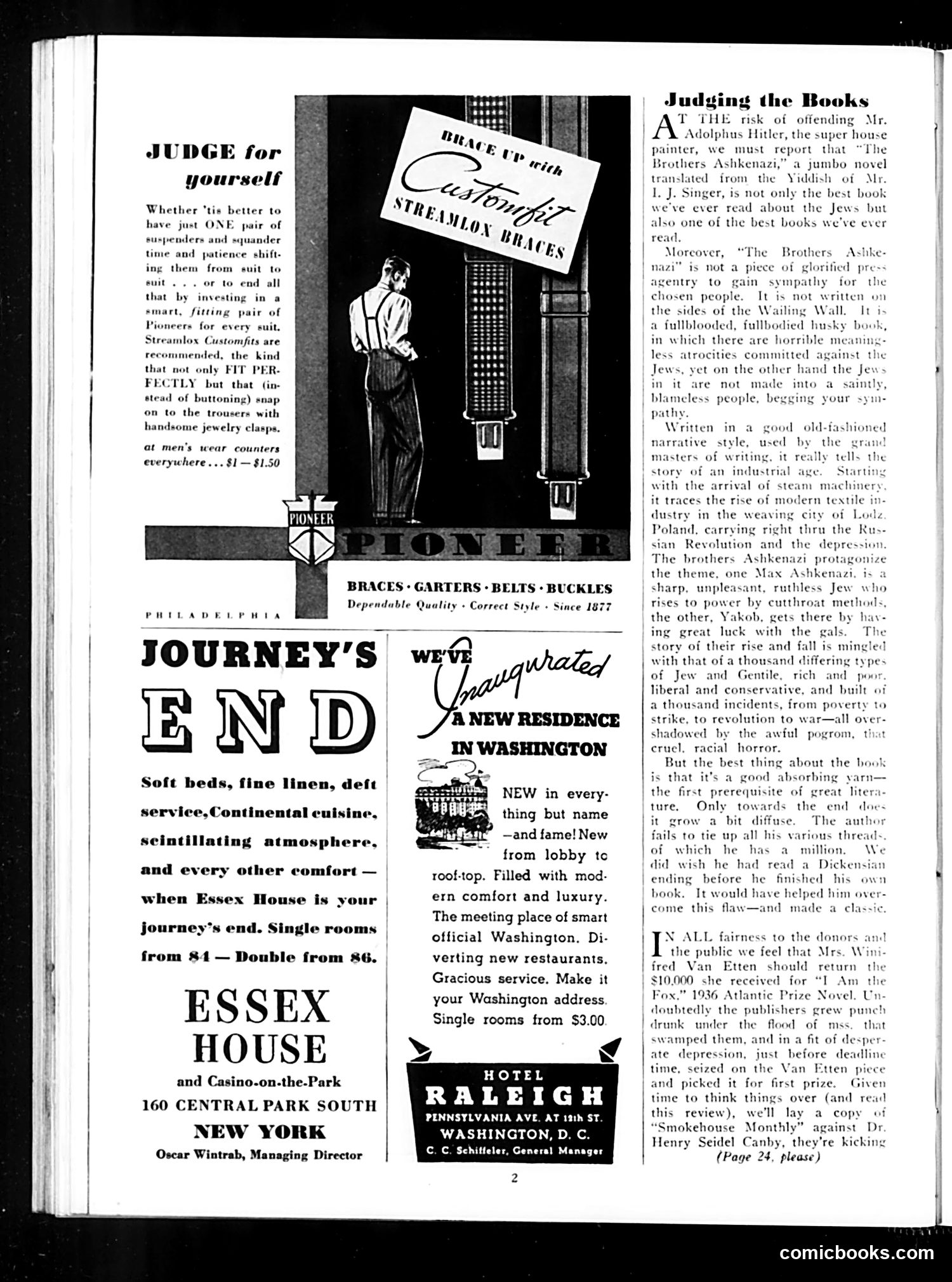
# Analysis of Judge Magazine Page This page is primarily **advertisements** (Pioneer suspenders, Essex House hotel, Hotel Raleigh) with a small book review section titled "Judging the Books." The review discusses two books about Jewish life: "The Brothers Askenazi" (translated from Yiddish) and another work. The reviewer praises them as excellent literature while critiquing "The Brothers Askenazi" for its depiction of Jews—noting it portrays them as neither uniformly sympathetic nor entirely blameworthy, showing instead a realistic "thousand incidents, from poverty to strike, to revolution to war" affecting both Jewish and Gentile characters. The review appears to be promoting literary merit over propagandistic representation, suggesting early-to-mid 20th-century discussions about how Jewish characters should be portrayed in American literature.
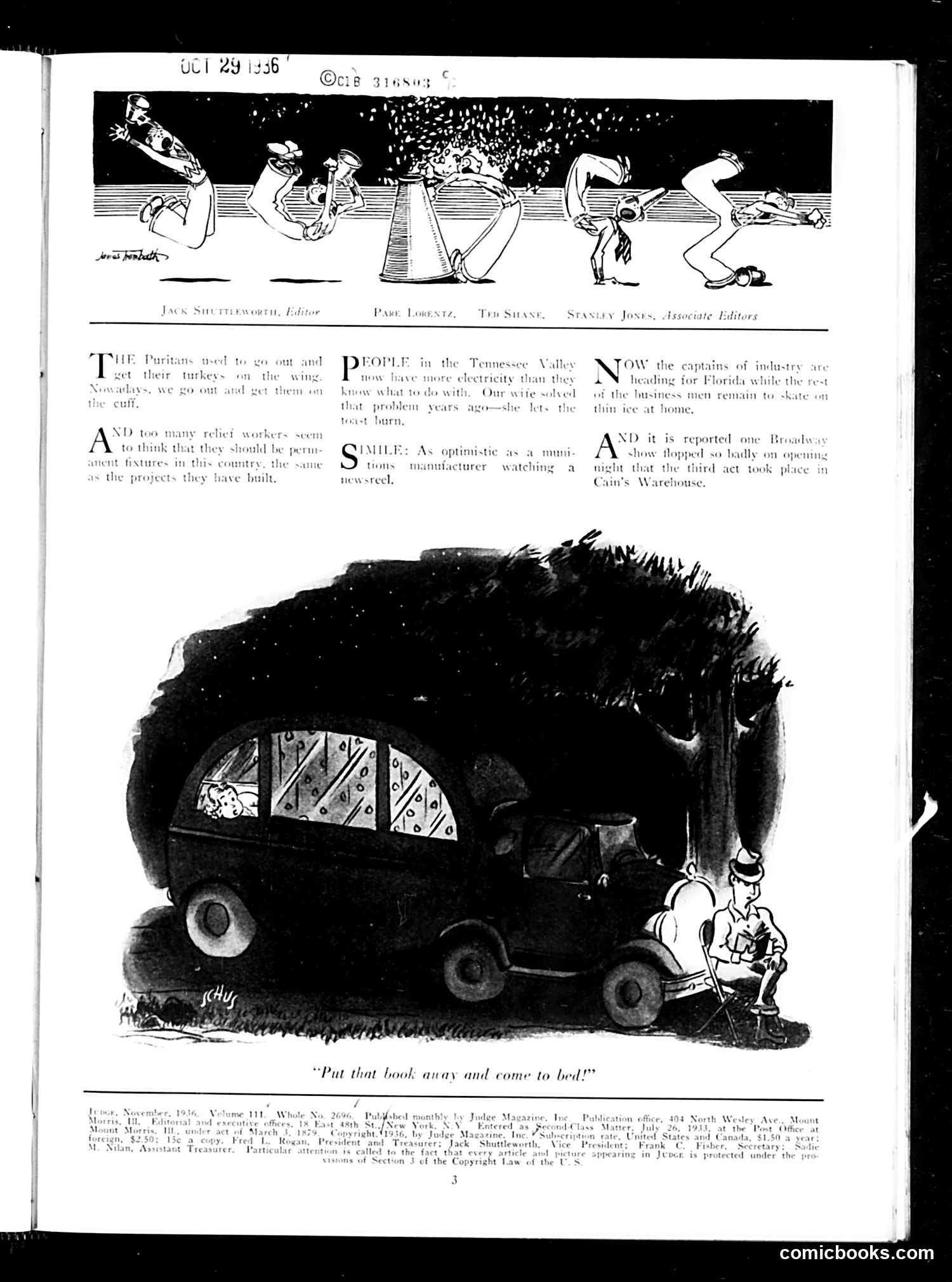
# Analysis of Judge Magazine Page (November 1936) The top panel shows six figures in exaggerated poses labeled as editors: Jack Shuttleworth, Paul Lorentz, Ted Shane, and Stanley Jones. This appears to be satirical commentary on magazine leadership. The main cartoon depicts a car filled with hay or straw, with a small figure hanging from it saying "Put that book away and come to bed!" The satire likely mocks domestic life or perhaps critiques leisure-time reading habits during the Depression era. The accompanying text snippets reference Tennessee Valley Authority (TVA) politics, manufacturing optimism, and a Broadway show mishap at Cain's Warehouse—typical Judge content mixing political commentary with theatrical gossip. The overall page blends editorial satire with social observation characteristic of 1930s American humor magazines.
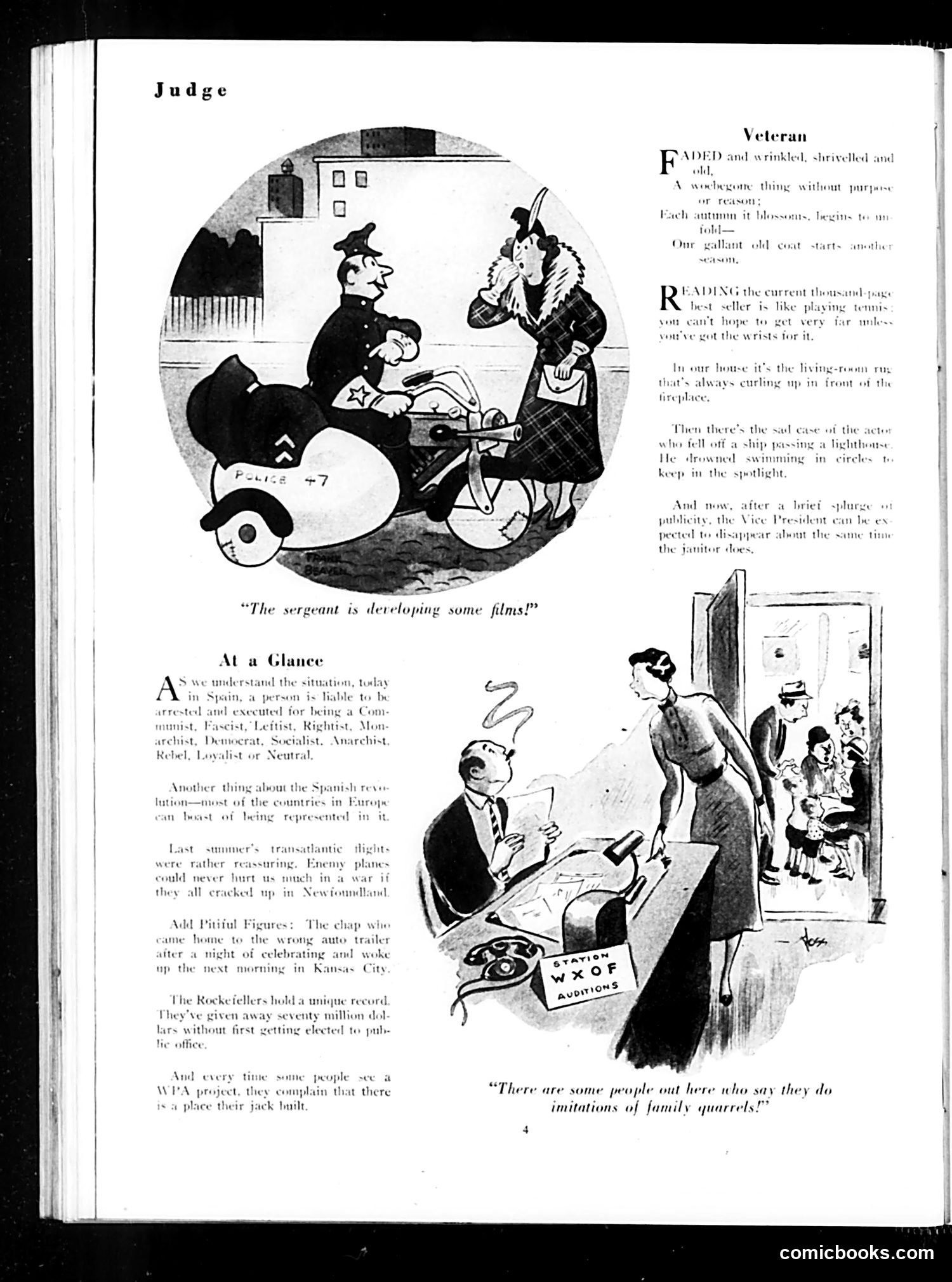
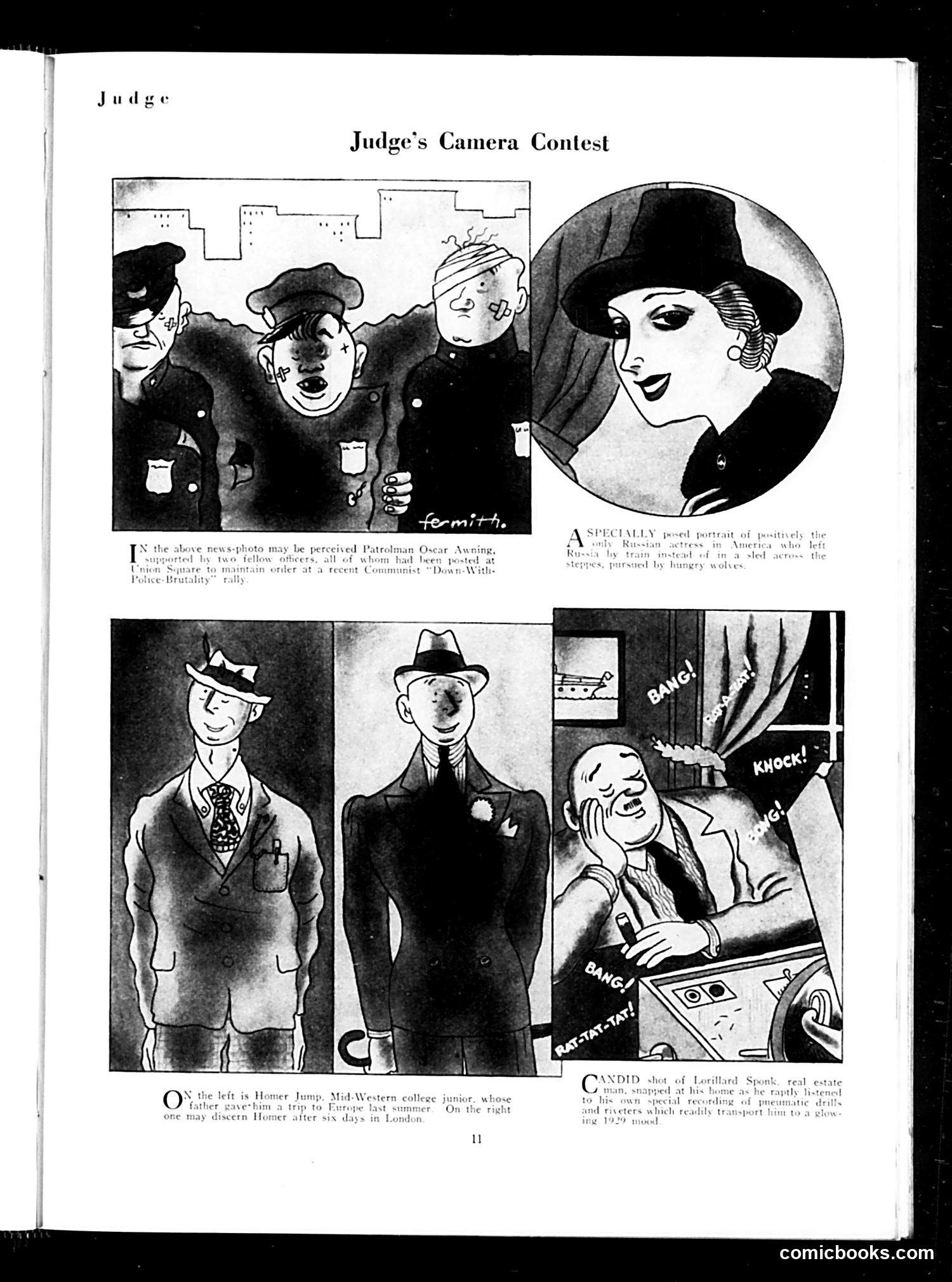
# Analysis The page contains two cartoons satirizing 1930s-era politics and bureaucracy. The top cartoon, "The sergeant is developing some films!" depicts a police officer showing photographs to a woman, likely referencing political surveillance or evidence gathering during an era of significant political tension (references to Communists, Fascists, and various political ideologies appear in the text). The bottom cartoon, "There are some people out here who say they do imitations of family quarrels!" shows an office labeled "Station House of Auditions," where a woman auditions before officials. This appears to mock either WPA arts programs or police/government bureaucratic processes of the Depression era—the satirical point being the absurdity of auditioning or justifying oneself before government authority. Both cartoons reflect Judge magazine's skepticism toward New Deal programs and expanding government power.
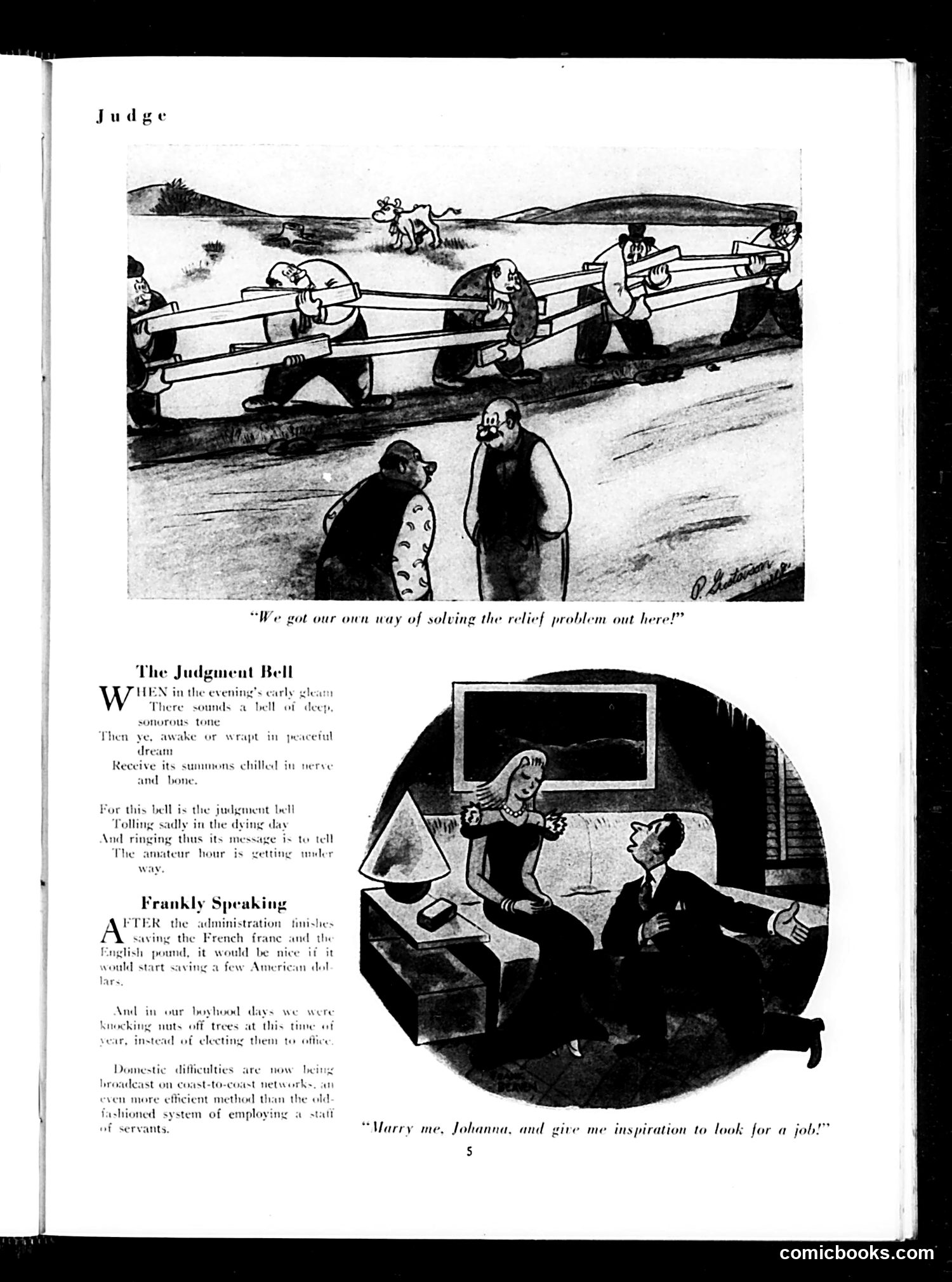
# Analysis of Judge Magazine Page This page contains two satirical pieces from Judge magazine: **"The Judgment Bell"** (top cartoon): Shows figures operating a large seesaw-like contraption labeled as a mechanism for "solving the relief problem." The satire appears to mock ineffective government relief policies—suggesting bureaucratic approaches to poverty assistance were absurdly mechanical and unbalanced rather than genuinely helpful. **"Frankly Speaking"** (bottom cartoon): A woman asks a man to "Marry me, Johanna, and give me inspiration to look for a job!" The accompanying text discusses employment difficulties and mentions "domestic difficulties" being broadcast on radio networks. This satirizes how economic hardship (likely Depression-era) was affecting marriage prospects and employment, while also mocking how personal problems became public entertainment through radio broadcasts.
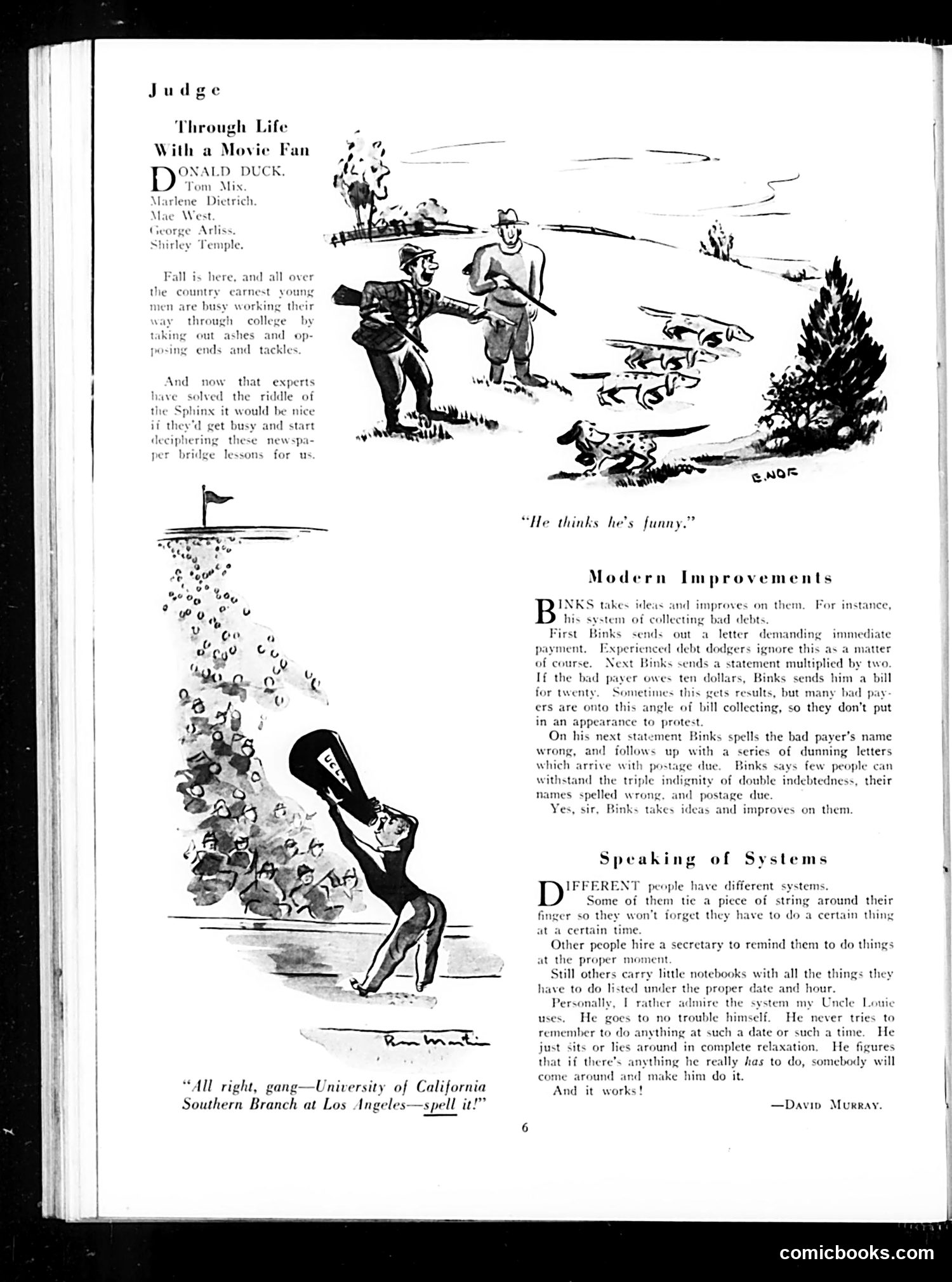
# Analysis of Judge Magazine Page This page contains two distinct sections: **Top Section - "Through Life With a Movie Fan":** A cartoon satirizing movie fan culture, featuring Donald Duck and other celebrities (Marlene Dietrich, Mae West, George Arliss, Shirley Temple). The gag depicts an overeager fan explaining film references to someone golfing, suggesting how movie enthusiasts impose cinema knowledge on everyday situations. **Bottom Section - "Modern Improvements" and "Speaking of Systems":** These are short humorous essays with accompanying cartoons. "Modern Improvements" ridicules a debt collector's elaborate system for pursuing debtors through intentionally misspelled letters and excessive postage. "Speaking of Systems" humorously contrasts different organizational methods people use, ultimately praising those who rely on others to remind them of obligations rather than self-discipline. The satire targets bureaucratic absurdity and modern life inefficiencies.
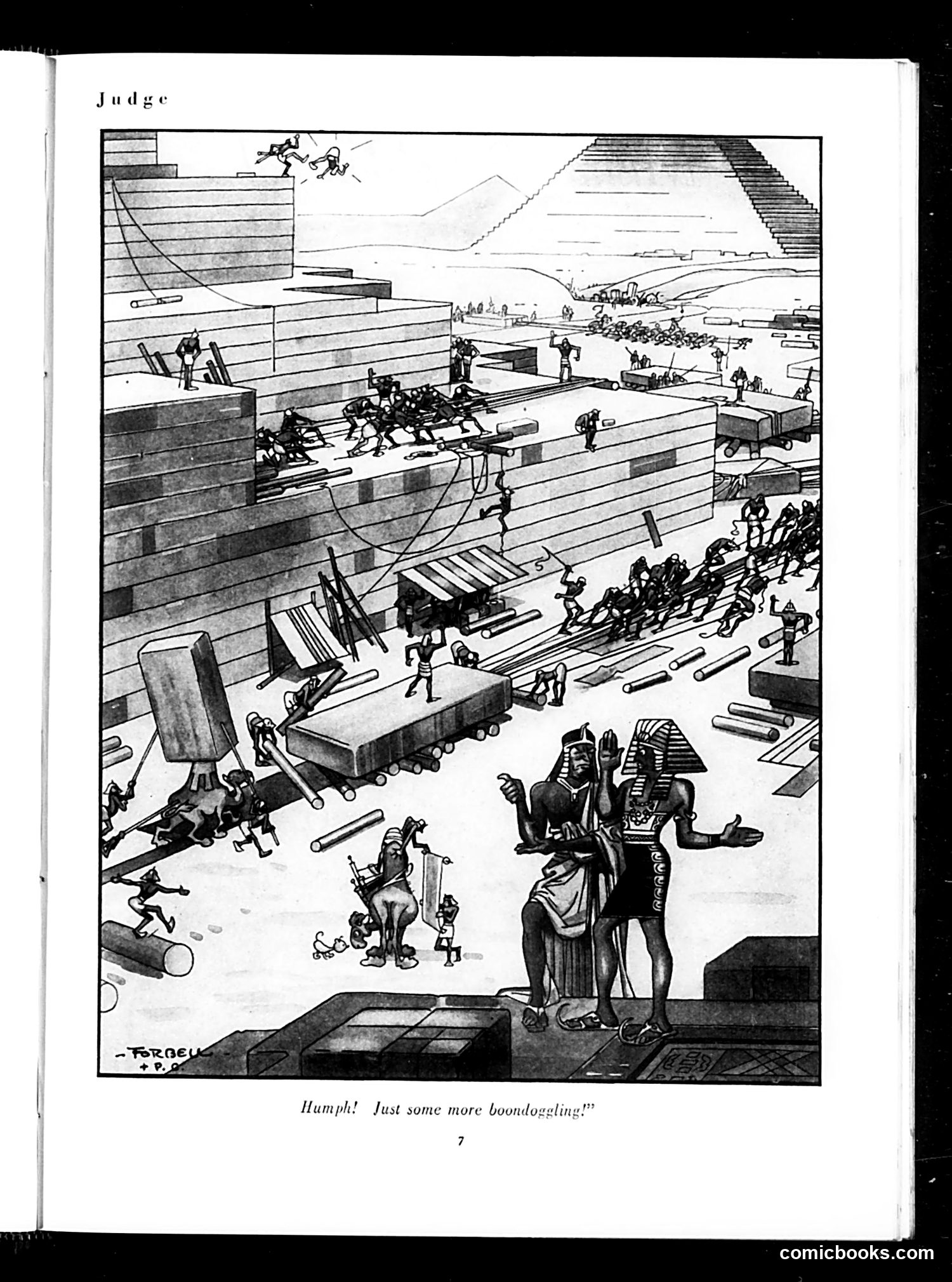
# Analysis of "Judge" Cartoon Page This page depicts an Egyptian construction scene, likely referencing pyramid-building. The foreground shows Egyptian figures in traditional dress (including what appears to be pharaohs or nobles in elaborate headdresses) observing enslaved workers hauling massive stone blocks and logs. The caption reads: "Humph! Just some more boondoggling!" "Boondoggling" was 1930s slang for wasteful government spending on make-work projects. This cartoon satirizes New Deal programs (likely WPA or similar relief initiatives) by comparing them to ancient Egyptian slave labor—suggesting such public works are pointless, wasteful, and exploitative. The joke equates Depression-era relief efforts with inefficient, tyrannical practices, criticizing government intervention in the economy during Franklin Roosevelt's administration.
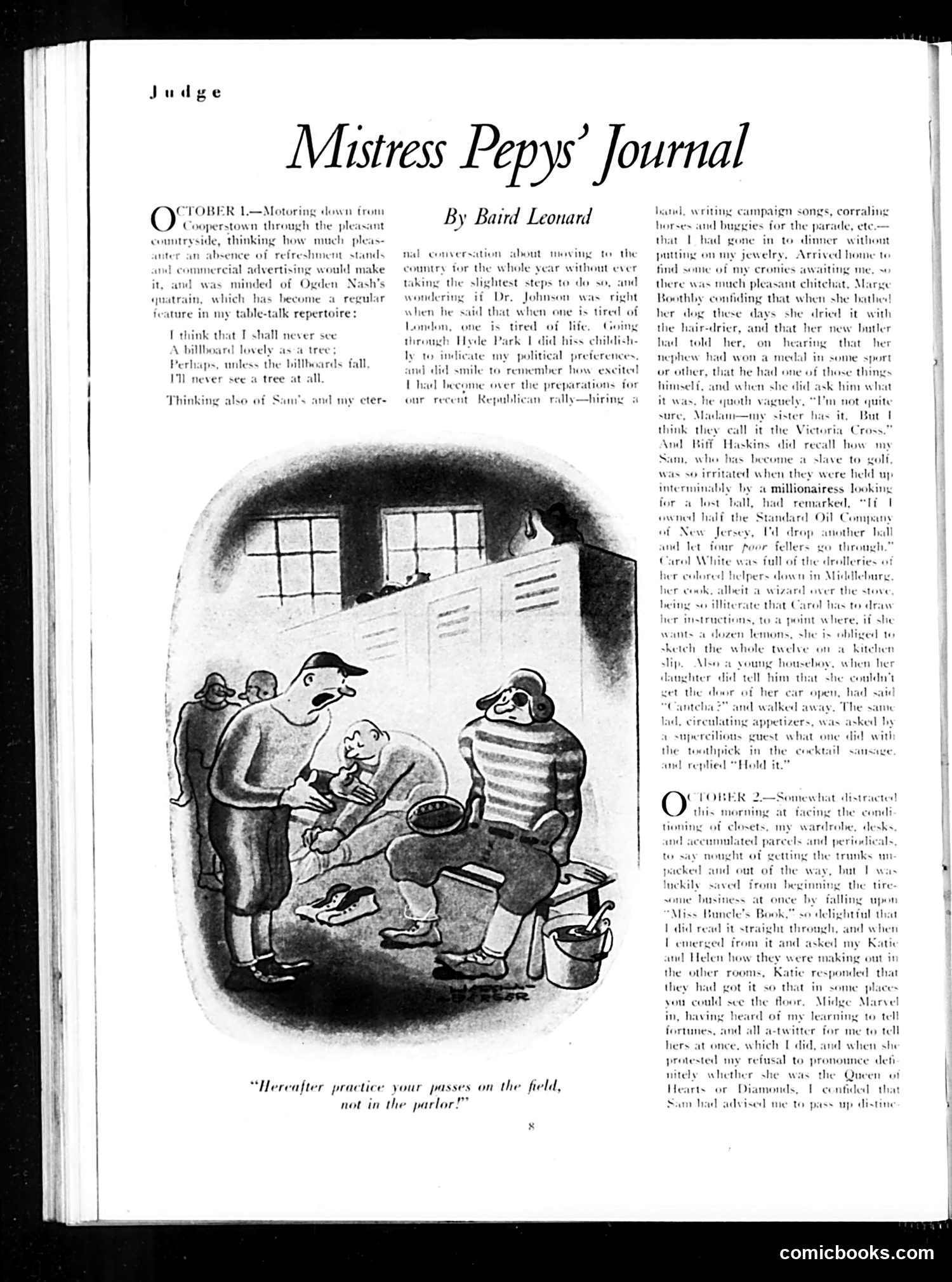
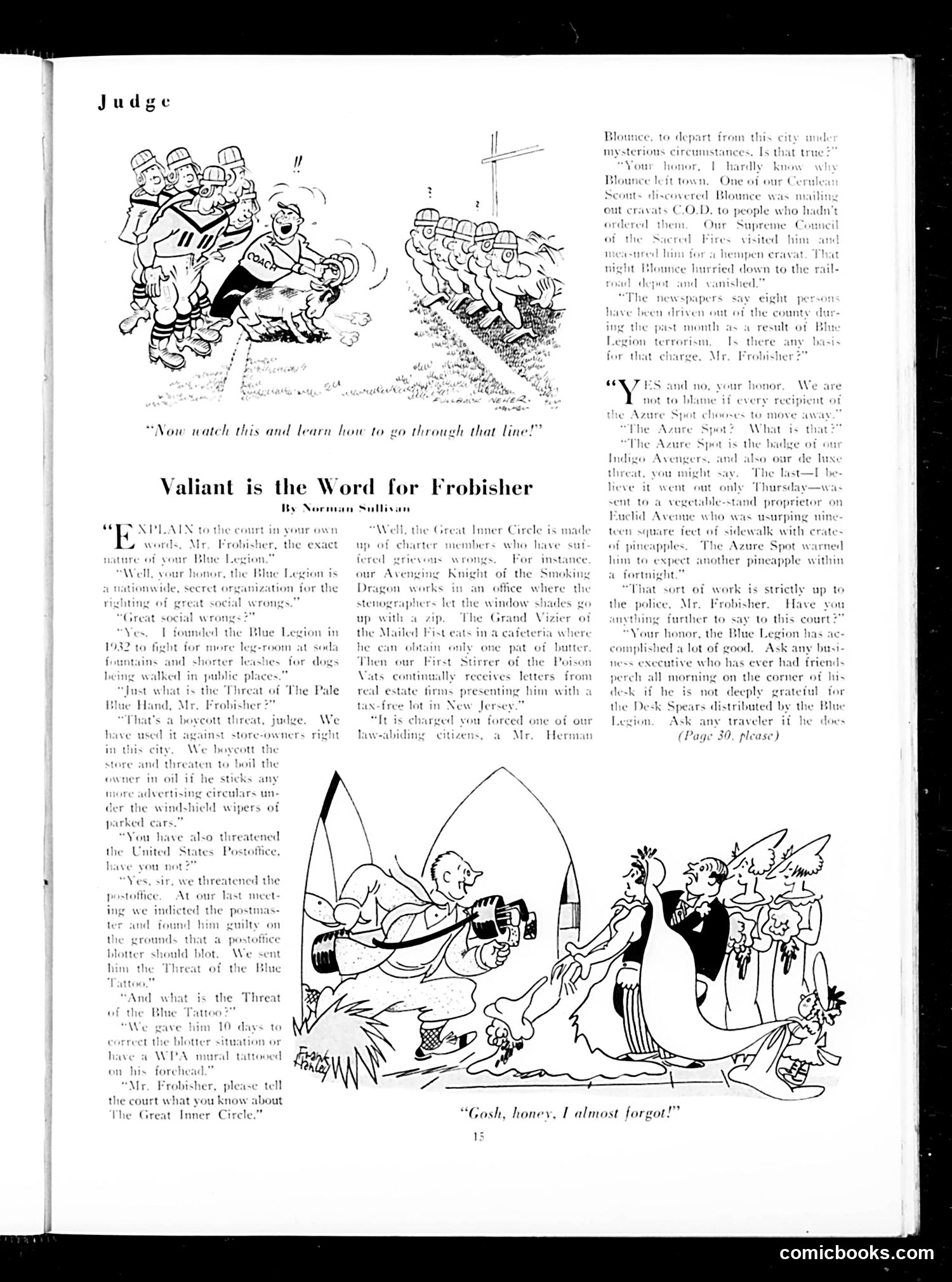
# Mistress Pepys' Journal - October 1-2 This is a humorous column by Baird Leonard mimicking Samuel Pepys's famous diary, written from a society woman's perspective. The accompanying cartoon shows a man instructing others: "Hereafter practice your passes on the field, not in the parlor!"—a joke about football players' romantic behavior. The column's satire targets American upper-class life circa early 20th century: obsession with automobiles, billboard advertising (referencing Ogden Nash's famous quatrain about never seeing a billboard), golf culture, and servants' malapropisms. Notable references include: - **Political enthusiasm** at a Republican rally (likely 1920s-era) - **Standard Oil Company** (major contemporary corporation) - **"Victoria Cross"** (military decoration, humorously confused by a servant) - Society gossip about wealthy acquaintances and their domestic staff's amusing incompetence The humor relies on readers recognizing these social markers and finding genteel mockery of the leisure class entertaining—a core Judge magazine audience appeal.
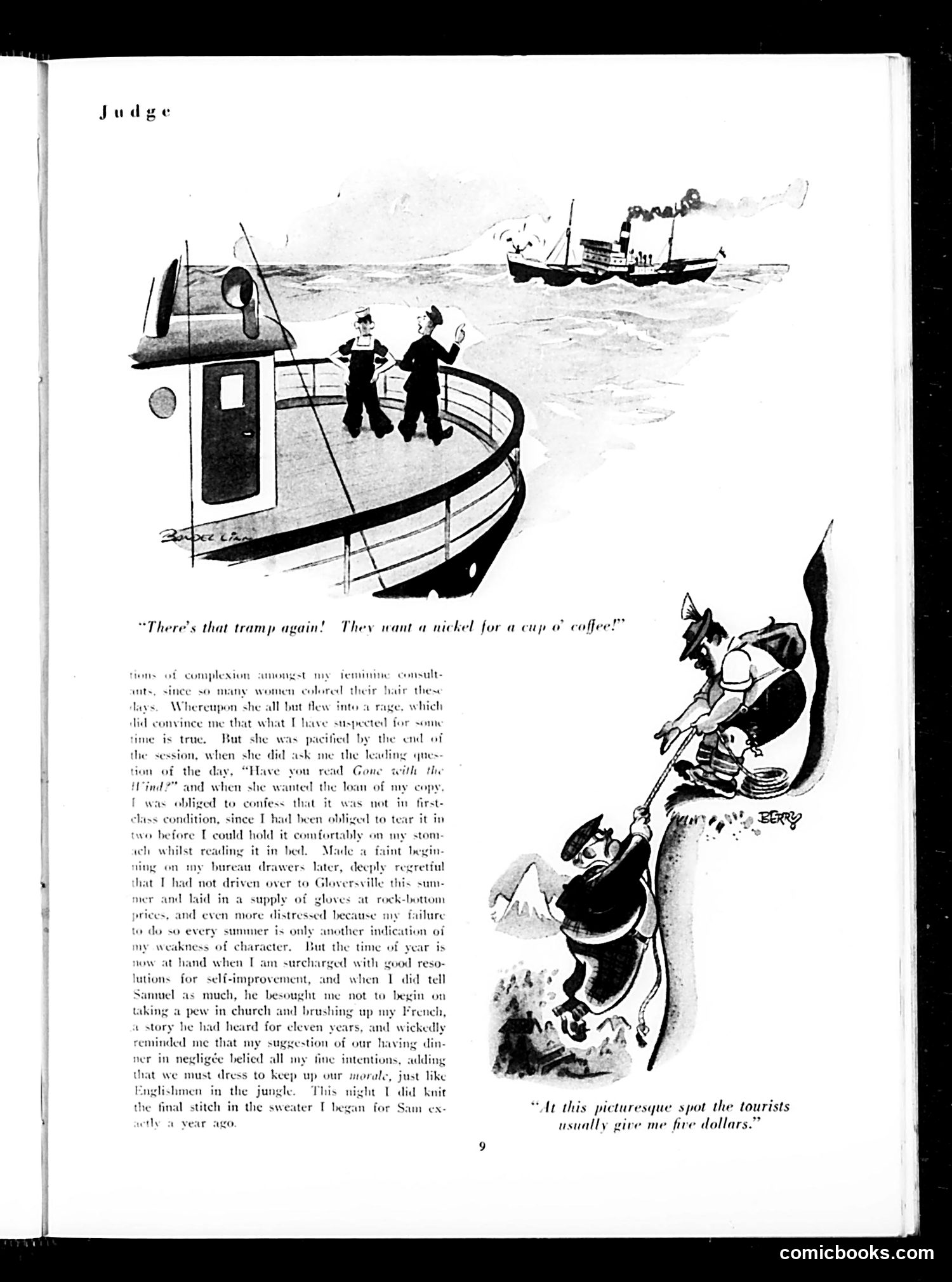
# Page Analysis: Judge Magazine This page contains two cartoons satirizing Depression-era poverty and tourism. **Top cartoon**: Two working-class men on a boat observe a tramp approaching, complaining "They want a nickel for a cup o' coffee!" The satire mocks the entitled attitude of the employed toward the unemployed poor—treating desperate requests for survival money as tiresome nuisances rather than genuine need. **Bottom cartoon**: A Native American (likely depicted in a stereotypical manner common to the era) stands at a scenic location, remarking that tourists usually give him five dollars there. The satire appears to mock both tourist exploitation of indigenous peoples and the performative, transactional nature of such encounters—reducing cultural authenticity to a photo-op with a tip. The accompanying text discusses a woman's social anxieties and self-improvement resolutions, seemingly unrelated to the cartoons. Both cartoons reflect 1930s-40s attitudes toward class, poverty, and ethnic stereotyping that modern readers would find offensive.
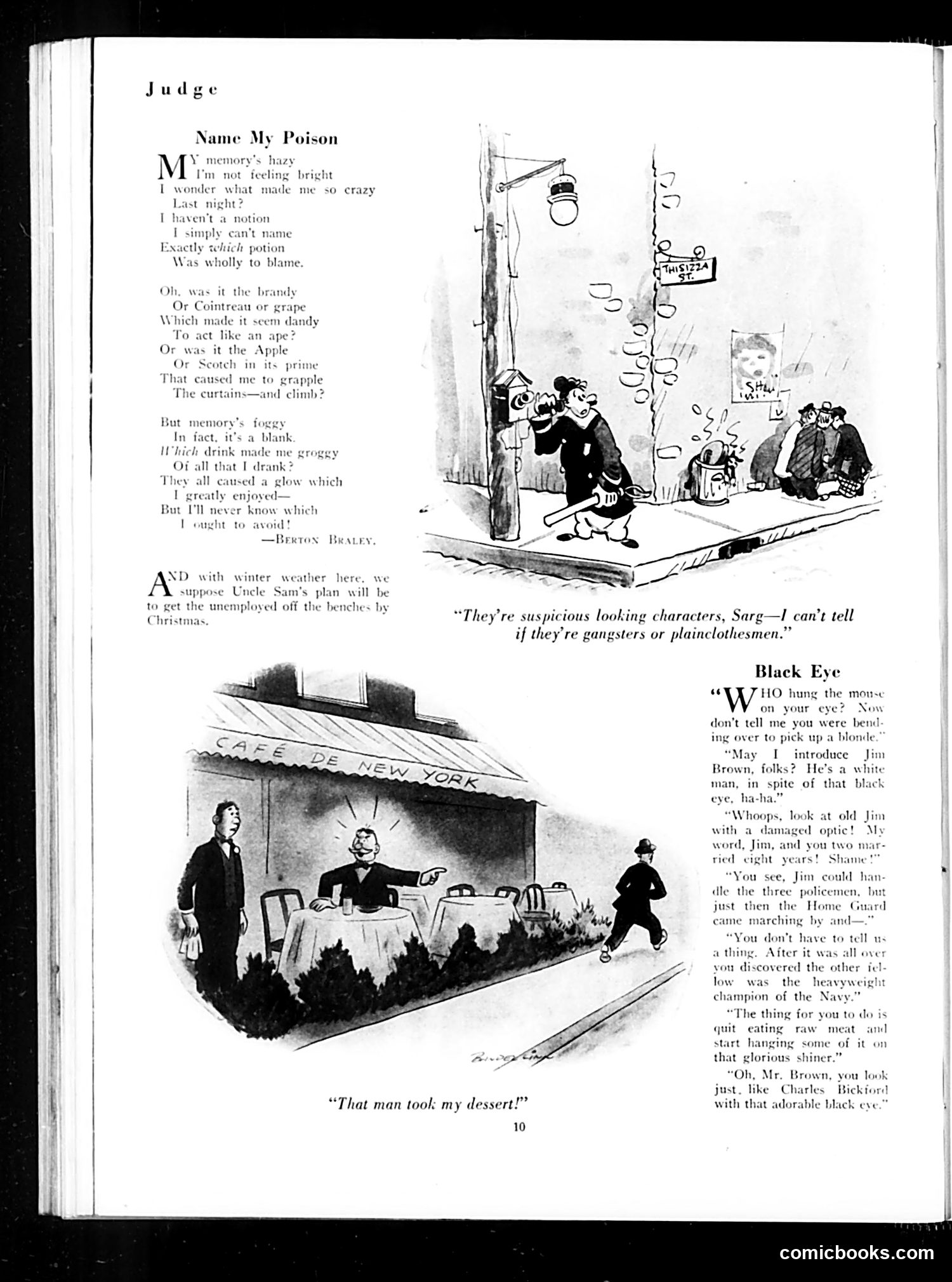
# Judge Magazine Page Analysis This page contains three separate humor pieces from Judge magazine: **"Name My Poison"** (poem by Breton Brayley): Satirizes Prohibition-era drinking. A hungover narrator can't remember which alcoholic beverage caused his intoxication—brandy, Cointreau, grape wine, apple liquor, or Scotch—mocking both the variety of illegal drinks available during Prohibition and the common excuse of feigned amnesia about one's drinking. **Top cartoon**: References unemployment during what appears to be the Great Depression, with Uncle Sam supposedly planning to employ the jobless by winter. **"Black Eye"** (dialogue): A series of jokes about a man with a black eye. The humor derives from increasingly absurd explanations—he fought policemen, then the Home Guard, then discovered his opponent was a Navy heavyweight champion. The final joke compares him to actor Charles Bickford, suggesting his shiner makes him look distinguished or movie-star-like. This appears to be light domestic comedy rather than political satire.