
Judge, 1938-12 · page 22 of 41
Judge — December 1938 — page 22: what you’re looking at
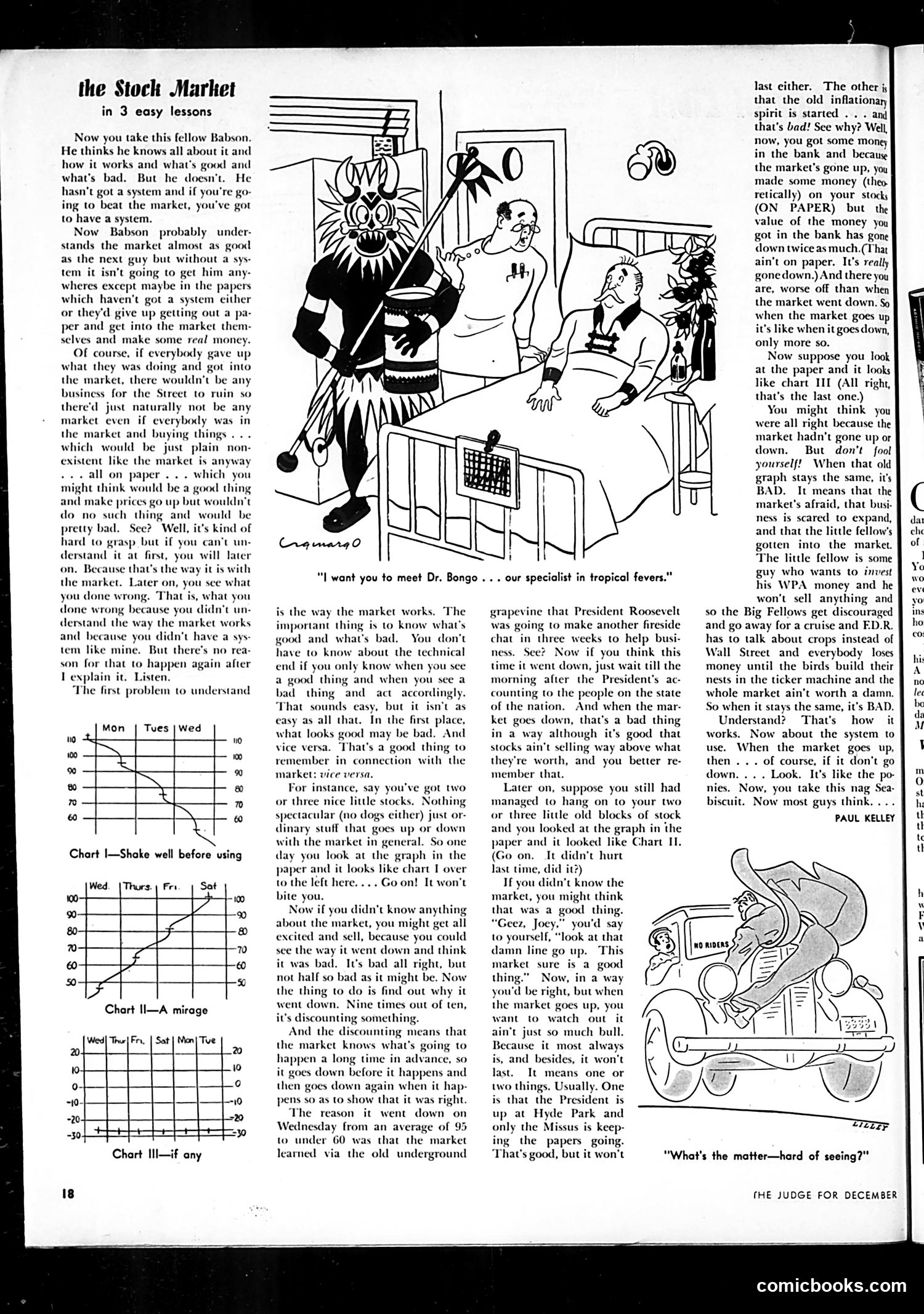
A restored page from Judge, 1938-12. Page through the whole issue in the reader above.
📄 Transcribed text from this page (OCR, searchable)
Machine-transcribed from the original scan — historical spelling and the odd misread are preserved.
the Stockh Market in 3 easy lessons Now you take this fellow Babson. He thinks he knows all about it and how it works and what's good and what's bad. But he doesn't. He hasn‘t got a system and if you're ing to beat the market, you've got to have a system. Now Babson probably under- stands the market almost as good as the next guy but without a sys- tem it isn’t going to get him any- wheres except maybe in the papers which haven't got a system either or they'd give up getting out a pi per and get into the market them- selves and make some real money. Of course, if everybody gave up what they was doing and got into the market, there wouldn't be any business for the Street to ruin so. there'd just naturally not be any market even if everybody was in the market and buying things which would be just plain no existent like the market is anyway . all on paper... which you might think would be a good thing and make prices go up but wouldn't do no such thing and would be pretty bad. See? Well, it’s kind of hard to grasp but if you can’t un- derstand it at first, you will later on, Because that’s the way it is with the market. Later on, you see what you done wrong. That is, what you done wrong because you didn’t un- derstand the way the market works and because you didn't have a sys- tem like mine. But there's no re son for that to happen again after I explain it. Listen. The first problem to understand oR Mon | Tues | Wed Ssaeegs Sages Chart |—Shake well before using Wed. | Thurs.) Fri Sat Chart IIA mirage Tue Chart Ill "I want you to meet Dr. Bongo is the way the market works. The important thing is to know what's good and what's bad. You don’t have to know about the technical end if you only know when you see a good thing and when you sce a bad thing and act accordingly. That sounds easy, but it isn’t as easy as all that. In the first place, what looks good may be bad. And vice versa. That's a good thing to remember in connection with the market: vice versa. For instance, say you've got two or three nice little stocks. Nothing spectacular (no dogs either) just or- dinary stuff that goes up or down with the market in general. So one day you look at the graph in the paper and it looks like chart I over to the left here... Goon! It won't bite you. Now if you didn’t know anythir about the market, you might get all excited and sell, because you could see the way it went down and think it was bad. It’s bad all right, but not half so bad as it might be. Now the thing to do is find out why it went down. Nine times out of ten, it's discounting something. And the discounting means that the market knows what's going to happen a long time in advance, so it goes down before it happens and then gocs down again when it hap- pens so as to show that it was right. The reason it went down on Wednesday from an average of 95 to under 60 was that the market learned via the old underground our specialist in tropical fevers." grapevine that President Roosevelt was going to make another fireside chat in three weeks to help busi ness. See? Now if you think this time it went down, just wait till the morning after the President's ac- counting to the people on the state of the nation. And when the mar- ket goes down, that’s a bad thing in a way although it’s good that stocks ain't selling way above what they're worth, and you better re- member that. Later on, suppose you still had managed to hang on to your two or three little old blocks of stock and you looked at the graph in the paper and it looked like Chart I. (Go on. It didn't hurt last time, did If you didn’t know the market, you might think that was a good thing. “Geez, Joey,” you'd say to yourself, “look at that damn line go up. This market sure is a good thing.” Now, in a way you'd be right, but when the market goes up, you want to watch out it ain't just so much bull. Because it most always is, and besides, it won't last. It means one or two things. Usually. One is that the President is up at Hyde Park and only the Missus is keep: ing the papers going. Phat's good, but it won't last either. The other js that the old inflationay spirit is started . . . and that’s bad! See why? Well, Now, you got some mon in the bank and becaug the market's gone up, you made some money (theo retically) on your stocks (ON PAPER) but the value of the money you got in the bank has gone down twice as much.(That ain't on paper. It’s really gonedown.) And there you are, worse off than when the market went down. So when the market goes up it’s like when it goes down, only more so. Now suppose you look at the paper and it looks like chart IIT (AIL right, that’s the last one.) You might think you were all right because the market hadn't gone up or down. But don’t fool yourself! When that old graph stays the same, it's BAD. It means that the market's afraid, that busi- ness is scared to expand, and that the little fellow's gotten into the market. The little fellow is some guy who wants to invest his WPA money and he won't sell anything and so the Big Fellows get discouraged and go away for a cruise and ED.R. has to talk about crops instead of Wall Street and everybody loses money until the birds build their nests in the ticker machine and the whole market ain't worth a damn. So when it stays the same, it’s BAD. Understand? That's how it works. Now about the system to use. When the market goes up, then . . . of course, if it don’t go down. . . . Look. It’s like the po- nies. Now, you take this nag Sea- biscuit. Now most guys think, PAUL KELLEY “What's the matter—hard of seeing?" fHE JUDGE FOR DECEMBER comicbooks.com