
Judge, 1938-09 · page 29 of 53
Judge — September 1938 — page 29: what you’re looking at
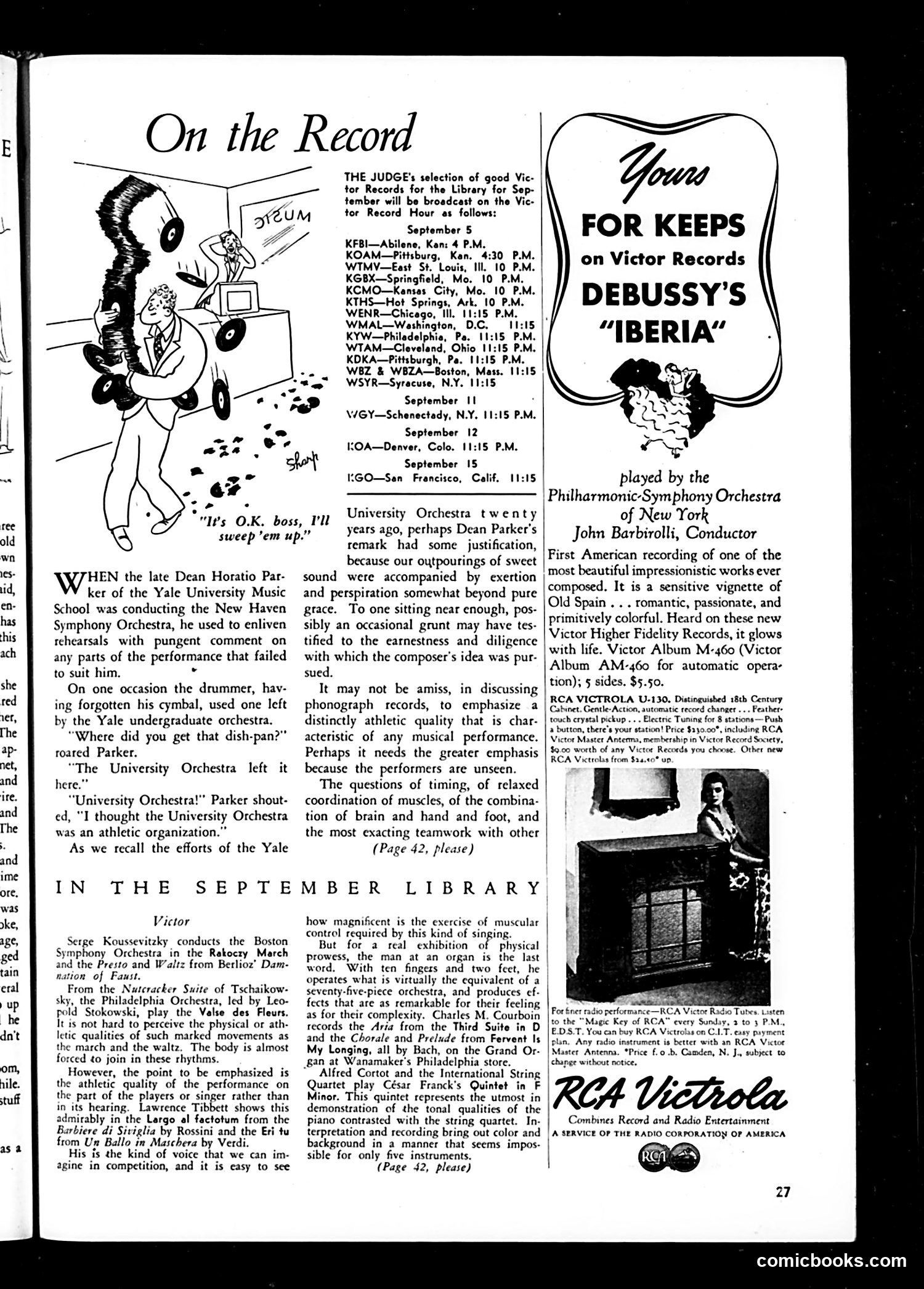
A restored page from Judge, 1938-09. Page through the whole issue in the reader above.
📄 Transcribed text from this page (OCR, searchable)
Machine-transcribed from the original scan — historical spelling and the odd misread are preserved.
On the Record “rlvs O.K. boss, Pl sweep ’em up.” HEN the late Dean Horatio Par- ker of the Yale University Music School was conducting the New Haven Symphony Orchestra, he used to enliven rehearsals with pungent comment on any parts of the performance that failed to suit him. ° On one occasion the drummer, hav- ing forgotten his cymbal, used one left by the Yale undergraduate orchestra. “Where did you get that dish-pan?” roared Parker. “The University Orchestra left it here.” “University Orchestra!” Parker shout- ed, “I thought the University Orchestra was an athletic organization.” As we recall the efforts of the Yale THE JUDGE's selection of good Vie- | tor Records for the Library for Sep- tember will be broadcast on the Vic- tor Record Hour as follows: September 5 KFBI—Abilene, Kan: 4 P.M. KOAM—Pittsburg, Ken. 4:30 P.M. WIMV—East St. Louis, Ill. 10 P.M. KGBX—Springfield, Mo. 10 P.M. KCMO—Kanses City, Mo. 10 P.M. KTHS—Hot Springs, Ark. 10 P.M. WENR—Chicago, Ill, 11:15 P.M. D.C, 1ht5 delphie, Pe. 11:15 P.M. WTAM—Cleveland, Ohio 11:15 P.M. KOKA—Pittsburgh, Pa. 11:15 P.M. WBZ & WBZA—Boston, Mass. 11:15 WSYR—Syracuse, N.Y. 11:15 September 11 \WGY—Schenectady, N.Y. 11:15 PM. September 12 KOA—Denver, Colo. 11:15 P.M. September 15 ;GO—Sen Francisco, Calif. ton, WS: University Orchestra twenty years ago, perhaps Dean Parker's rematk had some justification, because our oytpourings of sweet sound were accompanied by exertion and perspiration somewhat beyond pure grace. To one sitting near enough, pos- sibly an occasional grunt may have tes- tified to the earnestness and diligence with which the composer's idea was pur- sued. It may not be amiss, in discussing phonograph records, to emphasize a distinctly athletic quality that is char- acteristic of any musical performance. Perhaps it needs the greater emphasis because the performers are unseen. The questions of timing, of relaxed coordination of muscles, of the combina- tion of brain and hand and foot, and the most exacting teamwork with other (Page 42, please) IN THE SEPTEMBER LIBRARY Victor Serge Koussevitzky conducts the Boston Symphony Orchestra in the Rakocry March and the Presto and Waltz from Berlioz’ Dam- nation of Faust. From the Nutcracker Suite of Tschaikow- sky, the Philadelphia Orchestra, led by Leo- pold Stokowski, play the Valse des Fleurs. It is not hard to perceive the physics! or ath- letic qualities of such marked movements as the march and the waltz. The body is almost forced ¢o join in these rhythms. However, the point to be emphasized is the athletic quality of the performance on the part of the players or singer rather than in its hearing. Lawrence Tibbett shows this admirably in the Largo al factotum from the Barbiere di Siviglia by Rossini and the Eri tu from Un Ballo in Maschera by Verdi. His is the kind of voice that we can im- agine in competition, and it is easy to see how magnificent is the exercise of muscular control required by this kind of singing. But for a real exhibition of prowess, the man at an organ is the last word, With ten fingers and two feet, he operates what is virtually the equivalent of a seventy-five-piece orchestra, and produces ef- fects that are as remarkable for their feeling as for their complexity. Charles M. Courboin records the Aria from the Third Suite in D and the Chorale and Prelude from Fervent Is My Longing, all by Bach, on the Grand Or- gan at Wanamaker's Philadelphia store. Alfred Cortot and the International String Quartet play César Franck’s Quintet in F Minor. This quintet represents the utmost in demonstration of the tonal qualities of the Piano contrasted with the string quartet. In- terpretation and recording bring out color and background in a manner that seems impos- sible for only five instruments. (Page 42, please) physical | | Yours FOR KEEPS on Victor Records DEBUSSY’S “IBERIA” played by the Philharmonic-Symphony Orchestra of New York John Barbirolli, Conductor First American recording of one of the | most beautiful impressionistic works ever composed. It is a sensitive vignette of Old Spain . . . romantic, passionate, and primitively colorful. Heard on these new Victor Higher Fidelity Records, it glows | with life. Victor Album M-460 (Victor Album AM-460 for automatic opera- tion); § sides. $5.50. | RCA VICTROLA U.130, Distinguished 18th Century Cabinet. Gentle-Action, automatic record changer . .. Feather touch crystal pickup . . . Electric Tuning for 8 stations— Push a button, there's your station! Price $230.00", including RCA Victor Master Antena, membership in Victor Record Soctety, $9.00 worth of any Victor Records you choose. Other new RCA Victrolis from $24.¢0° up. Por io performance—RCA Victor Radio Tutes. Listen to the "Magic Key of RCA™ every Sunday, 2 to 3 P.M, E.DS.T. You can buy RCA Victrolas on C.I.T. easy payment plan, Any radio instrument is better with an RCA Victor Master Antenna. *Price f.0.b. Camden, N. J., subject to chapge without notice, RCA Urctiola Combines Record and Radio Entertainment A SERVICE OP THE RADIO CORPORATION OP AMERICA Ge comicbooks.com