
Judge, 1938-09 · page 28 of 53
Judge — September 1938 — page 28: what you’re looking at
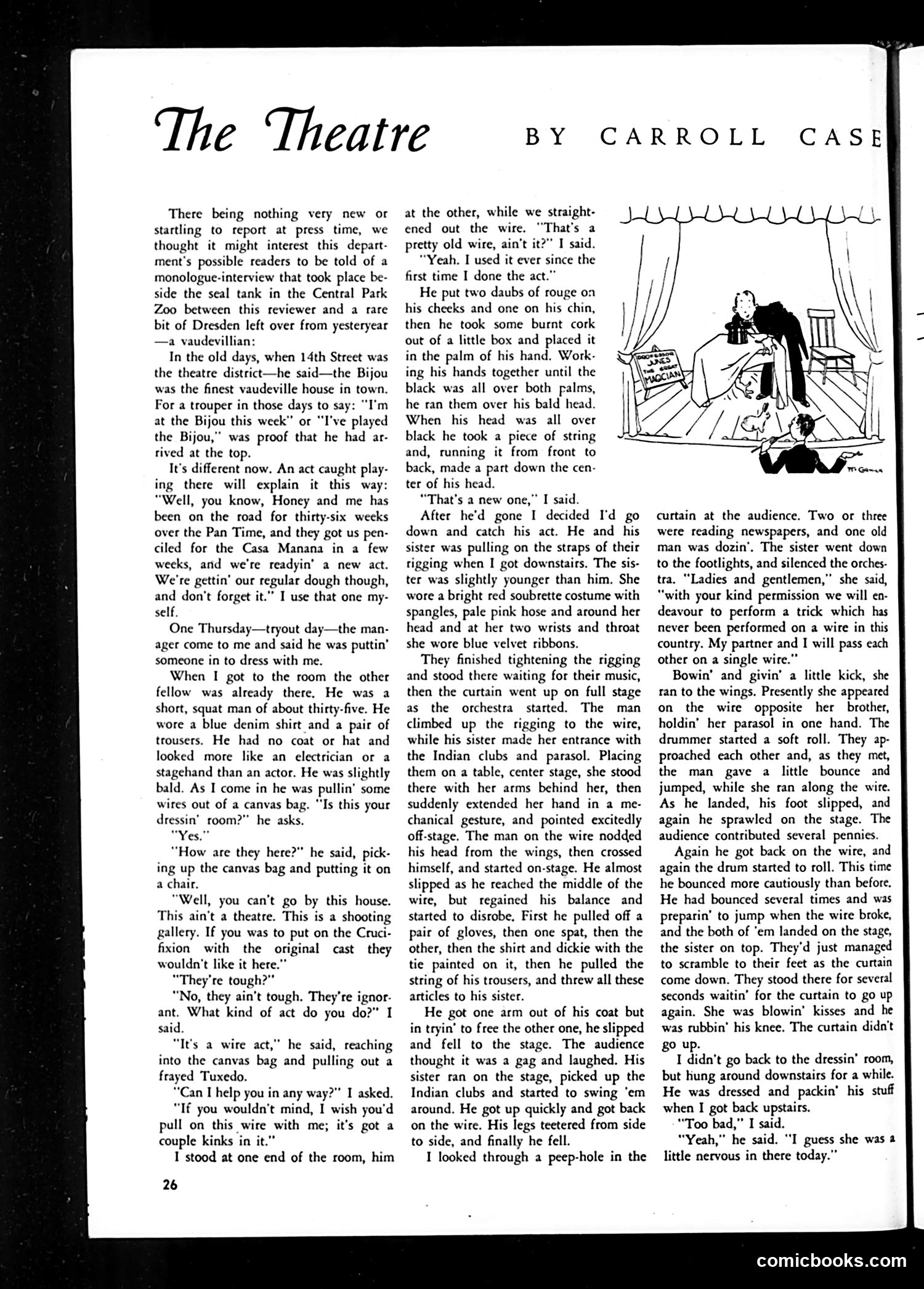
A restored page from Judge, 1938-09. Page through the whole issue in the reader above.
📄 Transcribed text from this page (OCR, searchable)
Machine-transcribed from the original scan — historical spelling and the odd misread are preserved.
The Theatre There being nothing very new or startling to report at press time, we thought it might interest this depart- ment's possible readers to be told of a monologue-interview that took place be- side the seal tank in the Central Park Zoo between this reviewer and a rare bit of Dresden left over from yesteryear —a vaudevillian: In the old days, when 14th Street was the theatre district—he said—the Bijou was the finest vaudeville house in town. For a trouper in those days to say: “I'm at the Bijou this week” or “I've played the Bijou,” was proof that he had ar- rived at the top. It's different now. An act caught play- ing there will explain it this way: “Well, you know, Honey and me has been on the road for thirty-six weeks over the Pan Time, and they got us pen- ciled for the Casa Manana in a few weeks, and we're readyin’ a new act. We're gettin’ our regular dough though, and don’t forget it.” I use that one my- self. One Thursday—tryout day—the man- ager come to me and said he was puttin’ someone in to dress with me. When I got to the room the other fellow was already there, He was a short, squat man of about thirty-five. He wore a blue denim shirt and a pair of trousers. He had no coat or hat and looked more like an electrician or a stagehand than an actor. He was slightly bald. As I come in he was pullin’ some wires out of a canvas bag. “Is this your dressin’ room?” he asks. “Yes.” “How are they here?" he said, pick- ing up the canvas bag and putting it on a chair. “Well, you can’t go by this house. This ain't a theatre. This is a shooting gallery. If you was to put on the Cruci- fixion with the original cast they wouldn't like it here.” “They're tough?” “No, they ain't tough. They’re ignor- ant. What kind of act do you do?” I said. “It’s a wire act,” he said, reaching into the canvas bag and pulling out a frayed Tuxedo. “Can I help you in any way?” I asked. “If you wouldn't mind, I wish you'd pull on this wire with me; it’s got a couple kinks in it.” I stood at one end of the room, him 26 at the other, while we straight- ened out the wire. “That's a pretty old wire, ain’t it?” I said. “Yeah. I used it ever since the first time I done the act.” He put two daubs of rouge oa his cheeks and one on his chin, then he took some burnt cork out of a little box and placed it in the palm of his hand, Work- ing his hands together until the black was all over both palms, he ran them over his bald head. When his head was all over black he took a piece of string and, running it from front to back, made a part down the cen- ter of his head. “That's a new one,” I said. After he’d gone I decided I'd go down and catch his act. He and his sister was pulling on the straps of their rigging when I got downstairs. The sis- ter was slightly younger than him. She wore a bright red soubrette costume with spangles, pale pink hose and around her head and at her two wrists and throat she wore blue velvet ribbons. They finished tightening the rigging and stood there waiting for their music, then the curtain went up on full stage as the orchestra started. The man climbed up the rigging to the wire, while his sister made her entrance with the Indian clubs and parasol. Placing them on a table, center stage, she stood there with her arms behind her, then suddenly extended her hand in a me- chanical gesture, and pointed excitedly off-stage. The man on the wire nodded his head from the wings, then crossed himself, and started on-stage. He almost slipped as he reached the middle of the wire, but regained his balance and started to disrobe, First he pulled off a pair of gloves, then one spat, then the other, then the shirt and dickie with the tie painted on it, then he pulled the string of his trousers, and threw all these articles to his sister. He got one arm out of his coat but in tryin’ to free the other one, he slipped and fell to the stage. The audience thought it was a gag and laughed. His sister ran on the stage, picked up the Indian clubs and started to swing ‘em around. He got up quickly and got back on the wire. His legs teetered from side to side, and finally he fell. I looked through a peep-hole in the BY CARROLL CASE curtain at the audience. Two or three were reading newspapers, and one old man was dozin’. The sister went down to the footlights, and silenced the orches- tra. “Ladies and gentlemen,” she said, “with your kind permission we will en- deavour to perform a trick which has never been performed on a wire in this country. My partner and I will pass each other on a single wire.” Bowin’ and givin’ a little kick, she ran to the wings. Presently she appeared on the wire opposite her brother, holdin’ her parasol in one hand. The drummer started a soft roll. They ap- proached each other and, as they met, the man gave a little bounce and jumped, while she ran along the wire. As he landed, his foot slipped, and again he sprawled on the stage. The audience contributed several pennies. Again he got back on the wire, and again the drum started to roll. This time he bounced more cautiously than before. He had bounced several times and was preparin’ to jump when the wire broke, and the both of ‘em landed on the stage, the sister on top. They'd just managed to scramble to their feet as the curtain come down. They stood there for several seconds waitin’ for the curtain to go up again. She was blowin’ kisses and he was rubbin’ his knee. The curtain didn't go up. I didn’t go back to the dressin’ room, but hung around downstairs for a while. He was dressed and packin’ his stuff when I got back upstairs. “Too bad,” I said. “Yeah,” he said. “I guess she was a little nervous in there today.” comicbooks.com