
Judge, 1938-09 · page 23 of 53
Judge — September 1938 — page 23: what you’re looking at
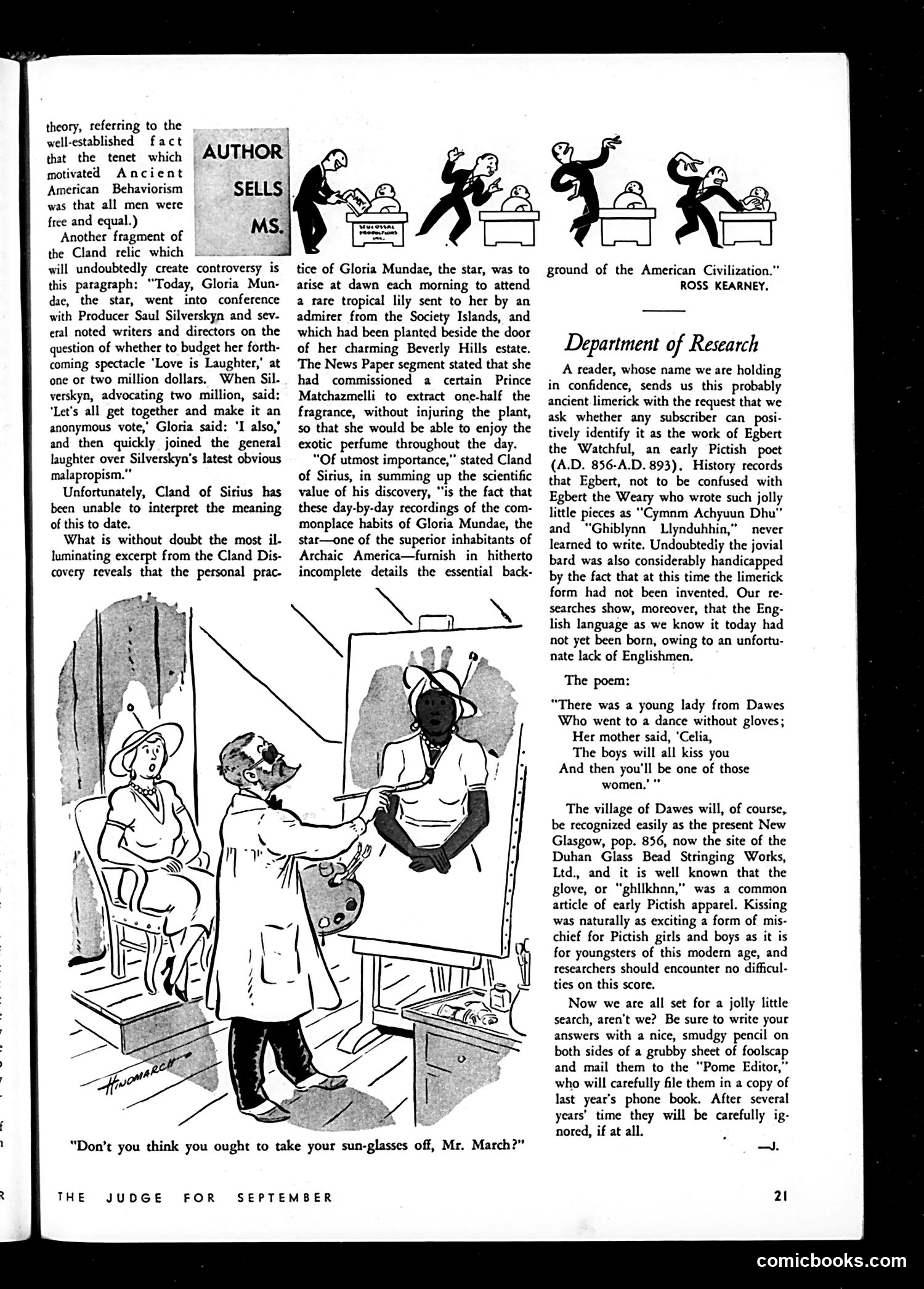
A restored page from Judge, 1938-09. Page through the whole issue in the reader above.
📄 Transcribed text from this page (OCR, searchable)
Machine-transcribed from the original scan — historical spelling and the odd misread are preserved.
theory, referring to the well-established fact that the tenet which motivated Ancient American Behaviorism was that all men were | free and equal.) Another fragment of the Cland relic which ~~ waa will undoubtedly create controversy is this paragraph: “Today, Gloria Mun- dae, the star, went into conference with Producer Saul Silverskyn and sev- eral noted writers and directors on the question of whether to budget her forth- coming spectacle ‘Love is Laughter,’ at one or two million dollars. When Sil- verskyn, advocating two million, said: ‘Let's all get together and make it an anonymous vote,’ Gloria said: ‘I also,’ and then quickly joined the general laughter over Silverskyn’s latest obvious malapropism.” Unfortunately, Cland of Sirius has been unable to interpret the meaning of this to date. What is without doubt the most il- luminating excerpt from the Cland Dis- covery reveals that the personal prac. tice of Gloria Mundae, the star, was to arise at dawn each morning to attend a rare tropical lily sent to her by an admirer from the Society Islands, and which had been planted beside the door of her charming Beverly Hills estate. The News Paper segment stated that she had commissioned a certain Prince Matchazmelli to extract one-half the fragrance, without injuring the plant, so that she would be able to enjoy the exotic perfume throughout the day. “Of utmost importance,” stated Cland of Sirius, in summing up the scientific value of his discovery, “is the fact that these day-by-day recordings of the com- monplace habits of Gloria Mundae, the star—one of the superior inhabitants of Archaic America—furnish in hitherto incomplete details the essential back- “Don’t you think you ought to take your sun-glasses off, Mr. March?” THE JUDGE FOR SEPTEMBER ground of the American Civilization.” ROSS KEARNEY. Department of Research A reader, whose name we are holding in confidence, sends us this probably ancient limerick with the request that we ask whether any subscriber can_posi- tively identify it as the work of Egbert the Watchful, an early Pictish poet (A.D. 856-A.D. 893). History records that Egbert, not to be confused with Egbert the Weary who wrote such jolly little pieces as “Cymnm Achyuun Dhu” and “Ghiblynn Llynduhhin,” never learned to write. Undoubtedly the jovial bard was also considerably handicapped by the fact that at this time the limerick form had not been invented. Our re- searches show, moreover, that the Eng- lish language as we know it today had not yet been born, owing to an unfortu- nate lack of Englishmen. The poem: “There was a young lady from Dawes Who went to a dance without gloves; Her mother said, ‘Celia, The boys will all kiss you And then you'll be one of those women.’ ” The village of Dawes will, of course, be recognized easily as the present New Glasgow, pop. 856, now the site of the Duhan Glass Bead Stringing Works, Ltd., and it is well known that the glove, or “ghilkhnn,” was a common article of early Pictish apparel. Kissing was naturally as exciting a form of mis- chief for Pictish girls and boys as it is for youngsters of this modern age, and researchers should encounter no difficul- ties on this score. Now we are all set for a jolly little search, aren’t we? Be sure to write your answers with a nice, smudgy pencil on both sides of a grubby sheet of foolscap and mail them to the “Pome Editor,” who will carefully file them in a copy of last year’s phone book. After several years’ time they will be carefully ig- nored, if at all. nN. 2 comicbooks.com