
Judge, 1938-06 · page 13 of 53
Judge — June 1938 — page 13: what you’re looking at
What you’re looking at
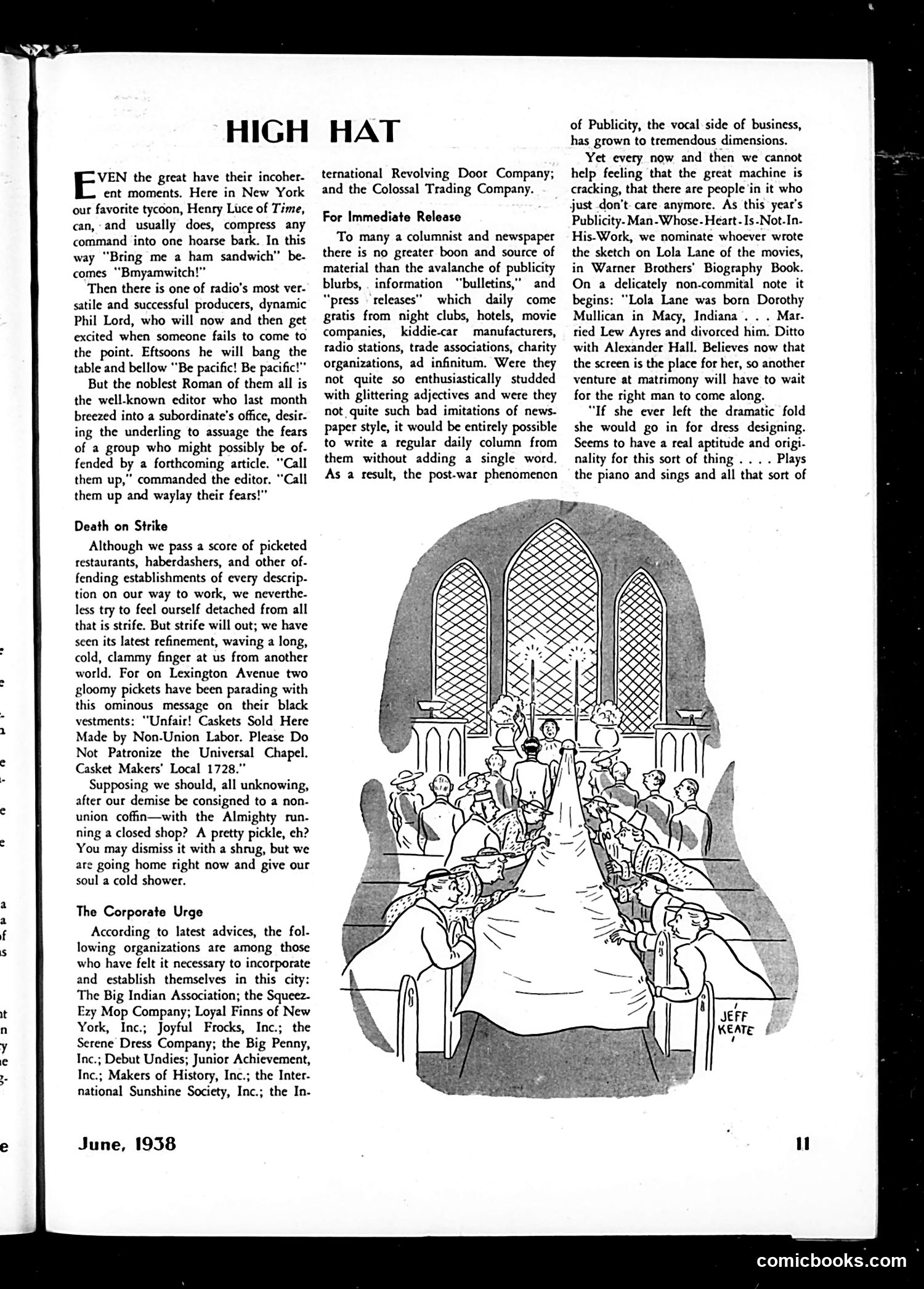
# "High Hat" - Judge Magazine, June 1938 This satirical page mocks the absurdities of 1930s American business and media culture. **"High Hat" opening**: Ridicules powerful men's incomprehensible speech patterns—Henry Luce (Time magazine founder) barks garbled commands; Phil Lord (radio producer) demands people "be pacific"; an unnamed editor confuses subordinates with malapropisms like "waylay their fears." **"Death on Strike"**: Darkly jokes about labor activism extending even to coffin-makers' unions, imagining non-union caskets as a damnation concern. **"The Corporate Urge"**: Lists absurdly named newly-incorporated organizations (Big Indian Association, Squeez-Ezy Mop Company, International Revolving Door Company) satirizing America's corporate boom and the proliferation of trivial organizations seeking legitimacy through incorporation. **Right panel illustration** (by Jeff Keate): Shows a crowded church interior, likely illustrating the casket-maker's union picketing story. The overall theme: powerful executives communicate nonsense; labor strikes reach comic extremes; and Americans obsessively incorporate meaningless entities.
📄 Transcribed text from this page (OCR, searchable)
Machine-transcribed from the original scan — historical spelling and the odd misread are preserved.
HIGH HAT VEN the great have their incoher- ent moments. Here in New York our favorite tycoon, Henry Luce of Time, can,-and usually does, compress any command into one hoarse bark. In this way “Bring me a ham sandwich” be- comes “Bmyamwitch!” Then there is one of radio's most ver- satile and successful producers, dynamic Phil Lord, who will now and then get excited when someone fails to come to the point. Eftsoons he will bang the table and bellow “Be pacific! Be pacific!” But the noblest Roman of them all is the well-known editor who last month breezed into a subordinate’s office, desir- ing the underling to assuage the fears of a group who might possibly be of- fended by a forthcoming article. “Call them up,” commanded the editor. “Call them up and waylay their fears!” Death on Strike Although we pass a score of picketed restaurants, haberdashers, and other of- fending establishments of every descrip- tion on our way to work, we neverthe- less try to feel ourself detached from all that is strife. But strife will out; we have seen its latest refinement, waving a long, cold, clammy finger at us from another world. For on Lexington Avenue two gloomy pickets have been parading with this ominous message on their black vestments: “Unfair! Caskets Sold Here Made by Non-Union Labor. Please Do Not Patronize the Universal Chapel. Casket Makers’ Local 1728.” Supposing we should, all unknowing, after our demise be consigned to a non- union cofin—with the Almighty run- ning a closed shop? A pretty pickle, eh? You may dismiss it with a shrug, but we are going home right now and give our soul a cold shower. The Corporate Urge According to latest advices, the fol- lowing organizations are among those who have felt it necessary to incorporate and establish themselves in this city: The Big Indian Association; the Squeez- Ezy Mop Company; Loyal Finns of New York, Inc.; Joyful Frocks, Inc.; the Serene Dress Company; the Big Penny, Inc.; Debut Undies; Junior Achievement, Inc.; Makers of History, Inc.; the Inter- national Sunshine Society, Inc.; the In. June, 1938 ternational Revolving Door Company; and the Colossal Trading Company. For Immediate Release To many a columnist and newspaper there is no greater boon and source of material than the avalanche of publicity blurbs, . information “bulletins,” and “press ‘releases which daily come gratis from night clubs, hotels, movie companies, kiddie-car manufacturers, radio stations, trade associations, charity organizations, ad infinitum. Were they not quite so enthusiastically studded with glittering adjectives and were they not quite such bad imitations of news- paper style, it would be entirely possible to write a regular daily column from them without adding a single word. As a result, the post-war phenomencn -, ve Os XX 0, Xx On YY x 2 XY? XY WON ", XY XXX) ‘ We ries XY ee OY X of Publicity, the vocal side of business, has grown to tremendous dimensions. Yet every now and then we cannot help feeling that the great machine is cracking, that there are people ‘in it who just don’t care anymore. As this year's Publicity. Man-Whose- Heart - Is-Not-In- His-Work, we nominate whoever wrote the sketch on Lola Lane of the movies, in Warner Brothers’ Biography Book. On a delicately non-commital note it begins: “Lola Lane was born Dorothy Mullican in Macy, Indiana. . . Mar- tied Lew Ayres and divorced him. Ditto with Alexander Hall. Believes now that the screen is the place for her, so another venture at matrimony will have to wait for the right man to come along. “If she ever left the dramatic fold she would go in for dress designing. Seems to have a real aptitude and origi- nality for this sort of thing . . . . Plays the piano and sings and all that sort of comicbooks.com