
Judge, 1937-11 · page 17 of 36
Judge — November 1937 — page 17: what you’re looking at
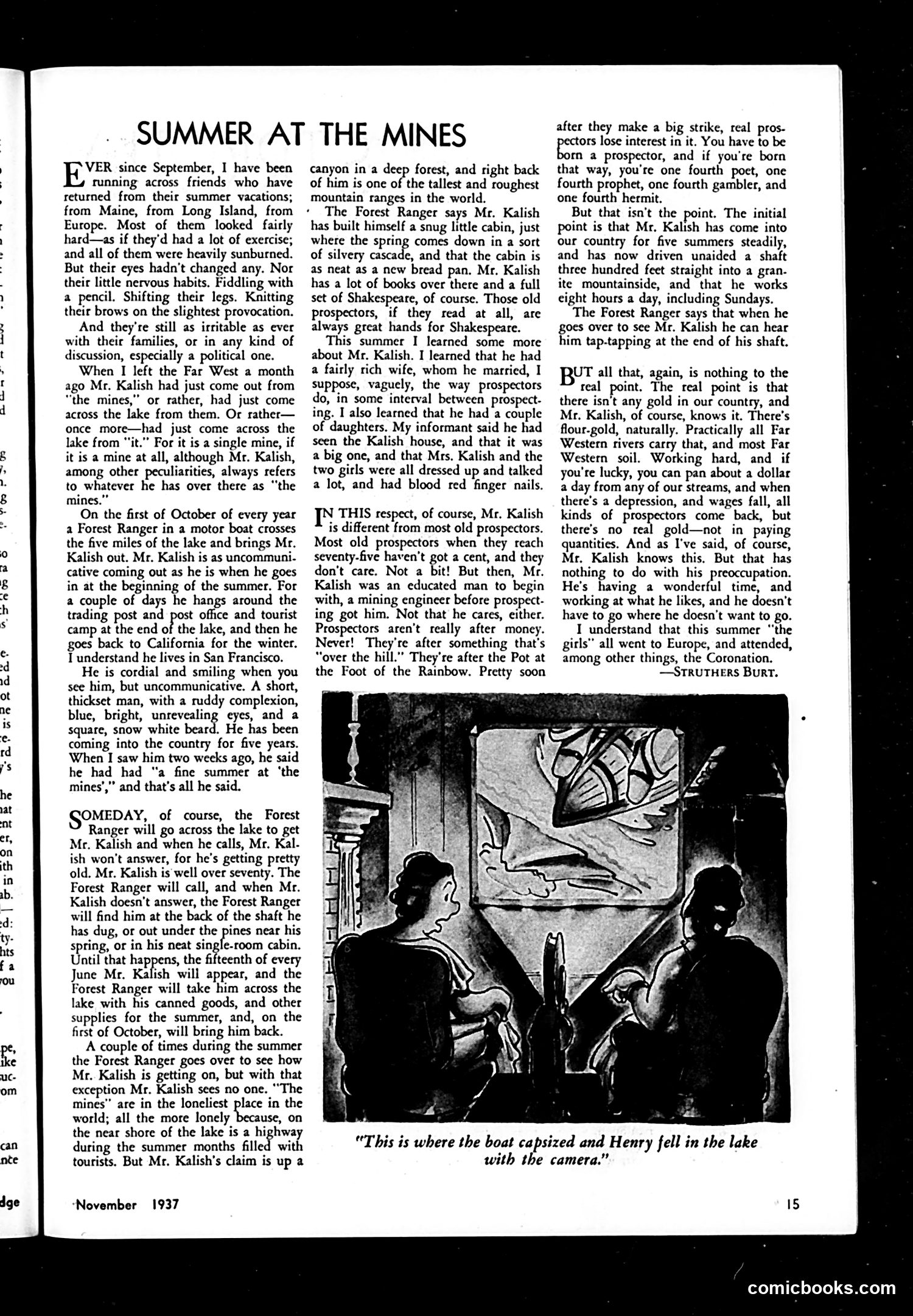
A restored page from Judge, 1937-11. Page through the whole issue in the reader above.
📄 Transcribed text from this page (OCR, searchable)
Machine-transcribed from the original scan — historical spelling and the odd misread are preserved.
SUMMER AT THE MINES | Dade since September, I have been running across friends who have returned from their summer vacations; from Maine, from Long Island, from Europe. Most of them looked fairly hard—as if they'd had a lot of exercise; and all of them were heavily sunburned. But their eyes hadn't changed any. Nor their little nervous habits. Fiddling with a pencil. Shifting their legs. Knitting their brows on the slightest provocation. And they're still as irritable as ever with their families, or in any kind of discussion, especially a political one. When I left the Far West a month ago Mr. Kalish had just come out from “the mines,” or rather, had just come across the lake from them. Or rather— once more—had just come across the lake from “it.” For it is a single mine, if it is a mine at all, although Mr. Kalish, among other peculiarities, always refers to whatever he has over there as “the mines.” On the first of October of every year a Forest Ranger in a motor boat crosses the five miles of the lake and brings Mr. Kalish out. Mr. Kalish is as uncommuni- cative coming out as he is when he goes in at the beginning of the summer. For a couple of days he hangs around the trading post and post office and tourist camp at the end of the lake, and then he goes back to California for the winter. I understand he lives in San Francisco. He is cordial and smiling when you see him, but uncommunicative. A short, thickset man, with a ruddy complexion, blue, bright, unrevealing eyes, and a square, snow white beard. He has been coming into the country for five years. When I saw him two weeks ago, he said he had had “a fine summer at ‘the mines’,” and that's all he said. SOMEDAY, of course, the Forest Ranger will go across the lake to get Mr. Kalish and when he calls, Mr. Kal- ish won't answer, for he's getting pretty old. Mr. Kalish is well over seventy. The Forest Ranger will call, and when Mr. Kalish doesn’t answer, the Forest Ranger will find him at the back of the shaft he has dug, or out under the pines near his spring, or in his neat single-room cabin. Until that happens, the fifteenth of every June Mr. Kalish will appear, and the Forest Ranger will take him across the lake with his canned goods, and other supplies for the summer, and, on the first of October, will bring him back. A couple of times during the summer the Forest Ranger goes over to see how Mr. Kalish is getting on, but with that exception Mr. Kalish sees no one. “The mines” are in the loneliest place in the world; all the more lonely use, on the near shore of the lake is a highway during the summer months filled with tourists. But Mr. Kalish’s claim is up a ‘November 1937 canyon in a deep forest, and right back of him is one of the tallest and roughest mountain ranges in the world. The Forest Ranger says Mr. Kalish has built himself a snug little cabin, just where the spring comes down in a sort of silvery cascade, and that the cabin is as neat as a new bread pan. Mr. Kalish has a lot of books over there and a full set of Shakespeare, of course. Those old prospectors, if they read at all, are always great hands for Shakespeare. This summer I learned some more about Mr. Kalish. I learned that he had a fairly rich wife, whom he married, I suppose, vaguely, the way prospectors do, in some interval between prtospect- ing. I also learned that he had a couple of daughters. My informant said he had seen the Kalish house, and that it was a big one, and that Mrs. Kalish and the two girls were all dressed up and talked a lot, and had blood red finger nails. JN THIS respect, of course, Mr. Kalish is different from most old prospectors. Most old prospectors when they reach seventy-five haven't got a cent, and they don't care. Not a bit! But then, Mr. Kalish was an educated man to begin with, a mining engineer before prospect- ing got him. Not that he cares, either. Prospectors aren't really after money. Never! They're after something that's “over the hill.” They're after the Pot at the Foot of the Rainbow. Pretty soon after they make a big strike, real pros- ‘ors lose interest in it. You have to be fm a prospector, and if you're born that way, you're one fourth poct, one fourth prophet, one fourth gambler, and one fourth hermit. But that isn’t the point. The initial point is that Mr. Kalish has come into our country for five summers steadily, and has now driven unaided a shaft three hundred feet straight into a gran. ite mountainside, and that he works eight hours a day, including Sundays. The Forest Ranger says that when he goes over to see Mr. Kalish he can hear him tap-tapping at the end of his shaft. But all that, again, is nothing to the real point. The real point is that there isn't any gold in our country, and Mr. Kalish, of course, knows it. There's flour-gold, naturally. Practically all Far Western rivers carry that, and most Far Western soil. Working hard, and if you're lucky, you can pan about a dollar a day from any of our streams, and when there's a depression, and wages fall, all kinds of prospectors come back, but there's no real gold—not in paying quantities. And as I've said, of course, Mr. Kalish knows this. But that has nothing to do with his preoccupation. He's having a wonderful time, and working at what he likes, and he doesn’t have to go where he doesn’t want to go. I iedented that this summer “the girls” all went to Europe, and attended, among other things, the Coronation. —STRUTHERS Burr. “This is where the boat capsized and Henry fell in the lake with the camera.” comicbooks.com