
Judge, 1937-11 · page 16 of 36
Judge — November 1937 — page 16: what you’re looking at
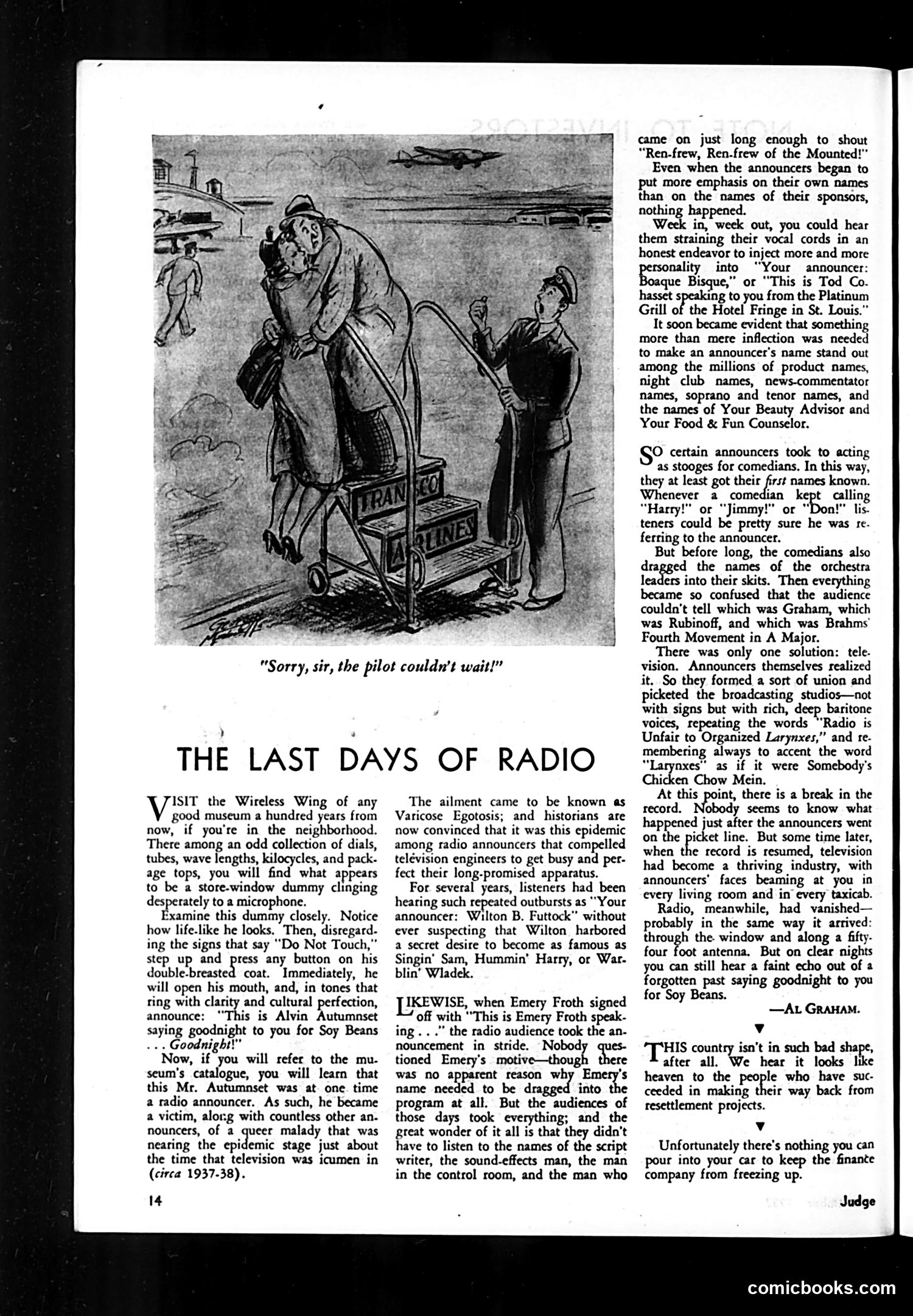
A restored page from Judge, 1937-11. Page through the whole issue in the reader above.
📄 Transcribed text from this page (OCR, searchable)
Machine-transcribed from the original scan — historical spelling and the odd misread are preserved.
"Sorry, sir, the pilot couldn't wait!” THE LAST DAYS OF RADIO Vise the Wireless Wing of any good museum a hundred years from now, if you're in the neighborhood. There among an odd collection of dials, tubes, wave lengths, kilocycles, and pack- age tops, you will find what appears to be a store-window dummy clinging desperately to a microphone. Examine this dummy closely. Notice how life-like he looks. Then, disregard- ing the signs that say “Do Not Touch,” step up and ress any button on his double-breasted coat. Immediately, he will open his mouth, and, in tones that ring with clarity and cultural perfection, announce: “This is Alvin Autumnset saying goodnight to you for Soy Beans +. Goodnight!” Now, if you will refer to the mu- seum's catalogue, you will learn that this Mr. Autumnset was at. one. time a radio announcer. As such, he became a victim, alorg with countless other an- nouncers, of a qices malady that was nearing the epidemic stage just about the time that television was icumen in (circa 1937-38). 14 The ailment came to be known as Varicose Egotosis; and historians are now convinced that it was this epidemic among radio announcers that compelled television engineers to get busy and per- fect their long-promised apparatus. For several years, listeners had been hearing such repeated outbursts as “Your announcer: Wilton B. Futtock” without ever suspecting that Wilton harbored a secret desire to become as famous as Singin’ Sam, Hummin’ Harry, or War. blin’ Wladek. IKEWISE, when Emery Froth signed off with ‘This is Emery Froth speak- ing . . .” the radio audience took the an- nouncement in stride. Nobod es tioned Emery's motive—though there was no sppareat treason wh Emery? name needed to be dra; into the program at all. But the audiences of those days took everything; and the great wonder of it all is that they didn’t have to listen to the names of the script writer, the sound-effects man, the man in the control room, and the man who came on just long enough to shout “Ren-frew, Ren.frew of the Mounted!” Even when the announcers began to put more emphasis on their own names than on the names of their sponsors, sothing happened. ‘Week in, week out, you could hear them straining their vocal cords in an honest endeavor to inject more and more pesouny into “Your announcer: que Bisque,” or “This is Tod Co. hasset sj ing to you from the Platinum Grill of the Hotel Fringe in St. Louis.” It soon became evident that something more than mere inflection was needed to make an announcer's name stand out among the millions of product names, night club names, news-commentator names, soprano and tenor names, and the names of Your Beauty Advisor and Your Food & Fun Counselor. se certain announcers took to acting as stooges for comedians. In this way, they at least got thete fi names known. Whenever a comedian kept calling “Harry!” or “Jimmy!” or “Bont lis. teners could be pretty sure he was re. ferring to the announcer. But before long, the comedians also dragged the names of the orchestra leaders into their skits. Then everything became so confused that the audience couldn't tell which was Graham, which was Rubinoff, and which was Brahms’ Fourth Movement in A Major. There was only one solution: tele. vision. Announcers themselves realized it. So they formed a sort of union and picketed the broadcasting studios—not with signs but with rich, deep baritone voices, repeating the words “Radio is Unfair to Organized Larynxes,” and re- membering always to accent the word “Larynxes” as if it were Somebody's Chicken Chow Mein. At this point, there is a break in the record. Nobody seems to know what happened just after the announcers went on the picket line. But some time later, when the record is resumed, television had become a thriving industry, with announcers’ faces beaming at you in every living room and in every taxicab. Radio, meanwhile, had vanished— robably in the same way it arrived: throng the. window and along a fifty- four foot antenna. But on clear nights you can still hear a faint echo out of 2 forgotten past saying goodnight to you for Soy Beans. —AL GRAHAM. v ‘THis country isn’t in such bad shape, after all. We hear it looks like heaven to the people who have suc- ceeded in making their way back from resettlement projects. v Unfortunately there's nothing you can pour into your car to keep the finante company from freezing up. Judge comicbooks.com