
Judge, 1937-10 · page 28 of 36
Judge — October 1937 — page 28: what you’re looking at
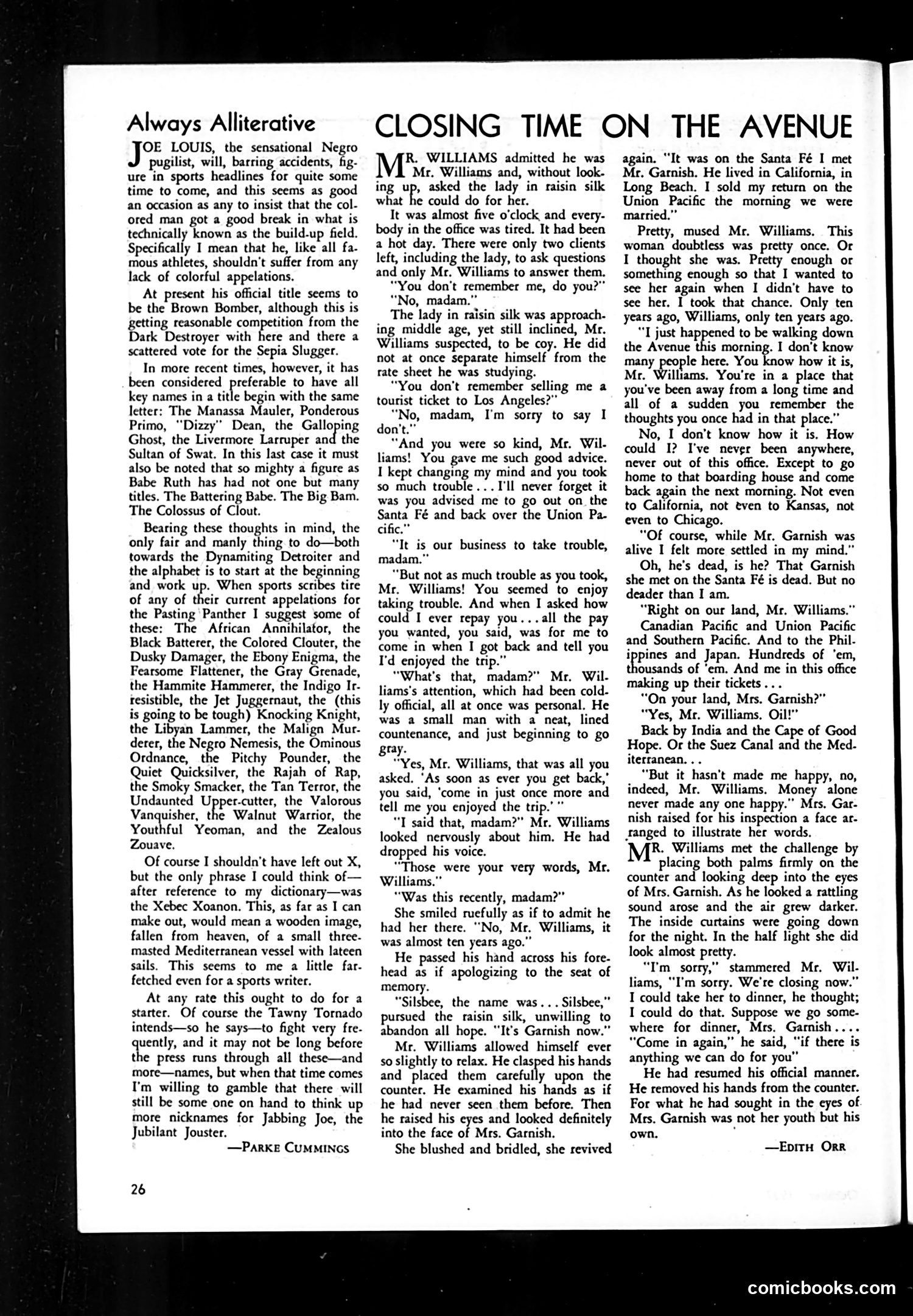
A restored page from Judge, 1937-10. Page through the whole issue in the reader above.
📄 Transcribed text from this page (OCR, searchable)
Machine-transcribed from the original scan — historical spelling and the odd misread are preserved.
Always Alliterative OE LOUIS, the sensational Negro pugilist, will, barring accidents, fig- ure in sports headlines for quite some time to come, and this seems as good an occasion as any to insist that the col- ored man got a good break in what is technically known as the build-up field. Specifically I mean that he, like all fa- mous athletes, shouldn't suffer from any lack of colorful appelations. At present his official title seems to be the Brown Bomber, although this is getting reasonable competition from the Dark Destroyer with here and there a scattered vote for the Sepia Slugger. In more recent times, however, it has been considered preferable to have all key names in a title begin with the same letter: The Manassa Mauler, Ponderous Primo, “Dizzy” Dean, the Galloping Ghost, the Livermore Larruper and the Sultan of Swat. In this last case it must also be noted that so mighty a figure as Babe Ruth has had not one but many titles. The Battering Babe. The Big Bam. The Colossus of Clout. Bearing these thoughts in mind, the only fair and manly thing to do—both towards the Dynamiting Detroiter and the alphabet is to start at the beginning and work up. When sports scribes tire of any of their current appelations for the Pasting Panther I suggest some of these: The African Annihilator, the Black Batterer, the Colored Clouter, the Dusky Damager, the Ebony Enigma, the Fearsome Flattener, the Gray Grenade, the Hammite Hammerer, the Indigo Ir- resistible, the Jet Juggernaut, the (this is going to be tough) Knocking Knight, the Libyan Lammer, the Malign Mur- derer, the Negro Nemesis, the Ominous Ordnance, the Pitchy Pounder, the Quiet Quicksilver, the Rajah of Rap, the Smoky Smacker, the Tan Terror, the Undaunted Upper-cutter, the Valorous Vanquisher, the Walnut Warrior, the Youthful Yeoman, and the Zealous Zouave, Of course I shouldn't have left out X, but the only phrase I could think of — after reference to my dictionary—was the Xebec Xoanon. This, as far as I can make out, would mean a wooden image, fallen from heaven, of a small three- masted Mediterranean vessel with lateen sails. This seems to me a little far- fetched even for a sports writer. At any rate this ought to do for a starter. Of course the Tawny Tornado intends—so he says—to fight very fre- ently, and it may not be long before the press runs through all these—and more—names, but when that time comes I'm willing to gamble that there will still be some one on hand to think up more nicknames for Jabbing Joe, the Jubilant Jouster. —Parke CuMMINGS 26 CLOSING TIME ON THE AVENUE R. WILLIAMS admitted he was Mr. Williams and, without look- ing up, asked the lady in raisin silk what he could do for her. It was almost five o'clock and every- body in the office was tired. It had been a hot day. There were only two clients left, including the lady, to ask questions and only Mr. Williams to answer them. “You don’t remember me, do you?” “No, madam.” The lady in raisin silk was approach. ing middle age, yet still inclined, Mr. Williams suspected, to be coy. He did not at once separate himself from the rate sheet he was studying. “You don’t remember selling me a tourist ticket to Los Angeles?” “No, madam, I'm sorry to say I don't.” “And you were so kind, Mr. Wil- liams! You gave me such good advice. I kept changing my mind and you took so much trouble... I'll never forget it was you advised me to go out on the Sal Fé and back over the Union Pa- cific,” “Tt is our business to take trouble, madam.” “But not as much trouble as you took, Mr. Williams! You seemed to enjoy taking trouble. And when I asked how could I ever repay you...all the pay you wanted, you said, was for me to come in when I got back and tell you I'd enjoyed the trip.” “What's that, madam?” Mr. Wil- liams's attention, which had been cold- ly official, all at once was personal. He was a small man with a neat, lined countenance, and just beginning to go gray. “Yes, Mr. Williams, that was all you asked. ‘As soon as ever you get back,’ you said, ‘come in just once more and tell me you enjoyed the trip.’ ” “T said that, madam?” Mr. Williams looked nervously about him. He had dropped his voice. “Those were your very words, Mr. Williams.” “Was this recently, madam?” She smiled ruefully as if to admit he had her there. "No, Mr. Williams, it was almost ten years ago.” He passed his hand across his fore- head as if apologizing to the seat of memory. “Silsbee, the name was... Silsbee,” pursued the raisin silk, unwilling to abandon all hope. “It's Garnish now.” Mr. Williams allowed himself ever so slightly to relax. He clasped his hands and placed them carefully upon the counter. He examined his hands as if he had never seen them before. Then he raised his eyes and looked definitely into the face of Mrs. Garnish. She blushed and bridled, she revived again. “It was on the Santa Fé I met Mr. Garnish. He lived in California, in Long Beach. I sold my return on the Union Pacific the morning we were married.” Pretty, mused Mr. Williams. This woman doubtless was pretty once. Or I thought she was. Pretty enough or something enough so that I wanted to see her again when I didn’t have to see her. I took that chance. Only ten years ago, Williams, only ten years ago. “T just happened to be walking down the Avenue this morning. I don’t know many ple here. You know how it is, Mr. Williams. You're in a place that you've been away from a long time and all of a sudden you remember the thoughts you once had in that place.” No, I don’t know how it is. How could I? I've never been anywhere, never out of this office. Except to go home to that boarding house and come back again the next morning. Not even to California, not even to Kansas, not even to Chicago. “Of course, while Mr. Garnish was alive I felt more settled in my mind.” Oh, he’s dead, is he? That Garnish she met on the Santa Fé is dead. But no deader than I am. “Right on our land, Mr. Williams.” Canadian Pacific and Union Pacific and Southern Pacific. And to the Phil- ‘pions and Japan. Hundreds of ‘em, ousands of ‘em. And me in this office making up their tickets... “On your land, Mrs. Garnish?” “Yes, Mr. Williams. Oil!” Back by India and the Cape of Good Hope. Or the Suez Canal and the Med- iterranean. . . “But it hasn't made me happy, no, indeed, Mr. Williams. Money alone never made any one happy.” Mrs, Gar- nish raised for his inspection a face ar- fanged to illustrate her words. ME: Williams met the challenge by placing both palms firmly on the counter and looking deep into the eyes of Mrs. Garnish. As he looked a rattling sound arose and the air grew darker. The inside curtains were going down for the night. In the half light she did look almost pretty. “I'm sorry,” stammered Mr. Wil- liams, “I'm sorry. We're closing now.” I could take her to dinner, he thought; I could do that. Suppose we go some- where for dinner, Mrs. Garnish.... “Come in again,” he said, “if there is anything we can do for you” He had resumed his official manner. He removed his hands from the counter. For what he had sought in the eyes of Mrs. Garnish was not her youth but his own. , —Eprrn Orr comicbooks.com