
Judge, 1937-10 · page 14 of 36
Judge — October 1937 — page 14: what you’re looking at
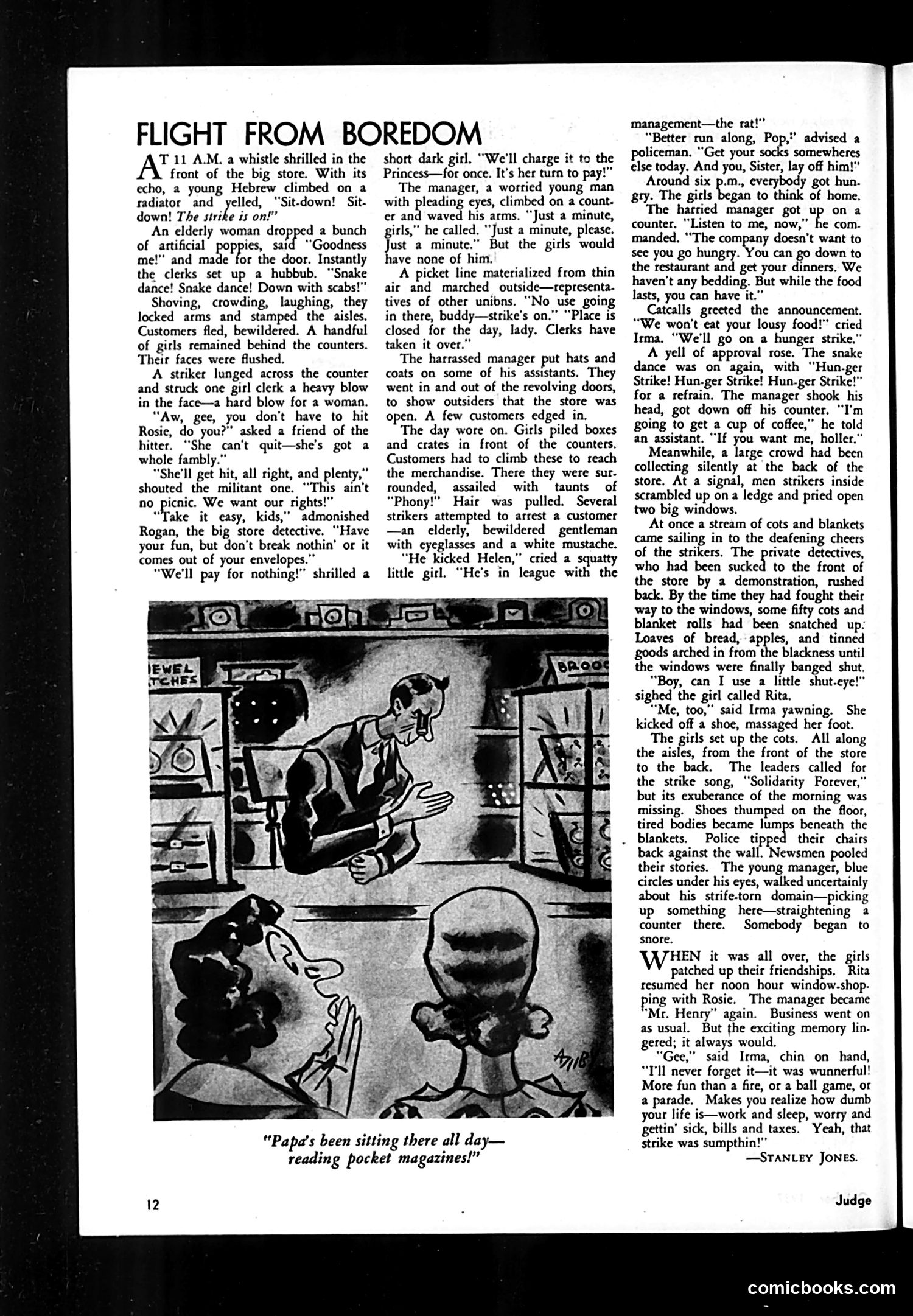
A restored page from Judge, 1937-10. Page through the whole issue in the reader above.
📄 Transcribed text from this page (OCR, searchable)
Machine-transcribed from the original scan — historical spelling and the odd misread are preserved.
FLIGHT FROM BOREDOM T 11 A.M. a whistle shrilled in the front of the big store. With its echo, a young Hebrew climbed on a radiator and yelled, “Sit-down! Sit- down! The strike is on!” An elderly woman dropped a bunch of artificial poppies, said “Goodness me!" and made bor the door. Instantly the clerks set up a hubbub. “Snake dance! Snake dance! Down with scabs!" Shoving, crowding, laughing, they locked arms and stamped the aisles. Customers fled, bewildered. A handful of girls remained behind the counters. Their faces were flushed. A striker lunged across the counter and struck one girl clerk a heavy blow in the face—a hard blow for a woman. “Aw, gee, you don’t have to hit Rosie, do you?” asked a friend of the hitter. “She can’t quit—she’s got a whole fambly.” “She'll get hit, all right, and plenty,” shouted the militant one. “This ain't no picnic. We want our rights!” Take it easy, kids,” admonished Rogan, the big store detective. “Have your fun, but don’t break nothin’ or it comes out of your envelopes.” “We'll pay for nothing!” shrilled a short dark girl. “We'll charge it to the Princess—for once. It’s her turn to pay!” The manager, a worried young man with pleading eyes, climbed on a count- er and waved his arms. “Just a minute, irls,”” he called. “Just a minute, please. Fast a minute.” But the girls would have none of him. A picket line materialized from thin air and marched outside—representa- tives of other unions. “No use going in there, buddy—strike’s on.” “Place is closed for the day, lady. Clerks have taken it over.” The harrassed manager put hats and coats on some of his assistants. They went in and out of the revolving doors, to show outsiders that the store was open. A few customers edged in. The day wore on. Girls piled boxes and crates in front of the counters. Customers had to climb these to reach the merchandise. There they were sur- rounded, assailed with taunts of “Phony!” Hair was pulled. Several strikers attempted to arrest a customer —an elderly, bewildered gentleman with eyeglasses and a white mustache. “He kicked Helen,” cried a squatty little girl. “He’s in league with the “Papa's been sitting there all day— reading pocket magazines!” . blankets. management—the rat!” “Better run along, Pop,’ advised a policeman. “Get your socks somewheres else today. And you, Sister, lay off him!" Around six p.m., everybody got hun. &ty. The girls began to think of home. The harried manager got up on a counter. “Listen to me, now,” he com. manded. ‘The company doesn’t want to see you go hungry. You can go down to the restaurant and get your dinners. We haven't any bedding. But while the food lasts, you can have it.” Catcalls greeted the announcement. “We won't eat your lousy food!" cried Irma. “We'll go on a hunger strike.” A yell of approval rose. The snake dance was on again, with “Hun-ger Strike! Hun-ger Strike! Hun-ger Strike!” for a refrain. The manager shook his head, got down off his counter. “I’m going to get a cup of coffee,” he told an assistant. “If you want me, holler.” Meanwhile, a large crowd had been collecting silently at the back of the store. At a signal, men strikers inside scrambled up on a ledge and pried open two big windows. At once a stream of cots and blankets came sailing in to the deafening cheers of the strikers. The private detectives, who had been sacked to the front of the store by a demonstration, rushed back. By the time they had fought their way to the windows, some fifty cots and blanket rolls had been snatched up: Loaves of bread,-apples, and tinned goods arched in from the blackness until the windows were finally banged shut. “Boy, can I use a little shut-eye!” sighed the girl called Rita. “Me, too,” said Irma yawning. She kicked off a shoe, massaged her foot. The girls set up the cots. All along the aisles, from the front of the store to the back. The leaders called for the strike song, “Solidarity Forever,” but its exuberance of the morning was missing. Shoes thumped on the floor, tired bodies became lumps beneath the Police tipped their chairs back against the wall. Newsmen pooled their stories. The young manager, blue circles under his eyes, walked uncertainly about his strife-torn domain—picking up something here—straightening a counter there. Somebody began to snore. WHEN it was all over, the girls patched up their friendships. Rita resumed her noon hour window-shop- ping with Rosie. The manager became “Mr. Henry” again. Business went on as usual. But the exciting memory lin- gered; it always would. “Gee,” said Irma, chin on hand, “T'll never forget it—it was wunnerful! More fun than a fire, or a ball game, or a parade. Makes you realize how dumb your life is—work and sleep, worry and gettin’ sick, bills and taxes. Yeah, that strike was sumpthin!"” —STANLEY JONES. Judge comicbooks.com